



Anta Sports delivered results that were largely well received by the market. In the first half of 2026, the group’s revenue rose 12.9% year-on-year (YoY) to RMB 43.5 billion (USD 6.5 billion), marking the first time its first-half revenue exceeded RMB 40 billion (USD 5.9 billion). Overall gross margin increased 0.5 percentage points to 63.9%, while operating profit climbed 16.1% to RMB 11.8 billion (USD 1.8 billion). Its operating margin rose to 27%, the highest level for a first half in nearly seven years.
Anta Group co-CEO Lai Shixian said at the earnings briefing that performance was broad-based across its brands. Growth at the Anta brand and its other brands exceeded the full-year guidance set at the beginning of the year, while Fila China reached the upper end of its guidance range. Lai said the results reflected the advantages of the group’s multibrand portfolio.
CFO Bi Mingwei added that the group maintained steady profitability even as revenue exceeded RMB 40 billion. Excluding the one-off gain from the placement of Amer Sports shares, profit attributable to shareholders was about RMB 7.9 billion (USD 1.2 billion), up 12.9% YoY.
The market reacted positively. On the day the results were released, Anta Sports shares closed at HKD 78.75 (USD 10), up 9.53%, lifting its market capitalization back above HKD 220 billion (USD 28.1 billion).
A breakdown by brand shows a more nuanced picture.
Revenue at the core Anta brand rose 4.8% YoY to RMB 17.8 billion (USD 2.6 billion). Operating profit increased 1.2% to RMB 4.0 billion (USD 593.8 million), while operating margin slipped to 22.5% from 23.3% a year earlier.
During the reporting period, the brand recorded growth in several key product categories. Sales of four running shoe lines, PG7, C Family, Mach, and Zone 2, exceeded 5.6 million pairs in the first half, up more than 30% YoY. In apparel, sales of products including Storm Mecha surpassed two million units, an increase of nearly 35%.
Lai said the Anta brand is becoming more focused in its product strategy, with a greater emphasis on professional sports products. At the same time, a higher mix of e-commerce and directly operated retail weighed on margins.
In July, former Anta brand CEO Tsui Yeung left the company for family reasons. Seven store formats he had championed, including Anta Super Store, Anta Sneakerverse, and Anta Arena, are still being tested.
As of June 30, the core Anta brand, excluding Anta Kids, had 7,122 stores, down 81 from the end of 2025. Lai said at the earnings briefing that the ultimate measure of channel reform was not how many stores were opened, but whether products could reach consumers more effectively through the right channels.
The comment suggests the company is placing greater emphasis on channel effectiveness after two years of retail experimentation.
Overseas markets, meanwhile, have become an increasingly important growth area for the core brand.
Anta’s overseas revenue rose 35% YoY in the first half. According to the company, the group is advancing a plan to operate as many as 1,000 stores in Southeast Asia. In North America, Anta has also opened its first flagship store in Los Angeles and is working with retailers including Foot Locker, DSG, and JD Sports.
The overseas growth, however, comes from a relatively small base. Expanding toward 1,000 stores in Southeast Asia will also require sustained investment, leaving uncertainty around both the pace of Anta’s international expansion and its returns.
RELATED ARTICLE
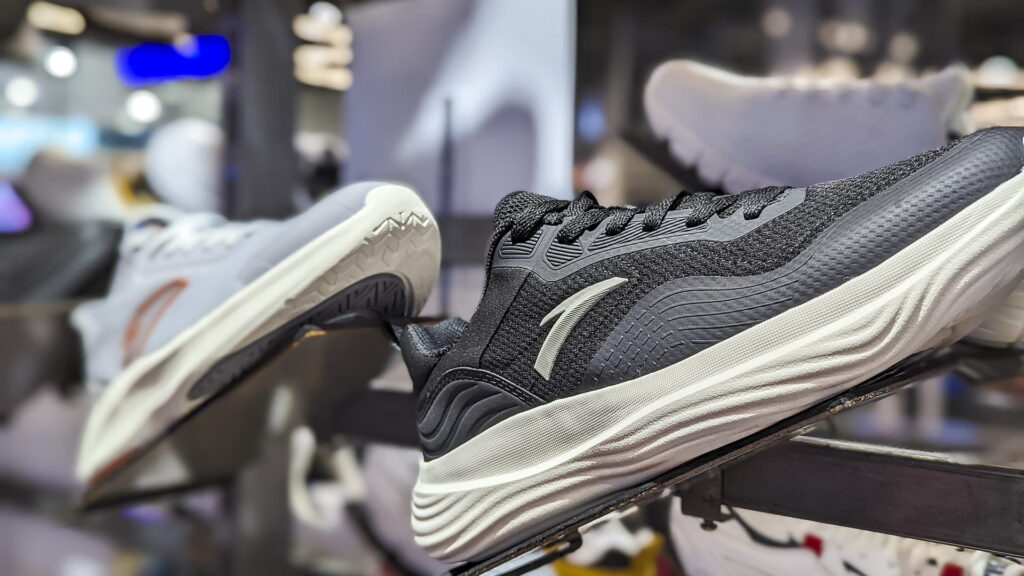
Fila presented a different picture. In the first half, revenue rose 6.1% YoY to RMB 15.1 billion (USD 2.2 billion). Operating profit increased 9.7% to RMB 4.3 billion (USD 638.4 million), while operating margin rose one percentage point from a year earlier to 28.7%.
Over the past two years, Fila has centered its business on the “One Fila” strategy and expanded its presence in sports including tennis and golf. The simultaneous increase in revenue and margin suggests the strategy is contributing to improved profitability.
Within Fila, apparel has again become a growth driver. Women’s apparel increased its share by 2 percentage points to more than 40%.
Fila has long been associated with premium sports fashion. Footwear, however, remains an important category for sportswear brands seeking to demonstrate product technology, and Fila has made fewer visible gains in this area.
Anta’s “other brands” segment, led by Descente and Kolon Sport, continued to record strong growth. Revenue rose 44.2% year over year to RMB 10.7 billion (USD 1.6 billion), surpassing RMB 10 billion (USD 1.5 billion) in a half-year reporting period for the first time. Operating profit reached RMB 3.5 billion (USD 519.6 million), up 43.9%.
Beyond its multibrand strategy, Anta Sports’ investment in artificial intelligence emerged as another focus of its results.
Lai said the group is advancing an “AI 365” strategy. Its self-developed Linglong design model can reportedly turn a sketch into a design rendering in 15 seconds, while its Lingxi styling model has been deployed in retail stores to recommend outfits for different scenarios and provide virtual try-ons.
Anta said it is also using AI in corporate management to analyze social media and consumer trends in support of market forecasting and inventory management. During the reporting period, the group’s R&D spending amounted to 2.5% of revenue.
The company is expanding the use of AI across areas ranging from design to retail and customer service, although it remains too early to determine how much those tools will improve operating efficiency.
Lai said the initiative was still at an early stage and that its value would ultimately need to be measured through better products, faster responses, healthier inventory, and an improved consumer experience.
Those are also areas that will remain important as growth in the broader sportswear market becomes more difficult to sustain.
KrASIA features translated and adapted content that was originally published by 36Kr. This article was written by Xie Yunzi for 36Kr.
Note: HKD, RMB figures are converted to USD at rates of HKD 7.84 = USD 1 and RMB 6.74 = USD 1 based on estimates as of August 31, 2026, unless otherwise stated. USD conversions are presented for ease of reference and may not fully match prevailing exchange rates.