


UBTech Robotics will join the Hang Seng Tech Index on December 7, following a quarterly review announced by index compiler Hang Seng Indexes on November 20. The review covered the period ended September 30.
Funds tracking the Hong Kong benchmark held USD 40.4 billion, or about RMB 272.5 billion (USD 40.8 billion), as of June, according to Hang Seng Indexes. Based on UBTech’s expected index weighting, IPO Zaozhidao estimates that those funds could purchase more than HKD 2 billion (USD 255.1 million) worth of its shares on the open market.
UBTech develops both hardware and software for its humanoid robots. Its engineering work spans four areas: systems that interpret the robots’ surroundings and plan their actions, controllers that translate decisions into movements, mechanical structures, and software that coordinates multiple robots. Together, these technologies are designed to help robots anticipate environmental changes and respond accordingly.
UBTech spent more than RMB 300 million (USD 44.9 million) on R&D in the first half of 2026 and expects full-year spending to reach RMB 700 million (USD 104.8 million). As of June 30, it held 3,112 granted patents, including 1,857 invention patents. Of the total, 530 were granted outside China.
In June, UBTech, chipmaker MetaX, and Zhejiang-based Fenglong Electric established Xilect to develop a chip capable of handling perception, reasoning, and motion control directly on the robot. The venture raised RMB 500 million (USD 74.8 million) in angel funding at a post-money valuation of RMB 4 billion (USD 598.7 million).
UBTech also acquired control of Shenzhen-listed Fenglong. Its wholly owned subsidiary, Xinfenglong, is developing joint servos, dexterous hands, and lifelike robotic arms. Bringing production of these components in-house is intended to reduce costs and accelerate design iterations. The subsidiary also plans to supply standardized components to other robot manufacturers.
Humanoid robots become UBTech’s largest revenue source
UBTech’s humanoid robot factory began production in September. A completed robot can roll off the production line approximately every ten minutes, with planned annual capacity exceeding 10,000 units.
Its industrial robots have been deployed in automotive and electronics manufacturing, logistics, semiconductor production, and aerospace. Partners include Airbus, BYD, Geely, FAW-Volkswagen, Dongfeng Liuzhou Motor, Foxconn, Damon Technology, Sany Renewable Energy, Honda Trading, and Hitachi.
In 2025, UBTech’s revenue rose 53.3% to RMB 2.001 billion (USD 299.5 million). Revenue from full-size humanoids surged 2,203.7% to RMB 820 million (USD 122.7 million), making them the company’s largest revenue source at 41% of the total.
Growth continued in the first half of 2026, when total revenue increased 104.2% year-on-year to RMB 1.269 billion (USD 189.9 million). Full-size humanoid revenue rose 1,445% to RMB 590 million (USD 88.3 million), while companywide gross profit increased 160.9% to RMB 570 million (USD 85.3 million).
A 2026 industry report by Frost & Sullivan ranked UBTech first globally by revenue in both the overall humanoid robot market and the full-size embodied humanoid segment.
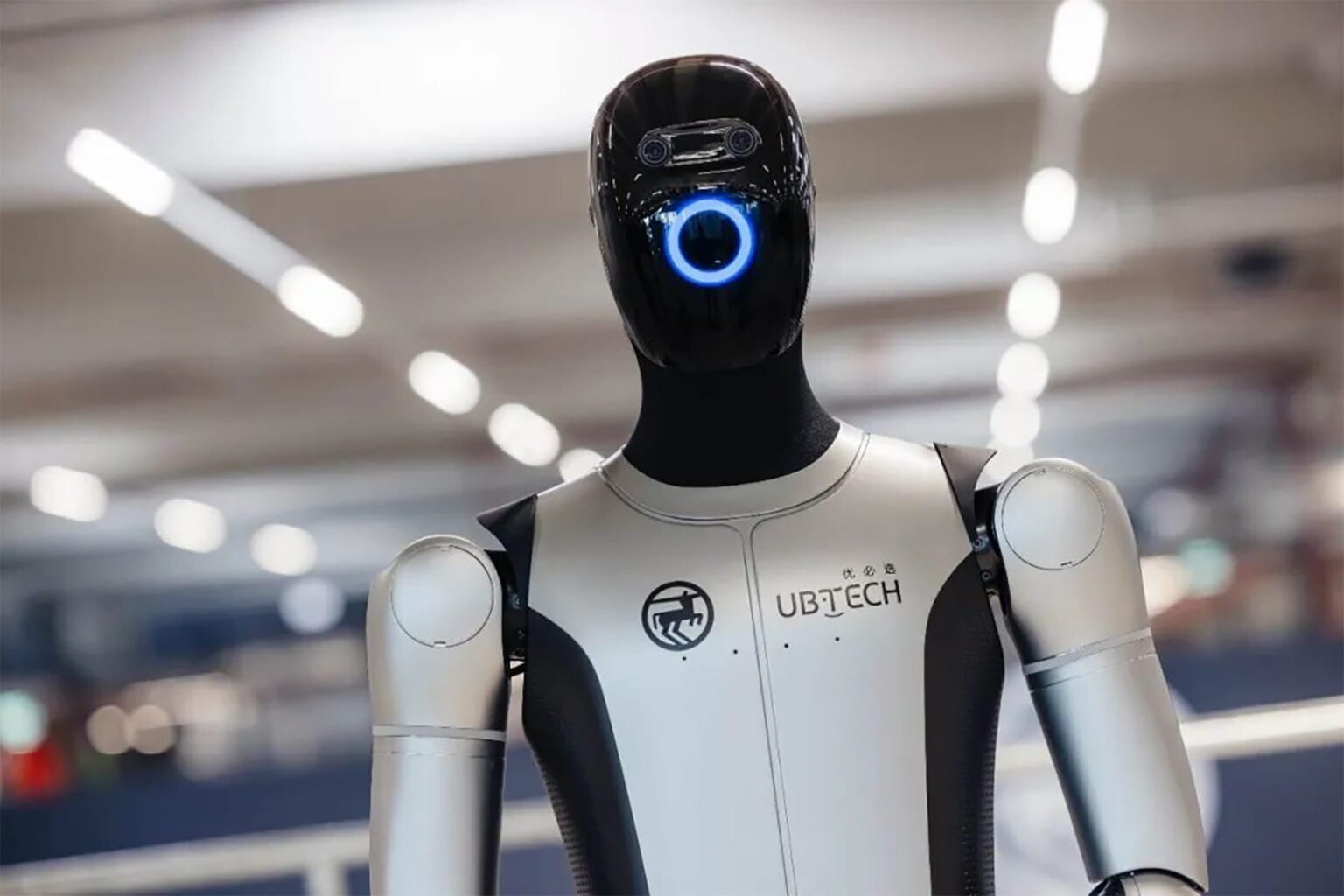
UBTech is also expanding beyond industrial applications. It has begun global deliveries of the Walker C1, a full-size commercial service robot introduced in June. Its intended uses range from greeting visitors, conducting tours, and assisting shoppers to hosting events, performing, and supporting education and research.
The U1, a lifelike full-size humanoid robot designed for long-term companionship, also debuted in June. Equipped with an artificial intelligence model designed to respond to human emotions, the robot began global deliveries in September.
This article was adapted based on a feature originally written by Stone Jin and published on IPO Zaozhidao. KrASIA is authorized to translate, adapt, and publish its contents.
Note: HKD, RMB figures are converted to USD at rates of HKD 7.84 = USD 1 and RMB 6.68 = USD 1 based on estimates as of November 23, 2026, unless otherwise stated. USD conversions are approximate and, where appropriate, rounded for ease of reference. They may not fully match prevailing exchange rates.