


Nasdaq- and Hong Kong-listed Hesai Group has released its unaudited financial results for the second quarter of 2026.
Beyond its fifth consecutive quarter of profitability, the results showed early revenue contributions from Hesai’s “strategic growth initiatives,” or SGIs, which include robotic actuation modules and the Kosmo spatial intelligence platform.
Robotic actuation modules began generating revenue during the quarter, with cumulative deliveries exceeding 10,000 units by the end of June. Kosmo has completed its first prototype deliveries and secured orders from humanoid robotics companies including Galbot, with revenue contributions expected to begin in the third quarter.
Citing stronger-than-expected commercialization and demand for its SGIs, Hesai raised its full-year 2026 SGI revenue guidance to RMB 200–300 million (USD 29.6–44.4 million). It expects the businesses to generate about RMB 700 million (USD 103.6 million) in revenue in 2027 and reach breakeven.
Hesai generated RMB 860 million (USD 127.3 million) in revenue in the second quarter. GAAP net income reached RMB 70.55 million (USD 10.4 million), up 60% year-on-year, marking its fifth consecutive quarter of GAAP profitability.
Its core light detection and ranging (LiDAR) business also continued to grow. Robotics LiDAR deliveries reached 142,371 units during the quarter, up 193.4% year-on-year, while deliveries for advanced driver assistance systems (ADAS) rose 60.1% to 485,904 units.
The company said its market share remained well ahead of competitors.
Moving beyond LiDAR
Hesai is expanding from its traditional LiDAR business into products covering perception, spatial understanding, and robotic movement.
Its portfolio now includes LiDAR, the Kosmo spatial intelligence platform, and robotic actuation modules. Hesai describes the combination as an infrastructure platform for robotics and physical artificial intelligence, covering what it calls the full chain of perception, understanding, and action.
On the perception side, LiDAR provides precise 3D spatial information. Hesai’s 6D full-color LiDAR combines depth and color data to give robots more information about their surroundings.
Kosmo sits in the middle of that chain. The spatial intelligence platform combines spatial cameras, algorithms, 3D assets, and cloud services to convert physical environments into 3D data that can be used by physical AI systems.
Kosmo completed its first prototype deliveries in July and has secured orders from several humanoid robotics companies, including Galbot. Hesai said it is in discussions with more than 200 potential partners across industries and expects Kosmo to begin contributing revenue in the third quarter.
On the action side, Hesai has developed robotic actuation modules, which provide the joints that allow robots to move. The product line covers joints for different parts of the body and draws on Hesai’s work in electric drive technologies, including chips, materials, and precision manufacturing.
Hesai said its modules are designed to balance precise control, compact size, power output, and backdrivability, or the ability for an external force to move a joint in reverse. The company said its modules are about 37% smaller than comparable leading products, while offering three times the torque density and power density.
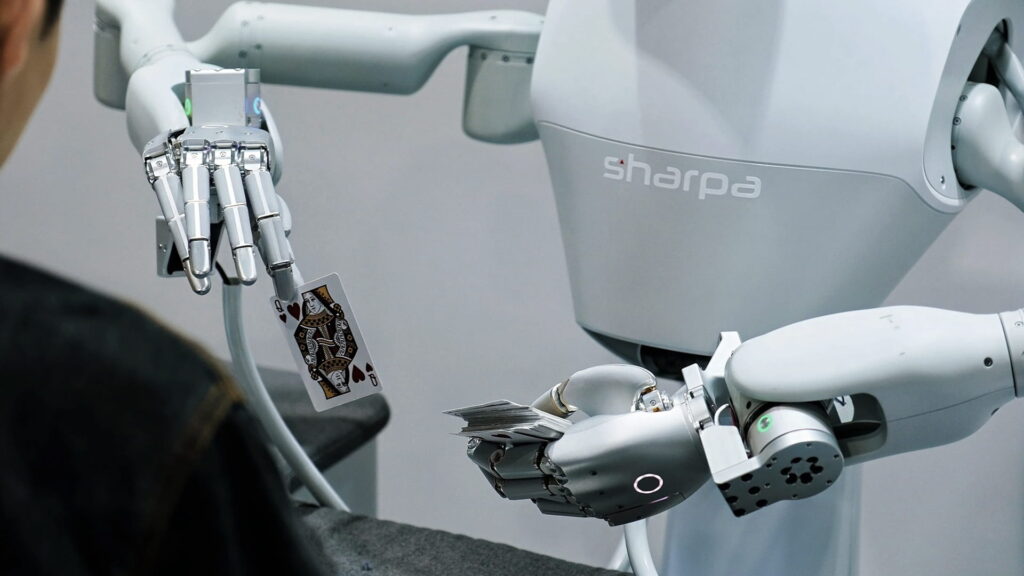
Hesai is supplying actuation modules to Sharpa, a robotics company focused on dexterous manipulation.
By the end of the second quarter, cumulative deliveries had exceeded 10,000 units. Hesai is expanding the product line from dexterous-hand modules to full-body joints and expects shipments to reach six figures in 2027.
More than 50 embodied intelligence companies, including Unitree Robotics, Robbyant, Honor Robotics, Galbot, Galaxea, and Dexmal, are adopting Hesai’s JT128 LiDAR solution, according to the company.
RELATED ARTICLE
Automotive business adds design wins
Hesai is also continuing to expand its automotive LiDAR business.
Its Picasso chip platform has moved from technology development into product integration and is ready for mass production, according to the company.
The ETX LiDAR system, which uses the Picasso chip, has entered customer validation as Hesai works with robotaxi operators and global automakers.
Hesai said third-party data showed that its primary LiDAR market share had ranked first in the industry for 17 consecutive months.
During the second quarter, the company secured several new design wins from automakers.
Hesai won a global Volkswagen Group design win covering multiple models from the automaker’s joint venture brands in China. Its ETX LiDAR also secured a design win from Great Wall Motor and is expected to enter mass production by the end of 2026. Following the bZ3X, Hesai secured another GAC Toyota design win for the bZ7.
Multi-LiDAR configurations are also moving into a broader range of vehicles.
Li Auto has expanded its multi-LiDAR setup from the Li L9 and Li L8 to the Li L6, which is priced at around RMB 250,000 (USD 36,999.2). A vehicle can carry as many as four Hesai LiDAR units, according to the company.
Robotics draws investor attention
As Hesai expands into robotics and physical AI, several international financial institutions have highlighted the potential contribution from those businesses.
Goldman Sachs said Hesai, as a LiDAR and actuation module supplier to Unitree Robotics and Sharpa within Nvidia’s ecosystem, could benefit as humanoid robotics production increases.
Morgan Stanley said related revenue could grow further over the next 12–18 months as humanoid robotics companies move more quickly toward commercialization.
Citi said Hesai is expanding from a LiDAR solutions provider into a supplier of components and systems for humanoid robots.
Hesai was also included in Morgan Stanley’s “Humanoid 100” list of companies exposed to the humanoid robotics industry.
Within Morgan Stanley’s categories of “brain,” “body,” and “integrators,” Hesai was included in three areas under the robot “body” segment: LiDAR, vision sensors, and actuators.
This article was adapted based on a feature originally written by Stone Jin and published on IPO Zaozhidao. KrASIA is authorized to translate, adapt, and publish its contents.
Note: RMB figures are converted to USD at rates of RMB 6.76 = USD 1 based on estimates as of August 19, 2026, unless otherwise stated. USD conversions are presented for ease of reference and may not fully match prevailing exchange rates.