
Chinese automaker Xpeng is going to such great lengths to build an image as a technology pioneer that some journalists expected a troupe of breakdancers performing at its global brand day in Munich to be humanoid robots.
In actuality, they turned out to be mere human. But the expectations underscored the company’s growing ambition to position itself as a rival to Tesla, with offerings ranging from fully autonomous electric vehicles to flying cars and—yes—human-form robots.
“Our mission is to explore the future of mobility through [artificial intelligence], seeing the next decade as a golden era for AI, transforming cars from simply electric to intelligent and connected,” Alex Tang, head of Xpeng’s international development and service center, told Nikkei Asia in an interview. “The most significant current use of Xpeng’s AI is autonomous driving … and we are actually one of the top two [autonomous driving brands] globally, together with Tesla.”
Tang said Xpeng is hoping to be among the first automakers to offer advanced autonomous features in the European Union (EU) once it receives permission to operate, potentially by early next year.
Automakers like Xpeng will have to conform to the world’s first set of regulations for fully driverless cars—formulated by a United Nations agency—that EU member states are also set to adopt.
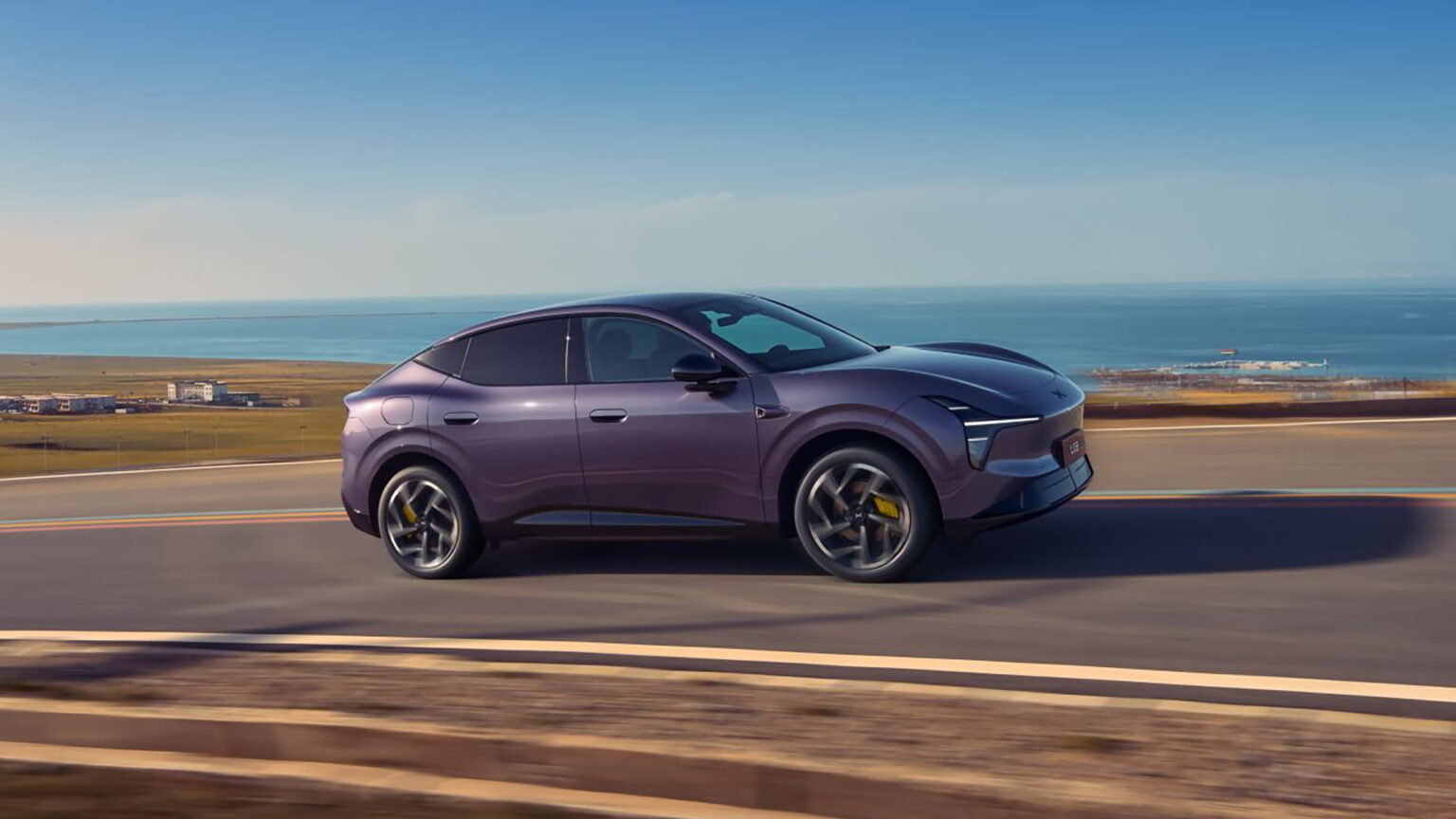
But high-tech autonomous driving offerings aside, the biggest focus by far of the event was the launch of Xpeng’s fully electric midsize crossover, the L03. Priced at EUR 35,600 (USD 40,546.7), the model is designed to compete with the Volkswagen ID.5, Skoda Enyaq and Hyundai Ioniq 5—all popular vehicles in Europe.
RELATED ARTICLE
The LO3 comes with an optional “super extended range” powertrain, meaning it can be fitted with a small combustion engine that is used for recharging its battery only and not for propelling the vehicle.
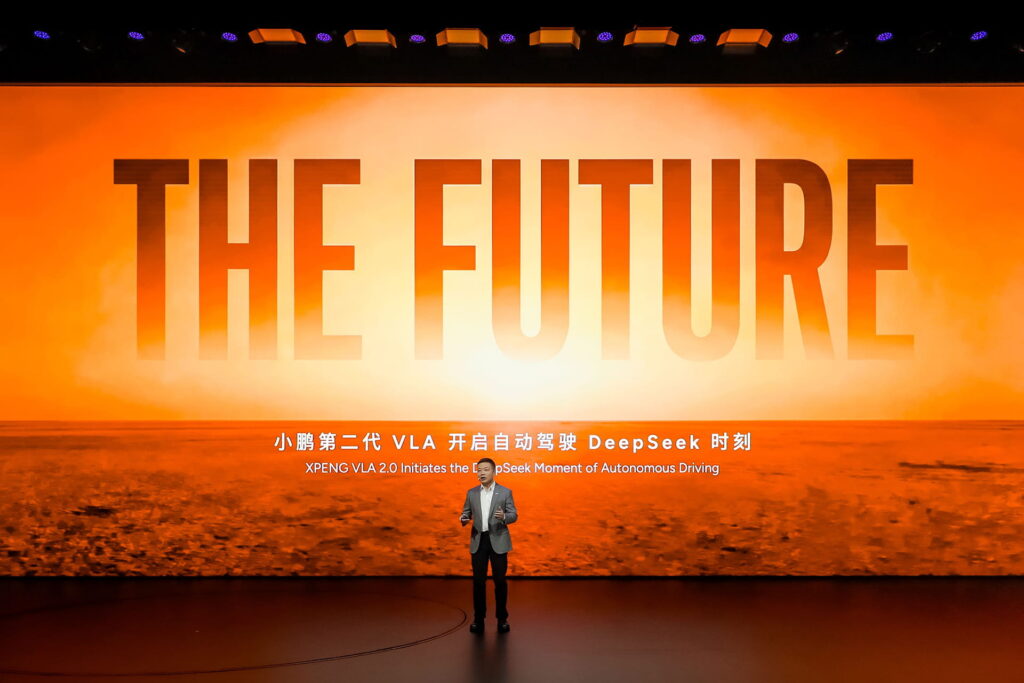
The car is ultimately meant to be equipped with Xpeng’s self-developed VLA 2.0 vision-language-action foundation model, meaning that it digests visual observations like camera feeds and processes voice instructions to create physical control commands, such as car steering.
Although VLA 2.0 was trained in China, the system learns from localized input at Xpeng’s R&D center in Munich, opened in September last year, for European use. Xpeng’s European headquarters are in Amsterdam and it also has an office in London.
“VLA 2.0 adapts to European road culture without massive retraining and data collection, understanding even the implicit rules, such as default yield-to-right for pedestrians and cyclists at certain intersections,” said Jacky Gu, general manager of Xpeng’s powertrain center, at a workshop flanking the launch event. “Its intelligent parking system copes with tight spaces of Europe’s historic city centers.”
Xpeng managers also stressed that the company aims to be as localized as possible in building charging and service networks, and onshoring production. Austrian car contract manufacturer Magna Steyr has been assembling two electric Xpeng SUV models since September at the same site where it makes the Mercedes-Benz G-class cars. This localization move has softened the impact for Xpeng of punitive EU tariffs that apply to direct imports from China.
Tang said Xpeng plans to double its European service network from the more-than 200 stores currently in operation by year’s end, and triple the number by next year, including shared workshops with premium brands like BMW and Mercedes-Benz.
Xpeng delivered 40,126 vehicles worldwide in June, up 15.9% year-on-year. Overall, it has delivered more than 1.2 million vehicles worldwide. The company began expanding into Europe in 2021, starting in Norway and Denmark due to high EV penetration in the two affluent Nordic countries.
Xpeng said it was the bestselling Chinese brand in Norway from January to June this year, but did not publicize any sales figures. Although the company targets sales of over 500,000 cars per year in Europe by 2030, Xpeng is rarely seen on German roads, with just 3,375 new cars registered in the first half of 2026, representing a market share of 0.23%.
Some observers expressed pessimism over the company’s prospects in Europe’s largest automotive market.
Ferdinand Dudenhoeffer, director at the Center for Automotive Research think tank, took issue with Xpeng’s strategy of distributing its cars through dealers that sell multiple brands, rather than setting up its own network.
“Despite Xpeng lacking brand recognition, they simply add a few vehicles to the lots of smaller dealerships, which is an old-fashioned sales model,” Dudenhoeffer said. “They offer only battery-electric vehicles, and have no real unique selling proposition, so it’s hard to imagine this becoming a success story.”
Matthias Schmidt, founder of Schmidt Automotive Research, was “very” skeptical about whether Xpeng can keep up with brands like BMW and Mercedes-Benz in Europe.
“I assume they will pursue an approach similar to Tesla’s: initially competing with premium brands, but then realizing they have a better chance of competing with mass-market brands and starting to offer more competitively priced mass market products,” Schmidt said. “This gives the customer the illusion of getting a premium product at a mass market price.”
But for the company that wants to be more than a carmaker, there’s still its yet-to-launch humanoid robot, Iron. From next year, Xpeng said it would start selling Iron, which will be able to perform duties like storekeeping and giving guided tours.
The company also said it was seeking European market entry of its electric flying cars capable of vertical takeoff and landing, as well as planning a roll-out of more than 4,000 high-power charging points across Europe by 2028.
This article first appeared on Nikkei Asia. It has been republished here as part of 36Kr’s ongoing partnership with Nikkei.
Note: EUR figures are converted to USD at rates of EUR 0.88 = USD 1 based on estimates as of July 27, 2026, unless otherwise stated. USD conversions are presented for ease of reference and may not fully match prevailing exchange rates.