



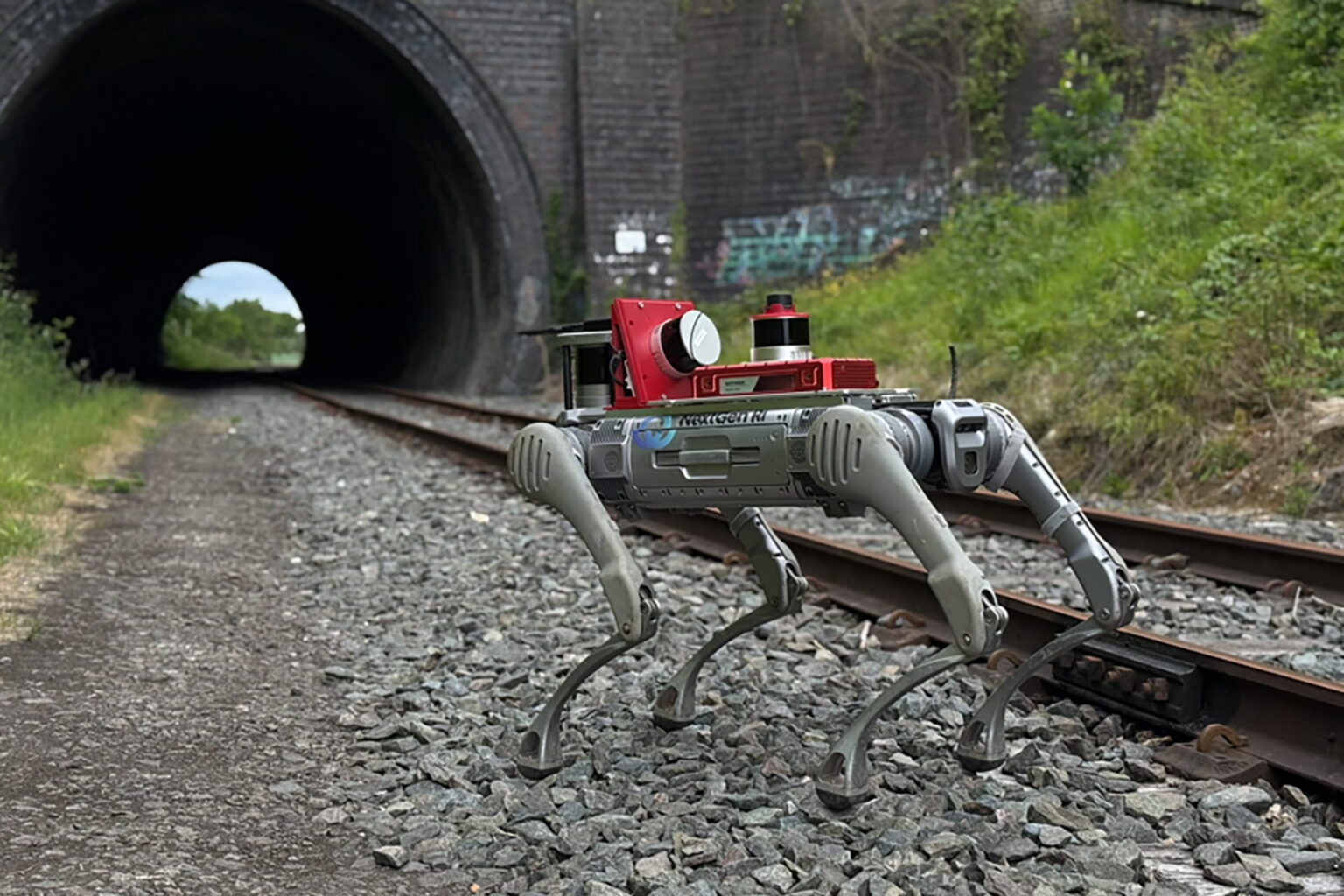
Robotics-related businesses accounted for more than half of Hesai Group’s third-quarter revenue, management said on its earnings call. The figure includes LiDAR (light detection and ranging) solutions used in robotics, 3D spatial data, and modules that power robotic joints. The latter two businesses belong to a newer division that more than doubled its revenue from the previous quarter.
Hesai Technology, which trades on Nasdaq and in Hong Kong, reported unaudited revenue of RMB 1.068 billion (USD 159.9 million) on November 10, up 34% year-on-year. Net income under US generally accepted accounting principles (GAAP) was RMB 80.79 million (USD 12.1 million), marking its sixth consecutive quarterly profit. A year earlier, net income was RMB 256.17 million (USD 38.4 million), including approximately RMB 185 million (USD 27.7 million) in gains from an equity disposal and an IP transfer. Estimates by IPO Zaozhidao put net income growth at 13.7% after excluding those gains from the previous year.
LiDAR remained the foundation of the business, with 729,673 units shipped during the quarter. Operating profit from the core LiDAR business rose 88% year-on-year to RMB 145 million (USD 21.7 million).
The newer division, which Hesai calls “strategic growth initiatives,” or SGI, generated RMB 90.51 million (USD 13.6 million) in revenue, up 101.4% from the previous quarter. Hesai also shipped 23,405 robotic actuation modules, up 96.8% quarter-on-quarter. Monthly production capacity reached 10,000 modules, while modules for joints throughout the body entered mass production. By the end of September, cumulative shipments had reached 35,295. Hesai expects annual shipments to reach six figures in 2027.
The motors behind a robot’s movements
Actuation modules give robots the power to move and manipulate objects. A humanoid robot can have close to 100 driven joints, and the components that power them can account for more than half its bill of materials. The cost and precision of these modules matter to companies seeking to commercialize robots.
Hesai designs its motors, control algorithms, and precision transmissions together. It says the resulting module is 37% smaller than comparable products and has three times their power density. The joint also offers little resistance when moved by an external force, a property known as backdrivability. That responsiveness helps robots move quickly and handle objects precisely.
Sharpa uses the modules in two products it unveiled in September. The D01 is its first integrated robot for dexterous manipulation with tactile sensing, while the W02 is a lightweight robotic hand with tactile sensing throughout. Hesai developed the motors and gear reducers in-house.
Kosmo brings real-world environments into film and robot training
In October, Hesai launched Kosmo, a system for converting physical environments into 3D data. It comprises Kosmo One, a spatial camera, and Kosmo World, its cloud platform. Hesai said the system can generate models up to five times faster than comparable systems using 3D Gaussian splatting, a technique for reconstructing scenes, and up to 200 times faster than manual modeling. The first demonstration units shipped in July, and Kosmo has begun generating revenue.
A partnership with Pixar’s RenderMan brings Kosmo’s scans into a film rendering pipeline. Artists can change how a real setting appears on screen or extract individual elements for use in a scene. Pixar has made a tutorial demonstrating the workflow publicly available. Hesai sees the collaboration as an opportunity to establish its approach to 3D Gaussian splatting in film production.
Kosmo has also partnered with robotics companies Galbot and Dexmal on embodied intelligence. A separate partnership with Alibaba’s Amap covers an initial 1,000 pilot locations, including shopping malls, retail outlets, restaurants, hotels, and branded stores.
LiDAR wins at Cadillac, Geely, and Great Wall Motor
In September, Hesai held 43% of the Chinese market for primary LiDAR sensors used in advanced driver assistance systems, according to industry figures cited by the company. Research firm Yole Group put Hesai’s share of the global robotaxi LiDAR market at 62% in 2025, the largest of any supplier.
In September, JD.com agreed to use Hesai’s sensing technology, including its 6D full-color LiDAR technology, in autonomous delivery vehicles and robots.
Five automakers selected Hesai’s ETX LiDAR, which offers more than 1,000 channels. They include Cadillac, Geely, Great Wall Motor, a major European automaker, and a leading new energy vehicle manufacturer. Hesai said its order book exceeded one million units.
Leapmotor and a major European automaker selected its FTX blind-spot LiDAR as more vehicles adopt multiple sensors. Wuling chose an updated ATX for a high-volume model.
The ETX series can use Picasso, which Hesai claims is the world’s first 6D full-color LiDAR chip platform. It combines red, green, and blue color data with depth information on a chip to generate a color point cloud. A world model can retain an object’s color and appearance alongside its position, distance, and outline, providing more information to recognize the object and interpret its surroundings.
ETX offers up to 4,320 channels and a maximum range of 600 meters. Hesai said its ability to detect small objects helps automated driving systems identify distant vehicles, pedestrians, and obstacles earlier, allowing more time to decide when to brake. Its photon isolation technology and waveform decoding also help reduce false alarms and missed detections in difficult conditions, according to the company.
RELATED ARTICLE

What Hesai wants to build next
After spending its first decade developing sensing technology, Hesai is expanding into the 3D data and actuation hardware that robots need to interpret and interact with their surroundings. The company sees both as businesses that can build on its experience in sensing systems.
CFO Andrew Fan said SGI revenue had exceeded its original full-year target of RMB 100 million (USD 15 million) within the first nine months of 2026. With Kosmo beginning to generate revenue and actuation module shipments increasing, Hesai maintained its full-year SGI revenue forecast of RMB 200–300 million (USD 29.9–44.9 million).
The company plans to increase investment in SGI as customers advance through product testing, while continuing to manage spending. Its longer-term aim is to become a supplier of the data and hardware infrastructure supporting robotics and physical artificial intelligence.
This article was adapted based on a feature originally written by Stone Jin and published on IPO Zaozhidao. KrASIA is authorized to translate, adapt, and publish its contents.
Note: RMB figures are converted to USD at rates of RMB 6.68 = USD 1 based on estimates as of November 17, 2026, unless otherwise stated. USD conversions are approximate and, where appropriate, rounded for ease of reference. They may not fully match prevailing exchange rates.