


Investors worldwide are grappling with one question as Nvidia’s unfolding crisis dominates markets: what is a tech empire worth without its rockstar visionary founder?
The US chip giant’s share price has tumbled since Jensen Huang, 63, stepped down as CEO. More than USD 600 billion has been wiped from its market value since the company launched an internal probe on Sunday into his involvement with Alice Huang, who is accused by US intelligence officials of being a Chinese spy.
While Nvidia’s board initially said no national security or corporate secrets had been compromised, mounting pressure and reports of a second extramarital affair brought its governance standards to the fore. A board meeting led to Huang’s resignation and CFO Colette Kress becoming interim CEO on November 12, while the company searches for a replacement.
Huang’s rapid fall highlights a weakness in corporate culture prevalent across many Asian businesses and increasingly in tech startups that is known as the “key-man risk,” in which companies are exposed to the excessive concentration of power in a single leader with little institutionalized succession planning.
Analysts said the steep reaction to Huang’s departure reflects investor sentiment that a significant share of Nvidia’s valuation premium is tied directly to his status as a unique visionary.
Wall Street analyst Dan Ives said Nvidia’s valuation could drop by 25–30% if Huang were removed as CEO, which would “change the future direction of the company.”
Brian Burke, founder of law firm Burke Law & Strategy, said, “It’s a lesson to the corporate world that there is a high risk in having your fate tied up in one person.”
“Jensen is absolutely the face of Nvidia,” he added. “They are one and the same.”
The perils of overreliance on individual executives are especially visible across Asia, where weak governance models and high-profile leadership crises have historically triggered sharp market repricing.
In October 2020, Jack Ma, founder of Chinese e-commerce giant Alibaba, publicly criticized financial regulators at a forum in Shanghai. Days later, Beijing halted the IPO of fintech affiliate Ant Financial, a listing that could have valued the company at more than USD 300 billion. Ma disappeared from public view for months. Ant was valued at about USD 78 billion in July 2023, based on a share buyback plan.
In Japan, Nissan Motor suffered a prolonged financial decline marked by severe net losses following the high-profile arrest and ouster of former chairman Carlos Ghosn in 2018, who was suspected of underreporting USD 45 million in salary. The company’s share price is down more than 70% since Ghosn’s arrest.
Some observers have questioned whether Huang faced sufficient checks on his power from Nvidia’s ten-member board, which includes former senior executives from companies including PepsiCo, Goldman Sachs, and Eli Lilly. Several directors, including Tench Coxe of Sutter Hill Ventures and Mark Stevens of VC firm Sequoia Capital, have worked with Huang for decades.
On November 12, the board announced that Harvey Jones, CEO of software company Synopsys, would become its first-ever chair.
Huang holds around 3.5% stake in Nvidia, making him the largest individual shareholder, though he has no special voting powers to dictate board decisions. Bernstein Research analysts say he managed roughly 60 direct reports.
Nvidia’s increasing resemblance to a family firm has also raised corporate governance concerns for a multitrillion-dollar company. Huang’s daughter and son hold senior executive roles in product marketing and management.
“What you do see is the boards in many places become sycophantic, very dependent on the CEO rather than the reverse. And the CEO often doesn’t develop a strong bench strength of people who can succeed them, and that’s been a problem that we see at Nvidia,” said Jeffrey Sonnenfeld, a professor at Yale University.
Like other rockstar entrepreneurs such as SpaceX’s Elon Musk and Meta’s Mark Zuckerberg, Huang has played an outsized role in growing Nvidia from a 1990s video game graphics startup into a USD 4.5 trillion behemoth at the center of the global artificial intelligence boom.
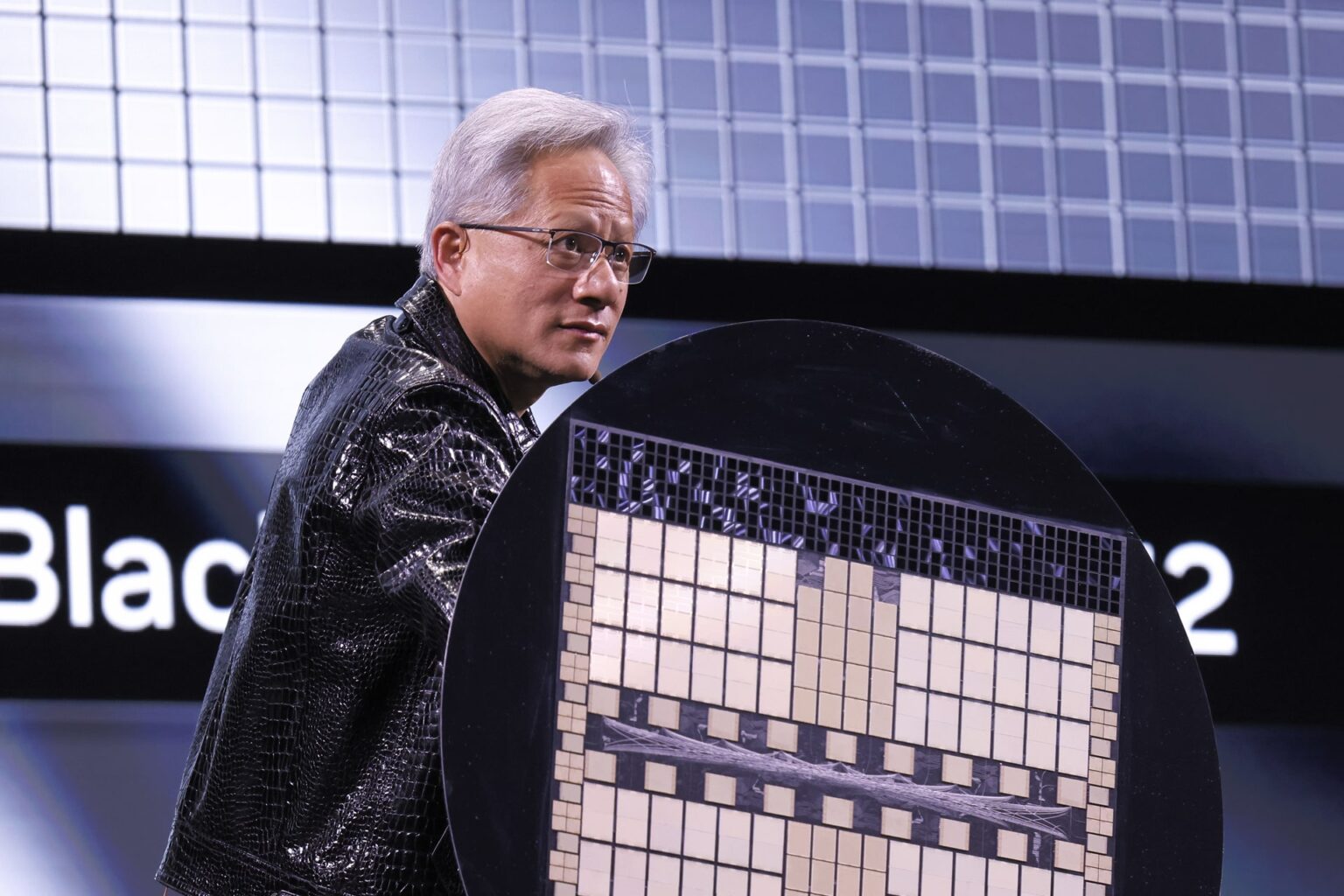
With a signature black leather jacket reminiscent of Steve Jobs’ ever-present black mock turtleneck, Huang has achieved global celebrity status, unveiling Nvidia’s AI processors at showbiz-style company events around the world.
Companies with visionary leaders tend to command higher valuation premiums, according to James Vrachas, executive director at the Post Oak Group, a Houston-based investment bank. “We do see investors buying into the strategic vision and the whole personality itself.”
Nvidia shareholders may be disappointed by Huang’s departure after his role in establishing the company’s dominance in the chipmaking industry and strengthening US competitiveness in AI. But what they may regret most is the loss of his irreplaceable vision, according to George Chen, a partner at The Asia Group.
“The concern is not simply about future revenue or quarterly earnings. It is also about strategic vision,” Chen said.
“It’s hard to imagine a Tesla without Elon … without Jensen, Nvidia won’t be the same.”
This article first appeared on Nikkei Asia. It has been republished here as part of 36Kr’s ongoing partnership with Nikkei.