
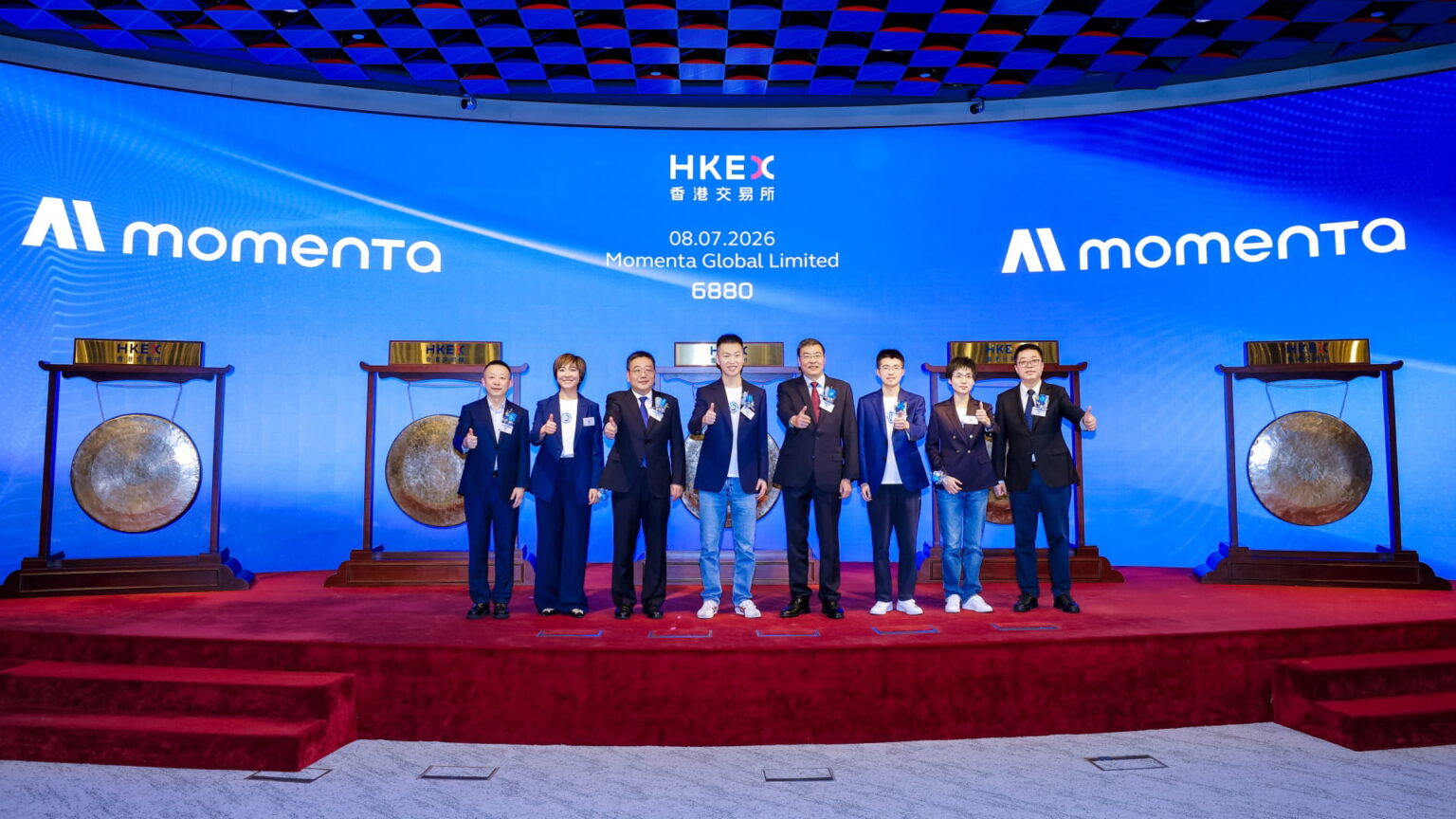
Momenta listed on the Main Board of the Hong Kong Stock Exchange on July 8, giving public market investors a new way to bet on physical artificial intelligence, a category of AI systems built to perceive, reason, and act in the physical world.
Based on its offer price of HKD 295.6 (USD 37.7) per share, and assuming the greenshoe option, or overallotment option, is exercised in full, Momenta’s global offering comprises about 22.93 million shares, raising gross proceeds of about HKD 6.8 billion (USD 867.1 million). The public offering was more than 414 times subscribed, while the international offering was about 44 times subscribed, excluding cornerstone investors and before the greenshoe option. Institutional orders exceeded HKD 100 billion (USD 12.8 billion), covering sovereign and long-term funds from 15 countries and regions.
Momenta’s anchor investors include global institutions such as GIC, Fidelity International, BlackRock, Franklin Templeton, Abu Dhabi Investment Authority, Canada Pension Plan Investment Board, Temasek, Wellington, and Schroders. Chinese long-term capital also participated, reinforcing the company’s positioning in China’s smart mobility market.
Subscriptions from long-term capital alone exceeded the offering size by more than 15 times, according to Momenta. The company also introduced 14 institutions as cornerstone investors, with total cornerstone subscriptions of about HKD 3 billion (USD 382.6 million), or about USD 376 million. The investor lineup includes international long-term funds, sovereign wealth funds focused on long-cycle value growth, strategic industry investors, and Chinese long-term institutions.
Momenta CEO Xudong Cao said in his listing speech: “Ten years ago, we founded Momenta to pursue a simple but firm mission: better AI, better life. Better AI comes from our curiosity. Our fascination with and curiosity about artificial intelligence have made our lives ‘full of vitality.’ Better life carries our sense of mission. We believe the value of technology lies in making people’s lives safer, freer, and better. So, we set three ten-year visions: to save one million lives in ten years, free up 100% of people’s time in ten years, and double the efficiency of logistics and mobility in ten years. Today, we have brought a safer and more reassuring driving experience to more than one million users.”
“In the past decade, we taught AI how to drive, bringing a dedicated driver to every family. In the next decade, we will bring dedicated robotic service scenarios to every family, including nannies, doctors, and teachers, ushering in physical AI’s ‘GPT moment.’ We hope to write the Silicon Valley legend of the East together with all Chinese AI companies, embrace the world, and let the world embrace China’s technology,” Cao said.
R7 world model anchors Momenta’s physical AI push
Founded in 2016, Momenta describes itself as a builder of physical AI foundation models. In April, the company’s R7 world model made its mass-production debut, marking a step toward scaled deployment of physical AI systems. R7 is a foundation model designed to understand physical laws and infer how the world evolves. It supports Momenta’s deployment across passenger vehicles, robovans, robotrucks, and robotaxis, and the company plans to expand it into robotics.
As the transition toward physical AI accelerates, world models are emerging as one of the technical foundations of the field. Momenta’s world model is designed to provide a spatiotemporal foundation for physical AI, allowing systems to interpret changes across space and time.
Momenta’s world model has three layers:
- Pretraining: Through pretraining on large volumes of real driving data, the model compresses physical laws, common sense, and causal relationships into its system, allowing it to interpret real-world driving conditions.
- Simulation: Through closed-loop simulation, the model gains a training environment where it can infer how the world may evolve as its own behavior changes, while evaluating performance in long-tail scenarios.
- Reinforcement learning: This gives the model a training process that more closely resembles the physical world, shifting the system from imitation-driven learning to what Momenta describes as “imagination and learning.” The company said this allows the model to learn how to make decisions in complex scenarios and improve performance in extreme cases.
Momenta said the R7 world model is based on more than 12 billion kilometers of real-vehicle mileage generated by its mass production business, as well as more than 100 million pieces of golden data extracted from that mileage. The company said the model can evolve through reinforcement learning and self-play, improving its capabilities in key scenarios.
R&D has been central to Momenta’s model development. In 2025, the company’s R&D spending was RMB 1.869 billion (USD 274.8 million), accounting for 77.5% of annual revenue. From 2023 to 2025, cumulative R&D spending reached RMB 4.66 billion (USD 685.1 million). As of December 31, 2025, Momenta had 1,157 R&D employees, representing nearly 82% of its workforce, with more than two-thirds holding master’s degrees or above.
Momenta’s R&D investment and technical workforce have helped it become a competitive third-party smart driving company. The company has achieved nationwide coverage of map-free urban navigate-on-autopilot (NOA), a driving assistance function that operates in urban environments without relying on high-definition maps. It is also among the first companies to scale an end-to-end large model and reinforcement learning for smart driving, while its world model is among the first to reach large-scale deployment.
For Momenta, the core of physical AI is the combination of data scale and commercial scale. Autonomous driving is one of the few physical AI fields that has achieved both thus far.
That creates a reinforcing cycle. More vehicles generate more data, which can improve model performance, support more deployments, and strengthen the company’s commercial position.
Deployments surpass one million units
Momenta has positioned itself as a platform-based company. It uses one large model to support passenger vehicles, robotaxis, and robovans, and plans to expand into robotrucks in 2027. This approach is intended to reduce marginal costs while building a diversified growth model across vehicle types and service scenarios.
The company has also integrated its scalable vehicle solutions with its robotaxi service solutions. Its vehicle solutions segment deploys urban NOA-centered systems in vehicles produced by automaker customers. Those vehicles collect real-world data, which is then used to optimize Momenta’s algorithms and support its robotaxi service solutions. Improvements in robotaxi technology can then feed back into the vehicle solutions business, creating a loop between the two segments.
According to China Insights Consultancy, Momenta is China’s first independent urban NOA solution provider to achieve mass deployment of the technology.
Among China’s independent urban NOA solution providers, it ranks first across three indicators: vehicle sales equipped with urban NOA solutions in the 12 months ended February 28 this year; cumulative design wins as of February 28; and cumulative number of mass-production models equipped with urban NOA solutions as of February 28. The consultancy also said Momenta ranked first among global independent urban NOA solution providers by urban NOA sales in the 12 months ended February 28, with a market share of 65%.
The day before its listing, Momenta said the deployment volume of its mass production business had surpassed one million units.
As of December 31, 2025, Momenta had established partnerships with 24 leading global automakers, including nine of the world’s top ten automakers: Toyota, General Motors, Mercedes-Benz, BMW Group China, Hyundai (including Kia), Volkswagen, BYD, Honda, and Ford. It has also partnered with Chinese automakers including SAIC Motor, GAC Group, Chery, FAW Group, Geely, Great Wall Motor, and Dongfeng Motor.
Momenta’s revenue was RMB 743 million (USD 109.2 million) in 2023, RMB 1.325 billion (USD 194.8 million) in 2024, and RMB 2.413 billion (USD 354.8 million) in 2025, representing a compound annual growth rate of more than 80%. Its revenue mainly consists of technology development revenue and licensing revenue. Licensing revenue rose from RMB 23 million (USD 3.4 million) in 2023 to RMB 968 million (USD 142.3 million) in 2025. Momenta said licensing revenue has a high marginal return and will be central to maintaining revenue growth.
Momenta’s gross margin rose from 17.5% in 2023 to 71.6% in 2025. As revenue and gross margin improved, its adjusted loss narrowed to RMB 303 million (USD 44.5 million) in 2025. As of December 31, 2025, Momenta’s cash reserves exceeded RMB 10.9 billion (USD 1.6 billion), which the company said will support its robotaxi business and global expansion.
Momenta’s Hong Kong IPO gives the company additional capital to expand its physical AI business, deepen automaker partnerships, and accelerate overseas growth.
This article was adapted based on a feature originally written by Stone Jin and published on IPO Zaozhidao. KrASIA is authorized to translate, adapt, and publish its contents.
Note: HKD, RMB figures are converted to USD at rates of HKD 7.84 = USD 1 and RMB 6.80 = USD 1 based on estimates as of July 8, 2026, unless otherwise stated. USD conversions are presented for ease of reference and may not fully match prevailing exchange rates.