


Pedal-assist electric bikes remain unfamiliar to many consumers in China, where electric two-wheelers are common but bicycles costing RMB 10,000 (USD 1,490) or more are a harder sell.
Lemmo’s RMB 7,999 (USD 1,200) Zero has found buyers among car owners. The company partnered with Nio in 2025 and has since received tens of thousands of orders for the folding bike through Nio Life.
Lemmo opened a Tmall store in June this year. By early August, the company said, the store ranked first in premium pedal-assist bicycles and second across the broader category. Its order volume through Nio Life is unusual for e-bikes in China.
Lemmo co-founder and CEO Victor Gao previously led global product R&D and design at Mobike. There, he saw how a startup could manufacture bicycles at scale and how shared mobility revealed common needs for everyday travel and the last mile across different markets.
In Europe, folding bikes are often used alongside public transport. “If you take a folding bike onto the subway or a train, you do not need to buy a separate ticket for it. There is an economic incentive behind that,” Gao told 36Kr.
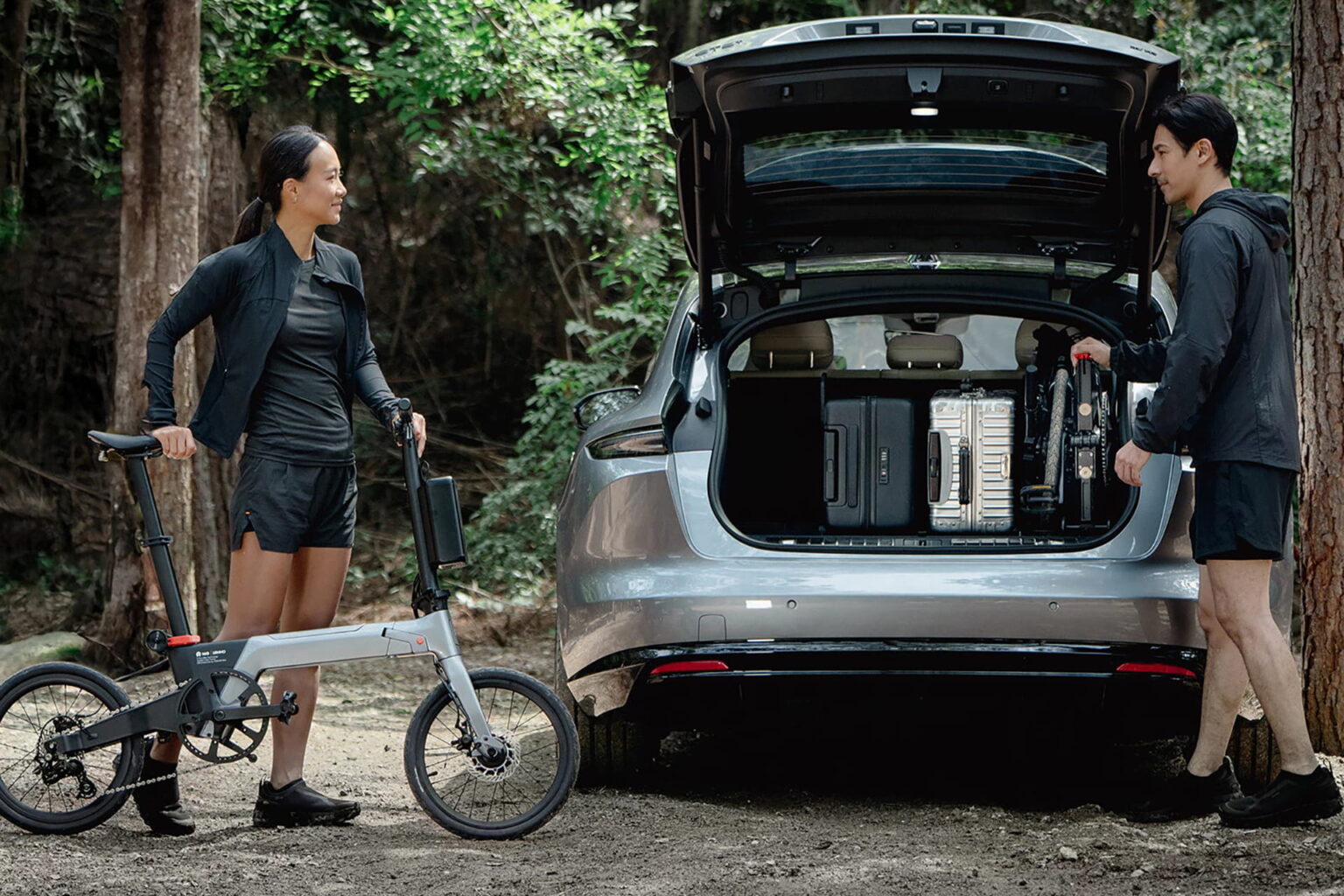
In China, Lemmo sees potential in pairing cars with folding bikes. Whether commuting or making everyday trips, drivers may still need another way to cover the last mile. Electric scooters face restrictions on road use, and regular bicycles take up too much space. A folding bike can fit in the trunk and travel with the car.
Beyond Nio, Lemmo announced partnerships with Xpeng and Volkswagen in 2026. Since its founding, it has raised an eight-figure USD sum from investors including Cyanhill Capital, Joy Capital, Daocin Capital, and Rockets Capital.
Its ambitions extend beyond new uses for folding bikes. Lemmo plans to combine features from neighboring categories of personal transport: bicycles, e-bikes, motorcycles, and microcars. Its lightweight DMV, or dual-mode vehicle, platform aims to combine bicycles and e-bikes, allowing riders to switch between pedal assistance and ordinary cycling.
Starting with its first product, the One, Lemmo combined its electrical components in a separate Smartpac module, paired with a dual-mode motor hub containing its patented low-resistance clutch. With the Smartpac attached, the bicycle provides electric assistance. Without it, the bike is designed to pedal smoothly like a conventional bicycle.
One user on social platform Xiaohongshu reportedly forgot the battery while commuting on a Lemmo Zero and completed the five-kilometer ride without power in 18 minutes.
“Today, it feels as though a wall separates e-bikes from bicycles. But looking five to ten years ahead, batteries and motors will become smaller and smaller, and that wall will become less distinct. What we want to do is break through it,” Gao said.
Designing an e-bike for the trunk
Automakers have already entered the e-bike market overseas. Porsche has worked with Rotwild, Mercedes-Benz has offered AMG-branded e-bikes, and BMW’s Mini has collaborated with premium folding bike brand Brompton in South Korea.
For carmakers competing on price, specifications, and the products and services offered under their brands, e-bikes offer a way to reuse technology, reach more consumers, support different kinds of trips, and engage communities of car owners. A folding e-bike that fits in the trunk and extends a driver’s reach is a natural starting point.
Nio and Lemmo took less than two months to initiate their joint project. Both had already spent considerable time working with folding bikes and preparing for such a project.
From the outset, Lemmo planned the Zero as a major product for the global market, which meant accommodating different regional needs.
Gao sees a clear difference between China and Europe. European riders tend to use folding bikes as a supplement to public transport. In China, leisure plays a larger role. Cities are adding recreational cycling routes linked to sightseeing and tourism, while the number of new energy vehicles is growing rapidly. China’s wider range of uses places more demands on the product. Meeting those needs, he believes, would make it more adaptable in Europe and the US, too.
“The car can take you from home to the riverside or a park, and the folding bike lets you enjoy recreational riding once you reach the destination,” Gao said.
Putting a folding bike in a trunk is not difficult. Doing it conveniently while taking up little room is harder. That became the starting point for the companies’ discussions.
“We used female users as our main reference. A woman needed to be able to lift the bike easily and slide it upright into the trunk gracefully. So we did not just develop the bike, but also provided an in-car rack system. The bike can slide into the trunk easily, in a very compact arrangement that takes up only one corner,” Gao said.
The Zero has 16-inch wheels and a carbon-fiber frame, bringing the bike’s reported weight to 10.8 kilograms. In its hands-on assessment, 36Kr found the bike light enough to lift with one hand. The publication reported that folding took less than ten seconds, while folding and unfolding together took about 20 seconds.
The bike also comes with a removable 2.3-kilogram Smartpac battery that can be charged separately. Nio’s in-car system alerts users when the battery or bike is low on power, and the battery can charge in the trunk while they travel. The stated pedal-assist range is 40 kilometers. Gao said future Smartpac versions would be smaller and lighter.
For comparison, Brompton’s classic C Line, known for its compact fold, starts at 11.35 kilograms and can be folded in 20 seconds.
Size mattered as much as weight. During development with Nio, Lemmo used the ET5T as its reference vehicle. A station wagon has less vertical trunk space than an SUV. If the folded Zero fit comfortably there, it would be compatible with a wider range of cars.
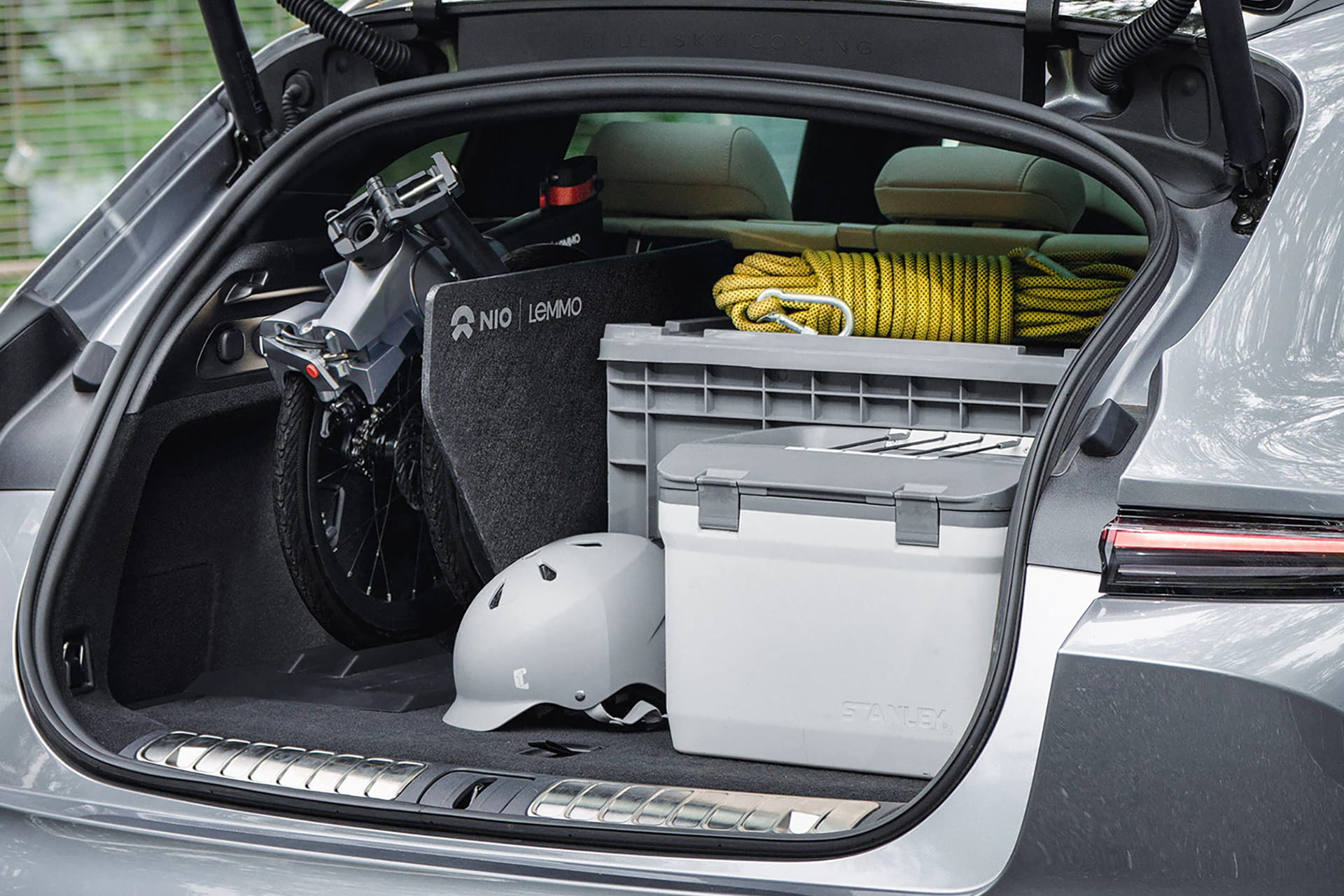
The goal was therefore to fold the Zero into a flat rectangle rather than simply make it shorter. It retains a three-part fold, but Gao said the folding direction and wheel stowage were redesigned. A hollow structure within the frame lets the wheels tuck further into the bike when folded, reducing the space it occupies.
That was one of the harder engineering problems. Gao considered the mechanical structure more challenging than the motor or software. Established folding bikes have undergone decades of refinement, balancing folded size, riding stability, and ease of use. Lemmo needed to make the bike smaller and easier to store without sacrificing the ride once unfolded.
The finished Zero fits inside a standard 28-inch suitcase. According to Lemmo, it can also travel by air, addressing another obstacle to combining the bike with longer journeys.
Remove the battery, keep the bicycle
Fitting a folding bike into a car is only one part of Lemmo’s redesign. Since launching the One, it has pursued another goal through its DMV platform: making an e-bike that rides like a conventional bicycle without its electrical system.
“For users, a bicycle and an electric bicycle should ideally be the same product. If you want power assistance today, use it. If you do not, pedal it yourself,” Gao said.
Conventional e-bikes typically distribute the battery, controller, and other electrical components throughout the frame. Riders can still pedal after the battery runs out, but motor resistance and the bike’s weight make it difficult to reproduce the feel of an ordinary bicycle.
Lemmo moves most of the complex electrical components out of the frame. The Smartpac combines the battery, motor controller, internet of things connectivity, GPS, and external power output in one module. The bike itself retains mainly the wiring harness and hub motor.
Separating the electrical system is only part of the challenge. The bike must also remain pleasant to ride without power. Lemmo developed a new clutch inside the hub that disengages the motor’s drive assembly from the hub shell in bicycle mode, reducing the mechanical resistance associated with conventional friction clutches.
The company sees manufacturing advantages, too. During his time at Mobike, Gao learned that bicycle factories and consumer electronics factories excel at different production methods. Packing electrical components and wiring into a frame complicates assembly and repairs. A separate module is easier to manufacture and service on its own.
The separation also gives Lemmo more options as a business. A bicycle can last for years, while electronics and smart systems evolve faster. The Smartpac and other electronic parts could be upgraded without replacing the whole bike. New smart functions would not necessarily require buying a new bike: some could come through hardware upgrades, such as an electronic gear shifter, combined with software updates for the Smartpac and the bike’s main controller.
Lemmo also intends the Smartpac to connect future products. It has introduced versions with capacities of 159, 540, and 1,000 watt-hours for three broad uses: short trips combining different forms of transport, including air travel; urban travel and journeys of up to about 100 kilometers; and family trips or heavier loads. The Zero, One, and Lemmo 3 are designed for those respective uses.
Under the company’s plan, the same Smartpac could move between bicycles, scooters, and other devices, each of which would remain usable without it. Because the Smartpac accounts for roughly one-quarter to one-half of a complete product’s price, sharing it could lower the cost of owning several devices.
There is a commercial rationale. Durable products such as bicycles are replaced infrequently, and an app alone makes it difficult to maintain an ongoing relationship with users. Lemmo wants the Smartpac to link hardware, smart accessories, and software services within one product system.
It is also expanding into other forms of transport. On September 28, Lemmo unveiled the Lemmo 3, a long-tail e-bike for family travel, marketed as an “SUV e-bike,” that moves closer to an electric moped. It adds full suspension and greater load capacity, power, and comfort. The product is intended for global markets, including China, with Europe and the US receiving it first.
Over the next two years, the company also plans to develop a lightweight, low-speed four-wheeled vehicle, extending from electric mopeds toward microcars. It is intended to carry several people as well as the smaller vehicles Lemmo has already introduced.
“Let cars handle more intercity, long-distance travel, and leave short- and medium-distance trips within cities and at destinations to lighter vehicles,” Gao said.
Over the past three years, excess inventory and a shakeout in Europe and the US have hurt established bicycle manufacturers and forced Chinese entrants to find new approaches in a stagnant market. DJI-affiliated Amflow has targeted the midrange and high-end e-bike segments, while Lemmo has taken a different route back into China through partnerships with automakers.
As other companies experiment with artificial intelligence, smart trailers, cargo bikes, and even exoskeletons, Lemmo’s folding bike is but one attempt to expand the role of e-bikes beyond their established market.
KrASIA features translated and adapted content that was originally published by 36Kr. This article was written by Leslie Zhang for 36Kr.
Note: RMB figures are converted to USD at rates of RMB 6.69 = USD 1 based on estimates as of October 20, 2026, unless otherwise stated. USD conversions are approximate and, where appropriate, rounded for ease of reference. They may not fully match prevailing exchange rates.