


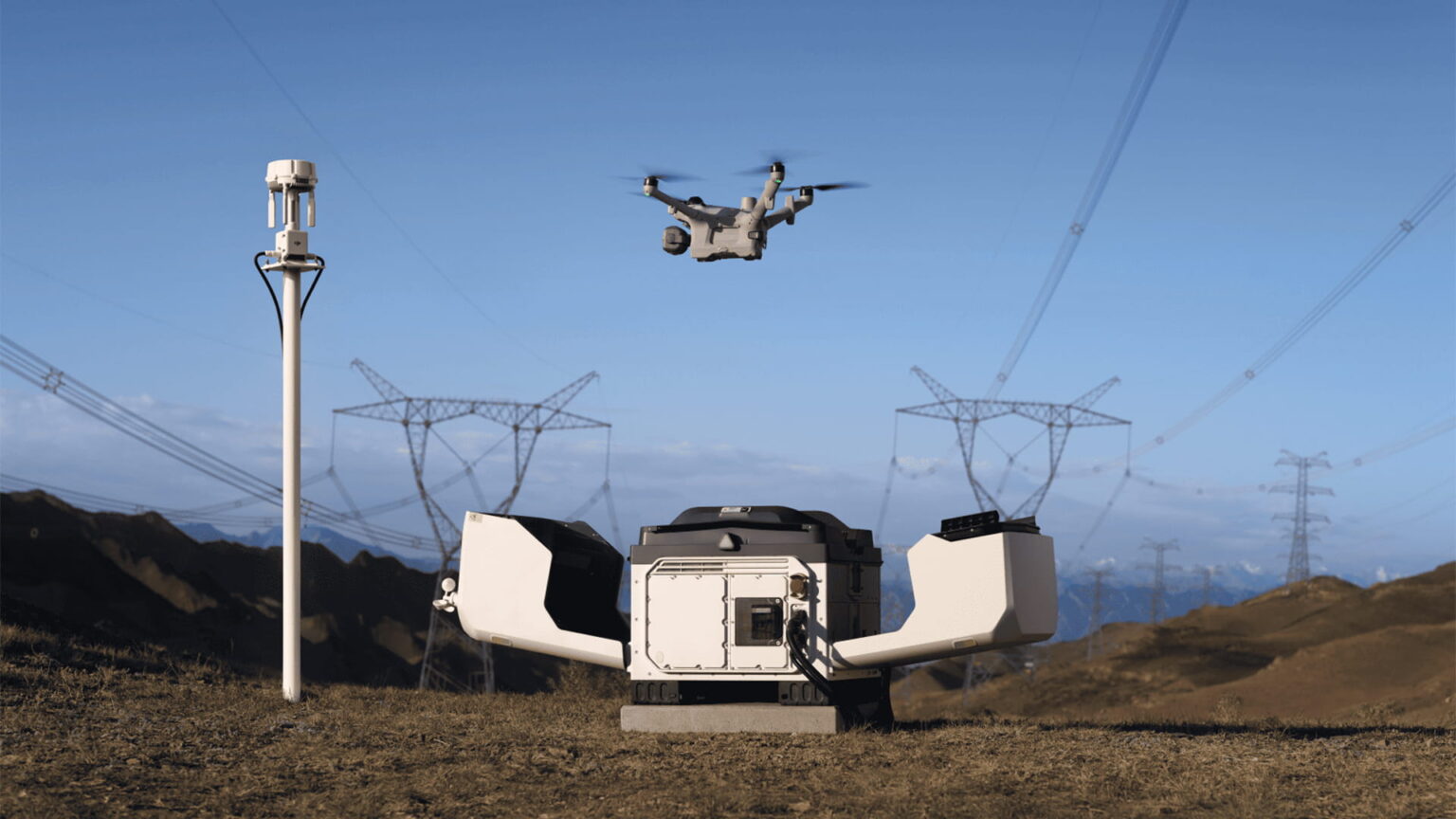
DJI launched Dock 4, its first unattended drone platform with automated battery swapping, on October 14. A package comprising the dock, Matrice 5TD drone, and O4 Ground Station is available for preorder in China at RMB 167,999 (USD 25,100). Software subscriptions, deployment in nonstandard settings, and other optional services cost extra.
A drone dock is a fixed automated station that handles takeoff, landing, battery charging or replacement, communications, and data transmission. For frequent tasks such as power infrastructure inspection, forest fire prevention, emergency rescue, and urban management, it reduces the need for pilots to bring equipment to a site repeatedly. The drone can remain stationed there between jobs, ready for remote deployment.
Dock 4 is the fourth generation of a series DJI introduced in 2022. According to the company, the series is deployed in more than 80 countries and regions and has completed over eight million flights and two million hours of unattended operations.
The main change is a shift from the previous generation’s fast charging to automated battery replacement. Drones previously recharged inside the dock after returning, typically leaving about half an hour between missions. According to DJI, Dock 4 can replace a battery in 25 seconds and get the drone airborne again within 45 seconds. The Matrice 5TD has a maximum flight time of 59 minutes.
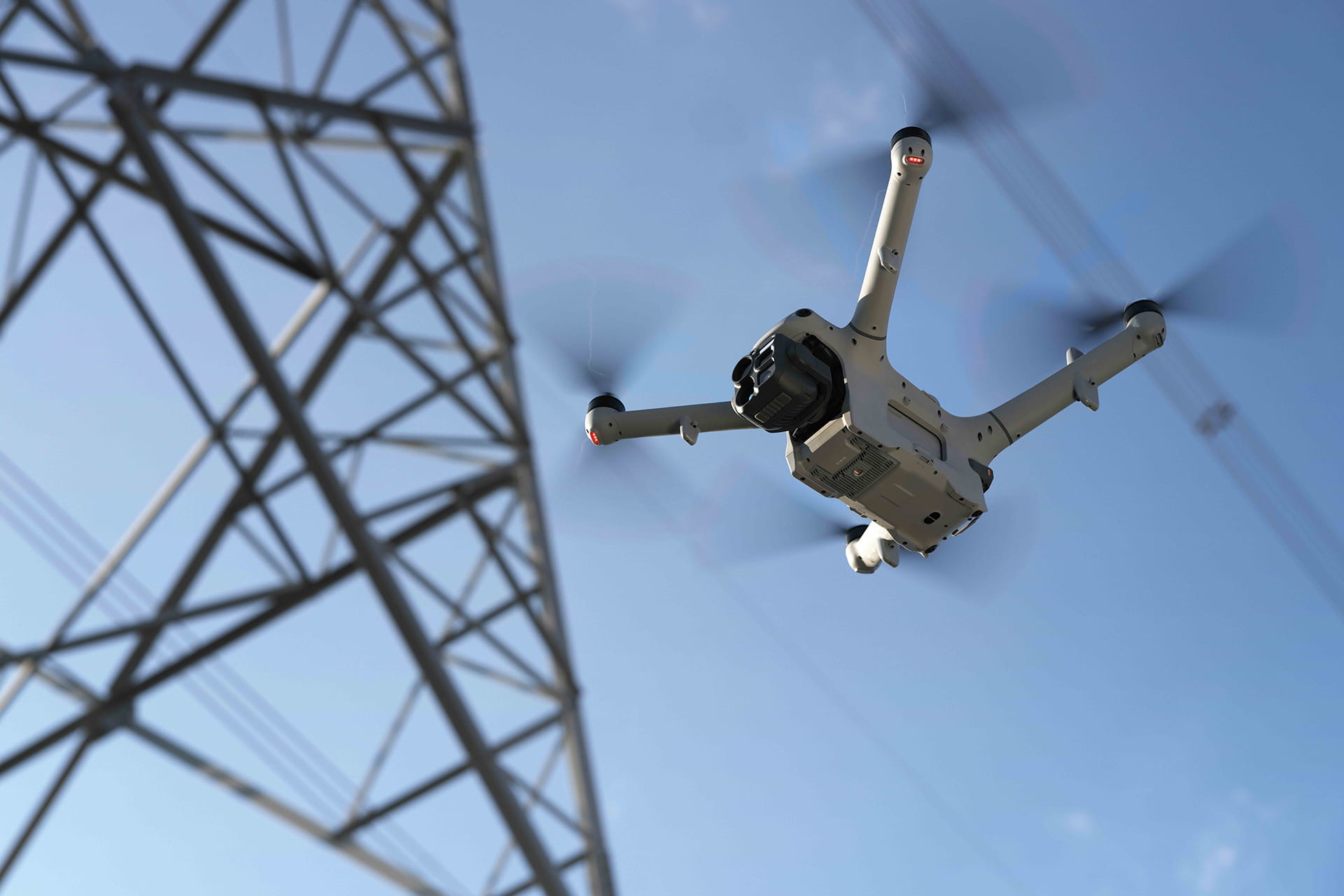
The shorter turnaround reduces time on the ground between missions. A half-hour recharge may be acceptable for routine inspections, but during responses to fires or earthquakes, or during continuous inspection work, it leaves a gap in coverage. Battery swapping allows the next mission to follow soon after the previous flight ends.
According to DJI, Dock 4 uses a carousel mechanism to remove a depleted battery, install a charged one, and perform system checks automatically. A wireless power system keeps the drone’s onboard electronics running while its battery is removed, reducing startup time after the swap. The dock operates at temperatures from minus 40 to 50 degrees Celsius. These specifications come from DJI’s tests in controlled environments; actual performance varies with conditions and use.
The Matrice 5TD integrates telephoto and infrared imaging with laser ranging. DJI’s tests indicate that its 11-times telephoto lens can distinguish license plates at distances of up to 400 meters and identify small objects such as bolts and pins within 100 meters. Its laser rangefinder has a range of up to three kilometers and can overlay distance readings and target coordinates on the video feed.
The drone has a maximum payload of 450 grams and three mounting positions. For a nighttime search-and-rescue mission, for example, it can carry a loudspeaker, spotlight, and parachute simultaneously. Its flight safety systems include three-directional millimeter-wave radar, rotating LiDAR (light detection and ranging), and six-directional vision sensing. It supports takeoff and landing in winds of up to 12 meters per second.
Dock 4 also uses artificial intelligence to identify targets through its onboard and remote systems. DJI said the Matrice 5TD can identify 17 types of targets in real time using onboard processing, including vehicles, vessels, and smoke or fire. It also supports third-party models. DJI FlightHub 2 handles remote control, flight missions, online inspection, alerts, and equipment operation and maintenance. The newly introduced Cloud API 2 helps enterprises and developers connect the dock to their existing business systems.
By combining battery swaps, onboard sensors, AI recognition, and remote dispatch in one unattended system, DJI aims to make frequent, successive missions less dependent on staff returning to the site.
KrASIA features translated and adapted content that was originally published by 36Kr. This article was written by Leslie Zhang for 36Kr.
Note: RMB figures are converted to USD at rates of RMB 6.69 = USD 1 based on estimates as of October 19, 2026, unless otherwise stated. USD conversions are approximate and, where appropriate, rounded for ease of reference. They may not fully match prevailing exchange rates.