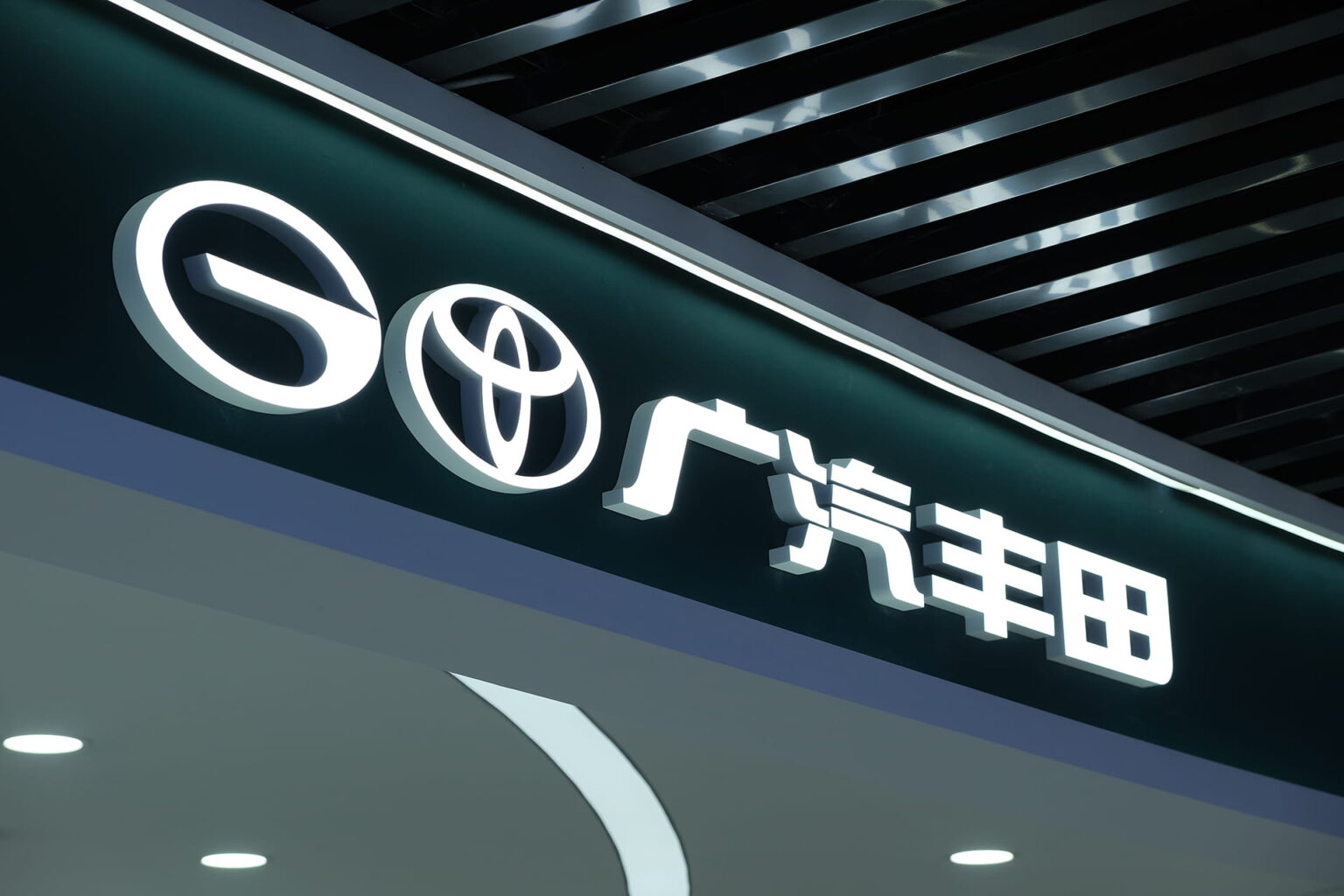
Guangzhou Automobile Group (GAC) said it has agreed to acquire peer FAW Group’s 50% stake in a joint venture with Japan’s Toyota Motor, bringing the restructuring of state-backed players in China’s crowded automotive sector into sharper focus.
The injection of a profitable Toyota business into the loss-making GAC will help its ailing financials. At the same time, the central government-controlled FAW is set to gain a substantial interest in GAC, becoming its second largest shareholder.
GAC announced the move toward the end of last month in filings to both the Shanghai and Hong Kong exchanges. It said it would acquire FAW’s half of the 50-50 joint venture with Toyota, while the Japanese carmaker will retain its holdings.
GAC and Toyota already operate a separate automaking joint venture, GAC Toyota Motor. There has been no mention of a merger, but the filings said the transaction “will promote the integration and collaboration of the two major joint venture systems” with the aim of “reducing duplicated investment within the same brand system and stabilizing the profit foundation of the joint venture business.”
For the first half of this year, GAC reported a net loss of RMB 4.46 billion (USD 665.4 million), nearly doubling from a RMB 2.53 billion (USD 377.4 million) loss for the same period last year. The Toyota joint venture was a rare bright spot.
And according to the filings, FAW’s operation with Toyota reported over RMB 4 billion (USD 596.7 million) in net profit for each of the last two years, and more than RMB 1 billion (USD 149.2 million) for the first six months of this year.
Taking the 50% equity interest in FAW Toyota “can directly increase the company’s investment income and improve its net profit” while also allowing it to take advantage of economies of scale, GAC said.
GAC said it will pay for the transaction by issuing new RMB-denominated A shares. While the size of the new issuance has yet to be determined, the price was announced at RMB 5.75 (USD 0.9) per share. This is 13% higher than the stock’s closing price of RMB 5.09 (USD 0.8) on September 11 before trading was temporarily suspended pending the announcement.
FAW will become GAC’s second largest shareholder after GAC’s parent, Guangzhou Automobile Industry Group (GAIG), which is owned by the city of Guangzhou’s State-owned Assets Supervision and Administration Commission, or SASAC.
RELATED ARTICLE
Joint ventures between foreign automakers and mainland Chinese state-owned enterprises (SOEs) have been hit by the onslaught of electrification in the world’s largest car market in recent years. Toyota has not been immune, but its businesses have remained profitable, unlike many competitors.
The GAC-FAW deal marks another step in reforming the inefficient state-owned sector, which Beijing has been working on over decades. The latest transaction between the central government-controlled FAW and Guangzhou’s GAC deepens “the reform of state-owned assets and state-owned enterprises while promoting the optimization of the layout and structural adjustment of the state-owned economy,” the filing said.
The deal is also deemed to be beneficial for Toyota, as it will be able to consolidate its resources in China.
Xiaoyi Lei, a Hong Kong-based analyst at Jefferies, said the transaction “could deliver a tangible earnings stream through FAW Toyota and [by] establishing a broader central-local SOE alliance rather than a one-off asset transfer.” But while the deal may offer cost benefits, she questions whether “equity cooperation translates into operating cooperation.”
FAW Toyota’s earnings trajectory and success at achieving tangible synergy remain “key swing factors,” she said, explaining her cautious “hold” rating for GAC.
Gary Ng, senior economist for the Asia Pacific region at French financial conglomerate Natixis, said the arrangement marks another instance of the “central government and central SOEs playing a bigger role in the economy.” Especially in the automotive sector, where the presence of state companies is relatively large, “it was probably easier to push through” consolidation like this, unlike in the renewable energy sector, which is dominated by private enterprises.
Alicia Garcia Herrero, Natixis’ chief economist for the Asia Pacific and the Middle East, who joined Ng at a press conference on September 29, painted a bigger picture of how local government SASACs are running out of cash, as revenues from land rights sales—which they have relied on for decades—are rapidly dwindling due to the country’s protracted real estate crisis.
As local government-backed SOEs are key sources of jobs in communities, she said a key question is “what is going to happen to employment and what kind of solution could be found for the local government to retain the power of keeping the local employment in the current circumstance.”
Bringing in central companies to support local peers like this could be a “solution,” she said. “We may see more cases like this.”
This article first appeared on Nikkei Asia. It has been republished here as part of 36Kr’s ongoing partnership with Nikkei.
Note: HKD, JPY, RMB figures are converted to USD at rates of HKD 7.85 = USD 1 and JPY 158.09 = USD 1 and RMB 6.70 = USD 1 based on estimates as of October 16, 2026, unless otherwise stated. USD conversions are approximate and, where appropriate, rounded for ease of reference. They may not fully match prevailing exchange rates.