



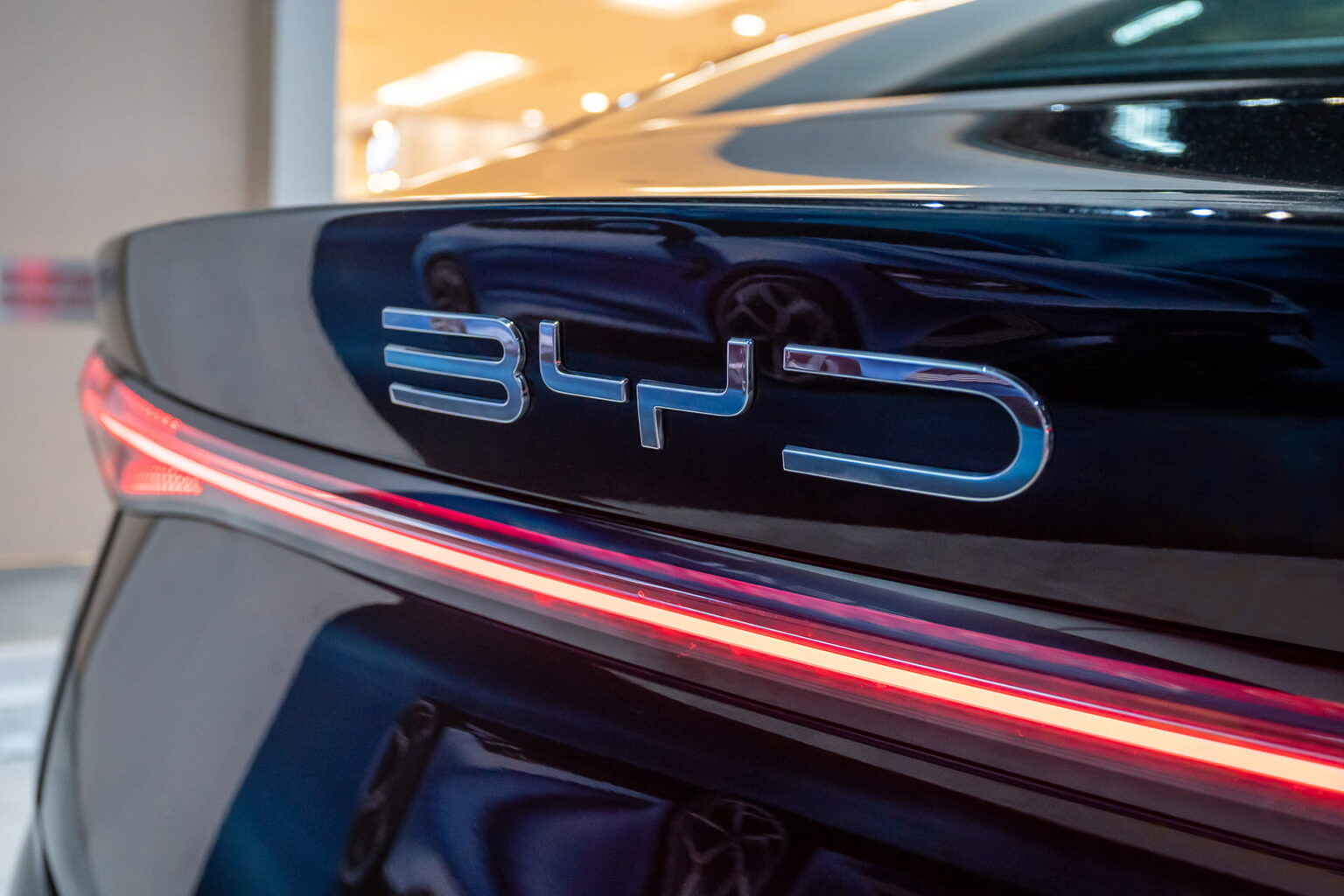
Chinese automotive giant BYD has appointed a local partner to assemble knocked-down parts into completed electric vehicles in Malaysia after shelving plans to build its own plant in a move that will help bypass various taxes and maintain competitiveness as competition increases.
BYD Malaysia has appointed Inokom Corporation, a subsidiary of Sime Darby based in Kulim, Kedah, as its local assembly partner, BYD Malaysia said in a statement on October 15. Inokom already assembles vehicles for several global automakers in the Southeast Asian country.
“Local assembly is an important part of BYD’s long-term commitment to Malaysia. Partnering with Sime to assemble at Inokom allows us to build on established automotive manufacturing capabilities as we progress our local assembly plans,” Jacob Ma, managing director, BYD Malaysia, said in the statement.
“We aim to bring BYD’s expertise in new energy vehicles and battery technologies closer to the Malaysian market while contributing to the continued development of the local automotive industry,” Ma said.
“This partnership marks another step in BYD’s growth in Malaysia alongside BYD Sime Motors,” Ma said.
Sime Motors, the official distributor of BYD vehicles in Malaysia, is the automotive arm of conglomerate Sime Darby.
BYD’s plan to build its own plant in Tanjung Malim, Perak, was first announced in August 2025.
Local financial news outlet The Edge reported in March that plans for the Tanjung Malim facility were in doubt after BYD failed to agree to conditions set by Malaysia’s Ministry of Investment, Trade and Industry.
One sticking point reportedly involved a requirement that up to 80% of locally assembled vehicles be exported.
Under the completely knocked-down (CKD) method, vehicles are shipped to Malaysia as parts and assembled locally, making them eligible for incentives not available to fully imported vehicles.
On July 1, Malaysia began requiring that imported completely built-up (CBU) EVs have a minimum declared cost, insurance, and freight, or CIF, value of MYR 200,000 (USD 49,000), as well as a minimum power output of 245 horsepower, or 180 kilowatts.
These new requirements follow the 2025 expiration of a special tax exemption for imported fully-built EVs on Dec. 31, 2025.
Some of BYD’s bestselling EVs in Malaysia are priced below MYR 200,000, making having a local assembly plant a pressing matter.
A Kuala Lumpur-based auto analyst for an investment bank said that with local assembly through Inokom, BYD can sell CKD models below MYR 200,000 and with a minimum MYR 100,000 (USD 24,500) price condition. That means CKD models can compete in the under-MYR 200,000 market, added the analyst, who declined to be named.
Local assembly gives BYD a way to keep more of its mainstream models in the market under the stricter rules, given its wide range of vehicles, strong battery and manufacturing capabilities.
“BYD’s CKD model can [now] compete with Proton and Tesla on price and features,” said the analyst.
Locally assembled EVs are exempt from import duty, excise duty and sales tax through December 31, 2027. Beyond that, the tax treatment and applicable CKD conditions will depend on the model and government approvals.
Malaysia is an important market for BYD as the country is the “largest active car market in Southeast Asia” with high potential growth for EVs as it is coming from a low base, said the analyst.
Despite a population of 34 million people, far smaller than Indonesia’s 288 million, 820,752 vehicles were sold in Malaysia in 2025 versus 803,000 in Indonesia and 604,000 in Thailand.
“Compare[d] to its ASEAN peers, car financing in Malaysia is widely considered highly accessible,” said the analyst, adding that low unemployment, strong domestic demand and record backlog will help aid EV sales in the country.
In the first half of 2026 alone, pure EV sales recorded a massive 106% year-on-year jump compared to the same period in 2025, Malaysian media have reported.
BYD has sold more than 35,000 EVs since entering the market in 2022. It sold 14,407 EVs last year, making it the country’s biggest EV seller.
But its lead has since been eroded by Malaysia’s national car brand, Proton. Its mass market EV, the Proton e.Mas 5, launched in October 2025 and became a hit with its competitive base price of MYR 56,800 (USD 13,900).
From January to September this year, a total of 24,857 Proton EVs were registered with Malaysia’s Road Transport Department, Malaysian automotive portal Paultan.org reported.
BYD came in second with 8,087 vehicles during the same period.
“The gap [between BYD and Proton] is likely to stay due to the government’s regulation that put [the] CKD floor price [of MYR 100,000] … to protect national carmakers,” said the analyst.
This article first appeared on Nikkei Asia. It has been republished here as part of 36Kr’s ongoing partnership with Nikkei.
Note: MYR figures are converted to USD at rates of MYR 4.08 = USD 1 based on estimates as of October 23, 2026, unless otherwise stated. USD conversions are approximate and, where appropriate, rounded for ease of reference. They may not fully match prevailing exchange rates.