

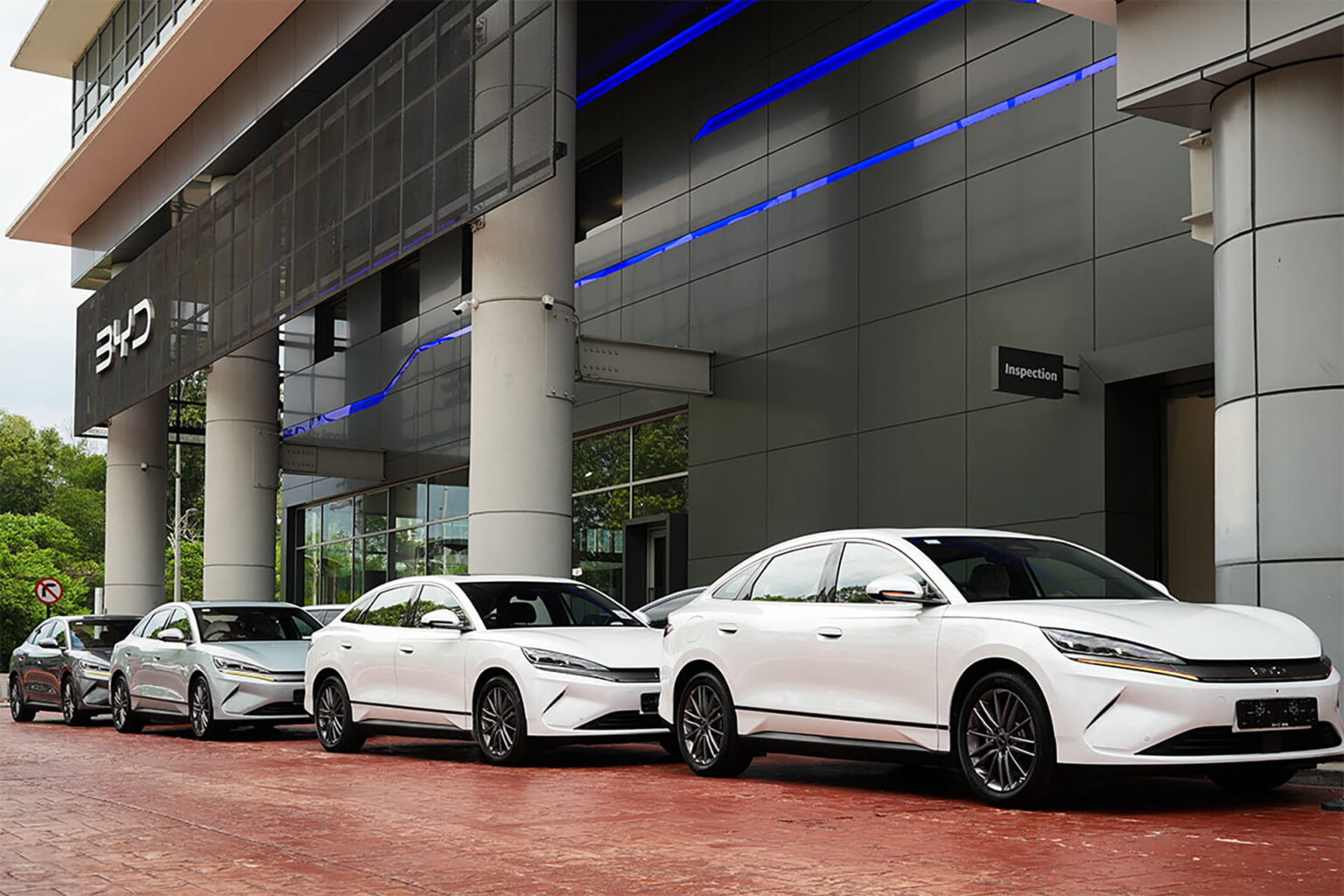
Chinese automotive giant BYD has shelved plans to set up its own assembly plant in Malaysia and is instead in “advanced talks” with a local partner to meet its production aims in the country.
Jacob Ma, managing director of BYD Malaysia, revealed the decision at a media briefing on September 10. The plan to build the plant in Tanjung Malim, Perak state, was first announced in August 2025.
“To clear the air,” Ma said, “the Tanjung Malim facility will not proceed.”
The automaker is now working with an established local player “who has the capacity and the capability to meet BYD requirements and support our full local assembly operations,” he added. “Discussions are already at a very advanced stage, and we are finishing the necessary documents.
“We will make an official announcement once everything is in place.”
Local financial news outlet The Edge reported in March that plans for the Tanjung Malim facility were in doubt after BYD failed to agree to conditions set by the Malaysian Ministry of Investment, Trade and Industry.
One sticking point reportedly involved a requirement that up to 80% of locally assembled vehicles are exported.
Ma did not directly reply to a question about why the facility was shelved, saying only that BYD’s culture is to “explore for the long term.”
In May, it was reported that BYD was evaluating a potential contract assembly partnership with local partner Sime Motors that would use a plant operated by Sime Motors’ Inokom subsidiary in Kulim, Kedah.
Sime Motors is the official distributor of BYD vehicles in Malaysia.
On July 1, Malaysia began requiring that imported, fully assembled EVs have a minimum declared cost, insurance, and freight (CIF) value of MYR 200,000 (USD 49,100), as well as a minimum power output of 245 horsepower (180 kilowatts).
These new requirements follow the 2025 expiration of a special tax exemption for imported fully built EVs at the end of 2025.
Some of BYD’s bestselling EVs in Malaysia are priced below MYR 200,000, making a local assembly plant more pressing.
Ma stressed that BYD “is here to stay in Malaysia.”
“The location and arrangement might evolve,” Ma said, “but our intention remains the same. We continue to see Malaysia as an important market and a strategic part of BYD’s growth in the future.”
Ma said changes will always take place as BYD’s business grows and that strategies might be “refined.”
“We will continue to invest,” he said, “we will continue to innovate.”
BYD is looking to build on its presence in Malaysia, where it has sold more than 35,000 EVs since entering the market in 2022. Last year it sold 14,407 EVs, making it the country’s biggest EV seller.
In the first six months of this year, BYD sold more than 7,000 EVs, Sime Motors managing director Adeline Lew said.
In July, BYD debuted its luxury Denza Z9GT in Kuala Lumpur at MYR 358,800 (USD 88,000), a level analysts said will provide “serious competition” in the high-end EV market.
According to Ma, the first batch of ZGTs is sold out, and the company is waiting for the second batch to arrive in the country. He did not provide further details.
This article first appeared on Nikkei Asia. It has been republished here as part of 36Kr’s ongoing partnership with Nikkei.
Note: MYR figures are converted to USD at rates of MYR 4.08 = USD 1 based on estimates as of September 15, 2026, unless otherwise stated. USD conversions are approximate and, where appropriate, rounded for ease of reference. They may not fully match prevailing exchange rates.