

What happens to a company with a vast library of stories when one person can produce a short drama in a day?
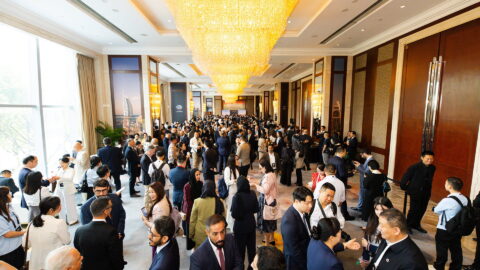
At the 2026 Yuewen Creation Conference, China Literature, also known as Yuewen, offered several figures. Revenue from short dramas and animated microdramas reached RMB 430 million (USD 64.4 million) in the first half of 2026, more than triple the figure from a year earlier. So far, 660 of its animated microdramas have exceeded ten million views, and 107 have surpassed 100 million.
The company has signed more than 5,000 individuals and studios. Its ten highest-earning creators operating as one-person companies (OPCs) each make more than RMB 1 million (USD 150,000) a year, while revenue sharing payouts to leading teams have exceeded RMB 6 million (USD 898,000).
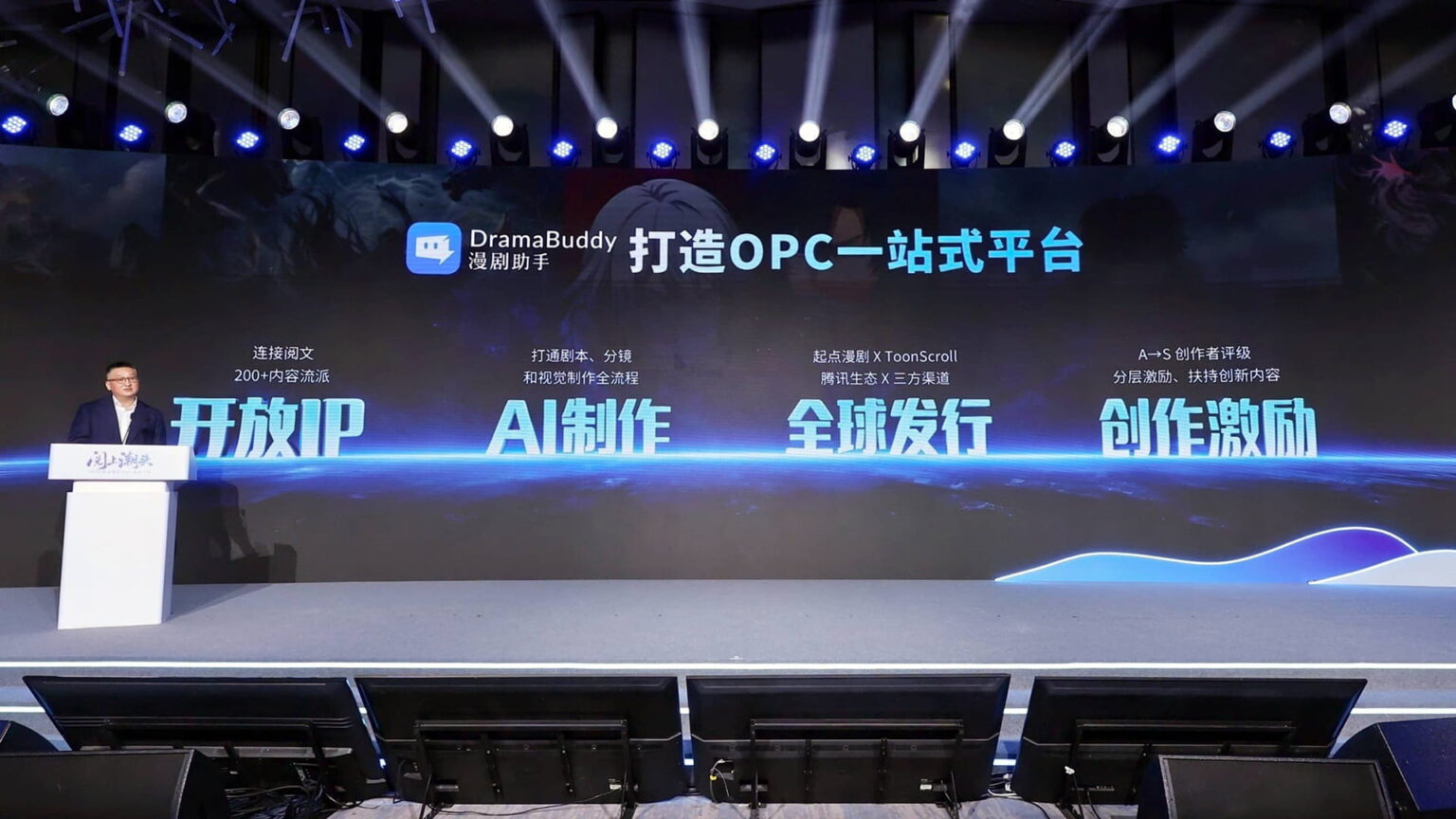
The OPC model was one of the conference’s central themes. President and CEO Hou Xiaonan announced that China Literature would upgrade DramaBuddy, its artificial intelligence-powered animated microdrama production assistant, into a one-stop platform for these creators, combining access to IP with AI-assisted production, global distribution, and further adaptations.
The platform will draw on Qidian’s extensive IP library, which covers more than 200 genres. DramaBuddy is adding a marketplace where creators can find projects, trial collaborations, and scripts with hit potential. China Literature will distribute their work through a broad range of third-party channels and a strategic partnership across Tencent’s ecosystem, alongside its own Qidian animated microdrama platform and ToonScroll, its overseas distribution platform.
It will also introduce creator ratings, with different levels of support.
Senior vice president Huang Yan said DramaBuddy would become the single point of entry for China Literature’s program for OPCs specializing in AI-generated content. Individuals and studios can register as creators or supplier partners to join its animated microdrama business directly. DramaBuddy already serves more than 400 studios and 50,000 creators.
Stories are not what China Literature lacks. It needs people who can adapt them. AI has put production tools into far more hands, and the company wants those creators working with its library.
In an interview after the conference, Jiangyou Wenhua founder Huang Haonan predicted that China would have no AI-powered animated microdrama production companies after 2026. “In the future, it will all be OPCs,” he said. His reasoning was simple: one person can now handle the entire production process.
Putting adaptations in more hands
Companies across entertainment, from web fiction and microdramas to longform and shortform video, have released AI production tools. Chen Weiyu, who heads China Literature’s AI platform department, said DramaBuddy’s purpose is different: it does not exist to “make money selling tokens.”
“The anchor for DramaBuddy is matchmaking,” Chen said.
China Literature has invested in animated microdrama producers including Jiangyou Wenhua, Qianweihou, and Xiaren Yuzhou. Yet less than one-thousandth of its IP library has been adapted, according to the company.
Production capacity is expanding. A single property once kept a studio occupied for one to three years. Now a studio can deliver a pilot version of more than 20 episodes in a month.
Huang described the change at Jiangyou Wenhua: ten people once needed a month to make one series; now one person can make three in that time. Its workforce has shrunk from a peak of 1,500 to a few hundred.
China Literature wants to connect these producers with the many stories awaiting adaptation in its library. But access will not be unrestricted.
“If a partner with weak production capabilities gets a great IP and makes something poor, it can actually damage the value of the original IP,” Chen said. Even with an author’s consent, a collaboration will still depend on an assessment of production ability. The aim, in Chen’s words, is to “get the right IP into the right hands.”
That also explains why DramaBuddy is willing to subsidize up to about 30% of computing costs instead of relying on token sales. The commercial opportunity lies in matching stories with producers and developing the resulting works.
What AI should not change
Chen described AI’s effect on IP development as a shift from a line to a plane. A property once moved along a single adaptation path. Now stories across more than 200 genres can be developed simultaneously, and the same story can become an animated microdrama, an interactive film-game hybrid, an AI-generated animation, or an AI-produced film, “because costs are manageable.”
Over more than a decade, China Literature has navigated the rise and fall of the longform video industry and the boom in shortform video. AI could now change both how stories are adapted and how they are written.
At the conference, Hou drew a boundary:
“AI can be used to adapt literature, but literature itself cannot be AI-generated.”
Qidian is taking steps to enforce that distinction. It is tackling low-quality AI-generated filler, cleaning up its rankings, and limiting daily character counts to discourage writers from using AI tools to pad their work or climb the charts.
“A story can be adapted into microdramas, animated microdramas, film and television, and games. It can cross languages and grow endlessly across different media,” Hou said. “All these opportunities begin at the same starting point: someone who wants to write a story sits down, opens a document, and writes the first line.”
China Literature said that this year it subsidized several hundred writers whose work it considered high quality but who attracted few paying readers. Subscriptions to the supported works rose by an average of 100%.
Next, it will issue targeted vouchers in batches, starting with one billion Qidian coins, the platform’s official virtual currency. The vouchers will fund subscriptions to quality works with low readership. The platform will cover the cost, while authors will receive their usual payment at the full price.
Writers are also earning income from adaptations. More than 1,500 have reportedly earned licensing income for the first time through animated microdramas. More than 300 have received over RMB 10,000 (USD 1,500) in revenue sharing payments from short dramas and animated microdramas, nearly 100 have received over RMB 100,000 (USD 15,000), and the highest payout exceeded RMB 1 million.
Vice president and editor-in-chief Yang Chen said China Literature would add a preauthorization feature for comics and animated microdramas to its author dashboard. Writers could approve adaptations in advance, connecting their work with DramaBuddy’s 50,000 OPC creators.
China Literature is ramping up production but holding firm on one rule: stories must be written by humans. The coming years will test whether that principle can survive the push for scale.
KrASIA features translated and adapted content that was originally published by 36Kr. This article was written by Wang Yuchan for 36Kr.
Note: RMB figures are converted to USD at rates of RMB 6.68 = USD 1 based on estimates as of October 28, 2026, unless otherwise stated. USD conversions are approximate and, where appropriate, rounded for ease of reference. They may not fully match prevailing exchange rates.