

China’s electric vehicle leader BYD is building test tracks across the country in a bid to strengthen its brand by getting drivers behind the wheel in various terrains.
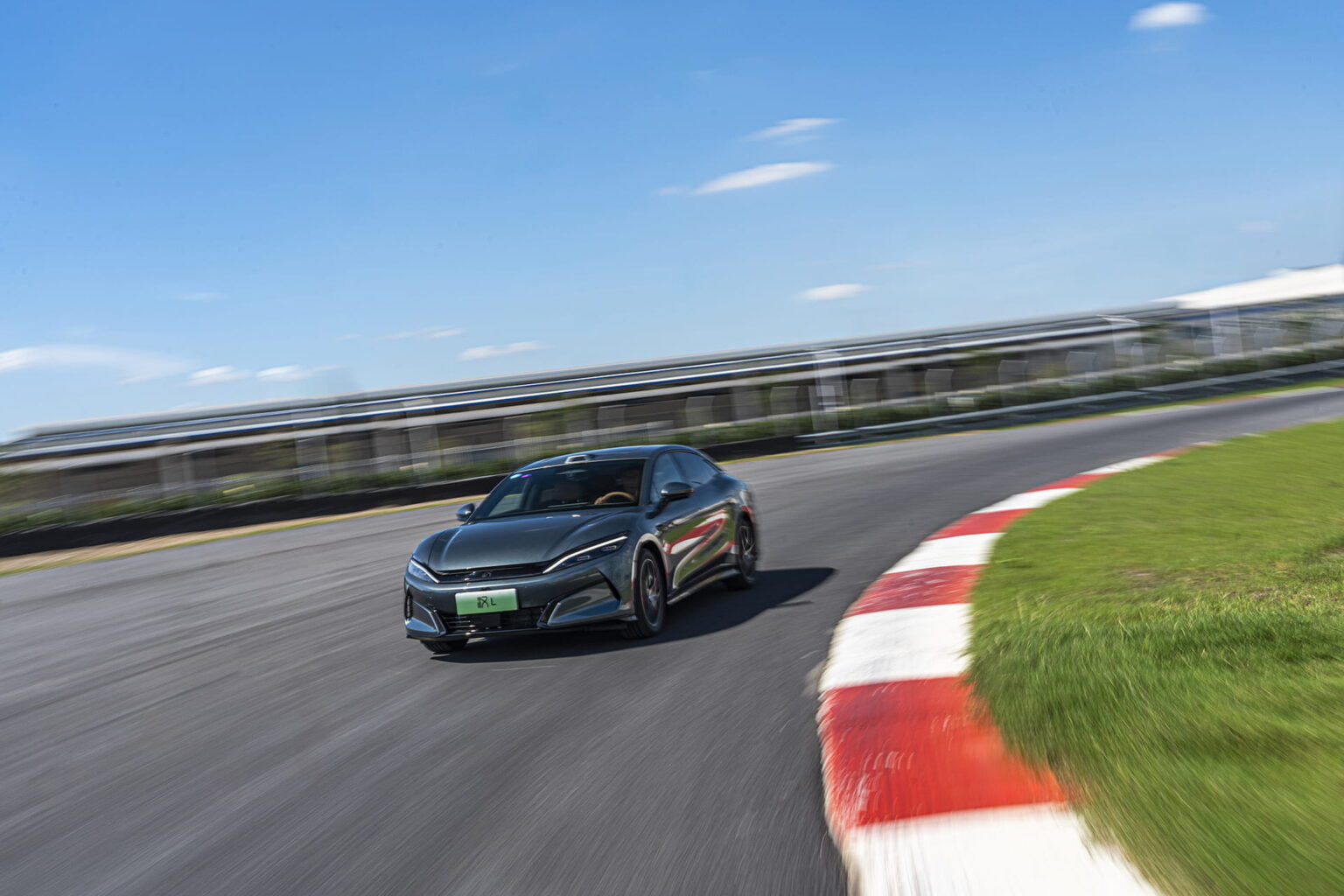
BYD’s Shaoxing automotive experience center in Zhejiang features a 1.6-kilometer racetrack with five curves and a 550-meter straight acceleration section.
The facility also has five other courses. One is a low-friction track, where water is added to the ground covered with about 30,000 basalt bricks that are completely level. This allows beginners to try drifting, where the tires slide sideways when driving. Another course features a steep 28-degree slope that mimics a sand dune, so a driver can get the feel of an off-road trip.
The experience center, which started operations in August, was opened up to foreign media a week ago.
Visitors can choose from beginner, intermediate, or advanced courses and receive coaching from instructors. The vehicles offered are limited to BYD models, including the Yangwang premium sports car and the off-road-focused Fangchengbao brand. The price for the beginner course is RMB 599 (USD 89.7) per hour.
BYD has opened two other auto circuits in the cities of Zhengzhou and Hefei, and plans to build more in other regions.
Construction of the experience centers is a pet project of BYD chairman and CEO Wang Chuanfu. At an event held in 2024, Wang said the company would invest RMB 5 billion (USD 748.4 million) to build a circuit where people could test-drive EVs and other new energy vehicles.
“To become a global brand, groundbreaking technology, being valued by the market, and the soft power of automotive culture are essential,” Wang said. In other words, a culture can only be cultivated by making the company’s technology known to a large number of consumers, according to Wang.
BYD’s sales volume has risen elevenfold from 2020, hitting 4.6 million units in 2025. By capturing demand for new energy vehicles, it has climbed to sixth place globally.
Now BYD appears to be striving to surpass top automaker Toyota Motor, which sells over ten million vehicles a year. The Chinese company’s challenge lies in the strength of its brand.
BYD’s brand value ranked 11th globally, according to the British research firm Brand Finance’s 2026 report. While this is an improvement from 12th place last year, the top ten companies are dominated by Japan, Europe, the US, and South Korea. The gap between those companies and BYD remains significant.
BYD’s approach to using racetracks to enhance its brand value echoes Japan’s history. The culture of racing and racetracks originated in Europe and the US, but it began to take hold in Japan with the boom in auto sales in the 1960s.
Honda Motor completed the Suzuka Circuit racetrack in 1962. The company’s founder Soichiro Honda sought to create a racetrack “where high-speed driving can be done safely.” Fuji International Speedway opened later in 1966.
Suzuka Circuit and Fuji International Speedway have always opened their facilities to beginners and enthusiasts, encouraging them to enjoy driving. At the same time, the two facilities host domestic and international races where automobile manufacturers compete.
By broadening the base of fans who appreciate automobiles and understand their technology and quality, the two racetracks have contributed to brand building.
BYD’s circuits are smaller than Japan’s international tracks, so it appears to be difficult to hold full-scale races at its locations at the moment. But BYD’s circuits aim to increase the number of fans by making the vehicles more accessible to them.
“Japan, South Korea, and the West are all traditional automotive powerhouses with mature automotive cultures,” said Tang Yu, senior director of BYD’s branding and public relations division. “China is actually a latecomer.”
But with new energy vehicles gaining headway among consumers, “BYD seeks to be a pioneer and build China’s automotive culture,” said Tang.
This article first appeared on Nikkei Asia. It has been republished here as part of 36Kr’s ongoing partnership with Nikkei.
Note: RMB figures are converted to USD at rates of RMB 6.68 = USD 1 based on estimates as of October 29, 2026, unless otherwise stated. USD conversions are presented for ease of reference and may not fully match prevailing exchange rates.