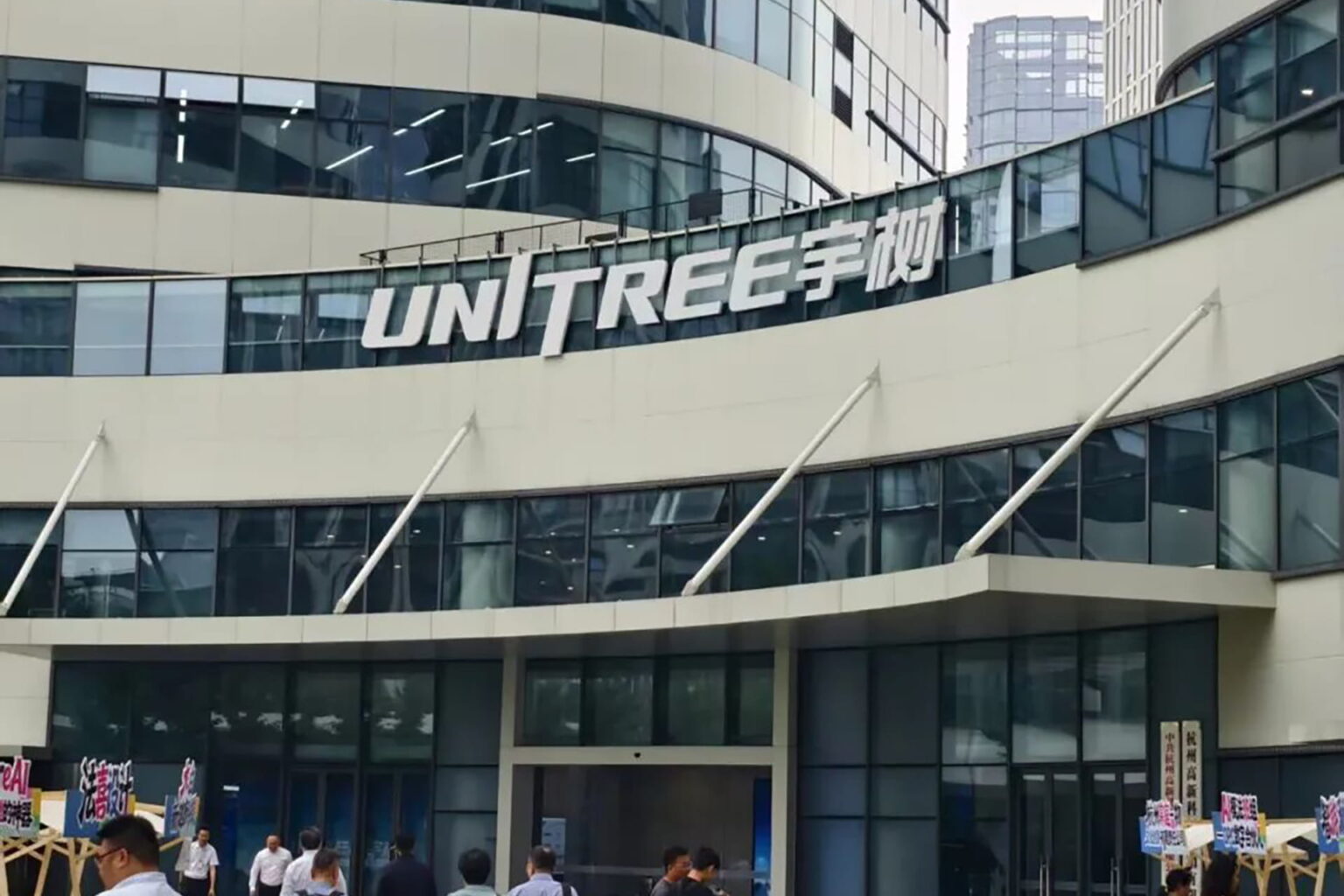
In 2026, Unitree Robotics’ headquarters has become something of a tourist attraction even by the standards of Hangzhou, one of China’s most popular travel destinations.
Tour groups appear all year round, posing for photos outside the entrance with banners stretched between them. Unitree’s official showroom occasionally opens slots to individual visitors, but at peak times, reported waits can exceed a month. So many third-party agencies began charging customers for tours while claiming to be official partners that Unitree posted a prominent notice stating that it does not offer paid visits.
New residential developments nearby began marketing themselves as homes for the “new Unitree elite of Hangzhou.” One oft-repeated claim was that after Unitree went public, each of its early employees would be able to buy an apartment in Hangzhou’s Binjiang district.
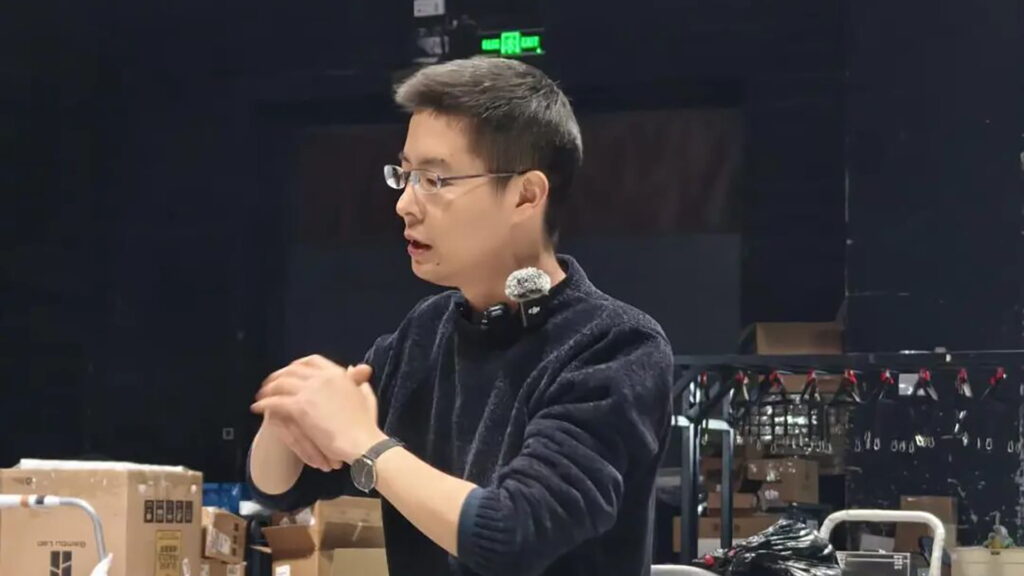
Even small details about CEO Wang Xingxing drew attention. He wore black suit trousers without a belt. After an interview, he clasped his hands in a gesture some observers compared with Tim Cook’s. His forceful signature also attracted commentary about his personal style. Online, people even debated his MBTI type: INTP or INTJ?
That enthusiasm spread from the public to the capital markets, reaching a peak this summer.
In June, Unitree’s application for an IPO on the Star Market passed the Shanghai Stock Exchange’s listing review committee. Just 73 days elapsed between the application being accepted and the review hearing, an unusually fast process. One view is that China’s advantage in artificial intelligence lies in manufacturing, and that Unitree, as one of the country’s leading robotics companies, carries some of that expectation.
Unitree’s IPO valuation was RMB 61 billion (USD 9 billion).
“After listing, a market capitalization of more than RMB 200 billion (USD 29.6 billion) would be entirely reasonable. I think it could even exceed RMB 400 billion (USD 59.2 billion) in the short term. Compared with valuations of similar companies overseas, that isn’t outrageous,” Yu Wenchao, an early Unitree investor and asset partner at Dunhong Capital Management, told 36Kr.
Some investors believe Unitree could become the Apple of robotics and Wang the industry’s Elon Musk. Others, particularly investors who had not participated in Unitree’s financing rounds, found such expectations difficult to justify, pointing to its 2025 revenue of just RMB 1.7 billion (USD 251.6 million).
On August 10, Unitree opened subscriptions for its Star Market IPO. The allocation rate was just two in 10,000, corresponding to a static price-to-earnings ratio of about 219 times. By comparison, the average static P/E ratio for the general-purpose equipment manufacturing industry was 38.56 times.
Part of Unitree’s valuation reflects what the company has built. Another part reflects the combined force of national strategy, industry investment, and public sentiment. Together, those forces have raised the expectations surrounding it.
Robotics was included in China’s 15th five-year plan. State-backed investors poured into the industry, and IPO pathways opened. Together, those developments drove a sharp rise in financing for embodied intelligence over the past three years, producing company after company valued at more than RMB 10 billion (USD 1.5 billion). Industry veterans began starting companies, changing jobs, and moving into the field.
Ordinary people who had watched robots take the stage at the Lunar New Year gala and imagined one day having a robotic housekeeper turned their attention to Unitree. So did investors and stock traders hoping to profit, along with Unitree’s robotics peers.
As a benchmark for China’s robotics sector, Unitree carries unusual weight. If it can sustain a market capitalization above RMB 100 billion (USD 14.8 billion), investors who backed embodied intelligence companies at valuations ranging from nine to ten figures in RMB can breathe easier. If its shares unexpectedly fall below the IPO price, sentiment across the industry could weaken.
As the listing approaches, investors across the sector are waiting for Unitree to provide a benchmark. Under that scrutiny, the company has become the tree at the summit.
The year investors collectively missed Unitree
In March 2019, when Decent Capital investment director Zhou Hualin, investment manager Deng Yiheng, and post-investment lead Fu Hao met Wang Xingxing, Unitree had only a few hundred thousand RMB left in the bank.
Wang, however, did not look worried.
Zhou was surprised because Unitree clearly did not have much money. Its office consisted of just two small rooms, each around 20 or 30 square meters, inside a rundown office building. The place looked more like a laboratory. Electronic components covered the walls. Quadruped robot parts were scattered across the floor and desks, leaving almost nowhere to stand.
The group had no choice but to find an open spot in the ground-floor lobby and talk there. People streamed past them. The automatic doors kept opening and closing, periodically letting in gusts of cold air.
Temperatures in Hangzhou can hover only a few degrees above freezing in winter. The men hunched their shoulders, and after just a few sentences, they felt frozen stiff.
“It was so cold,” Zhou said.
Wang was not especially eager to raise money. He wanted just RMB 4 million (USD 591,987.4), but Decent Capital founder Zeng Liqing decided to offer him more than RMB 10 million (USD 1.5 million).
Venture capitalists, meanwhile, were not especially enthusiastic about Wang.
By then, Wang had been an entrepreneur for two years. Unitree was valued at less than RMB 100 million (USD 14.8 million), and investors had already rejected him repeatedly.
At the time, backing Unitree was not the mainstream choice.
Hangzhou was home to another robotics company, Deep Robotics, which positioned itself as China’s equivalent to Boston Dynamics. Its founder, Zhu Qiuguo, was a professor at Zhejiang University’s College of Control Science and Engineering. He was already established in the industry, had led major national-level projects, and had rarely lacked funding since starting the company.
In 2019, most investors would have chosen Deep Robotics.
That year, Deep Robotics was valued at RMB 200–300 million (USD 29.6–44.4 million), more than twice Unitree’s valuation.
“Zhejiang University’s control school had a strong reputation. Of course people would choose the founder with the stronger background,” one investor said.
Next to Deep Robotics, Wang and Unitree looked unremarkable.
Tian Jiangchuan, managing partner at Monad Ventures, remembers describing Wang in an internal memo as having a “grassroots background.”
Wang was a student entrepreneur who had graduated from Shanghai University, a Project 211 institution, and had worked at DJI for only three months. Around people he did not know well, he often wore a stern expression and appeared tense.
When investors asked how he planned to make money from robot dogs, Wang answered plainly: They could climb stairs and deliver parcels in residential buildings without elevators.
That answer also made investors shake their heads.
Years later, the investment community would collectively ask why it had missed Unitree. But in 2019, faced with this founder and this company, most investors simply could not bring themselves to write a check.
Tian later dissected his own mistake.
“The main problem was my elitist arrogance. I believed the robotics industry required a background from a top university. Wang Xingxing graduated from Shanghai University, so I concluded that his background did not match the industry’s needs or our fund’s preferences. That was clearly a huge misjudgment.”
Unitree had also chosen a technical path that differed from the mainstream.
Around 2016, when Unitree was founded, most Chinese robotics companies used Boston Dynamics as a benchmark and adopted hydraulic systems. “That era was basically ‘Copy From America,’” an early Unitree investor told 36Kr.
Hydraulic systems use high-pressure fluid to move pistons in a joint, converting pressure into mechanical force. The process resembles the contraction of human muscles.
Zhou clearly remembers asking Wang why he did not pursue hydraulics.
Wang became somewhat irritated.
His answer was direct: hydraulics would never scale.
First, hydraulic cylinders are precision mechanical components. US companies could make them compact and finely engineered, while Chinese manufacturers could not yet produce them to the same tolerances.
Second, hydraulic costs were difficult to bring down.
Third, hydraulic control lacked sufficient precision, making fine movements difficult.
Compared with hydraulics, Wang’s electric-motor approach could not deliver the same peak power output, but it was easier to operate, cheaper, and more precise.
Later developments supported Wang’s judgment.
In April 2024, Boston Dynamics retired the hydraulic version of Atlas and shifted to electric actuation, the path Unitree had pursued since 2016.
Wang’s thinking was never especially academic. From the beginning, it focused on cost and scale.
He once told Zheng Juncong, founder of Vertex Ventures China, that Unitree’s R&D began with three goals: low cost, high reliability, and practicality.
The idea was to “truly bring quadruped robots into everyday life.” To do that, Wang built an entire system from scratch.
Not long after Unitree adopted direct drive, other Chinese robotics startups began testing similar approaches. But they tended to use the same template: a high-speed Maxon motor from Switzerland paired with a harmonic reducer from Leaderdrice.
The principle was straightforward. High-speed motors are small and spin quickly but generate limited torque. Adding a harmonic reducer works much like adding an amplifier. It lowers the motor’s rotational speed while multiplying torque by tens or even hundreds of times, allowing the robot to handle heavier loads.
Unitree went in the opposite direction. It adopted quasi-direct drive, using a low-speed motor with a planetary gearbox. Although low-speed motors rotate more slowly and are larger, they produce greater torque, reducing what is required from the gearbox. Only a modest increase in torque is needed to reach the target.
More importantly, the gear ring inside a harmonic reducer can be as thin as an eggshell. A hard fall can break it, and a single unit can cost several thousand RMB.
Planetary gearboxes, by contrast, are common industrial components. They can cost less than RMB 100 (USD 14.8) and are far more durable.
Wang even redesigned structural layouts that had been standard in the industry for years.
Consider motor placement.
Peers largely followed a design associated with Switzerland’s ANYbotics: two motors mounted in the thigh and another at the knee, with each of the three motors handling a different movement. The problem was that the lower limbs became heavy and consumed large amounts of power.
Unitree concentrated all three motors near the hip joint, leaving only a lightweight connecting rod in the lower leg. That allowed the robot to travel farther while reducing maintenance difficulty.
The architecture also helped compensate for the lower peak power and torque of electric actuation.
“When I saw its structure, I thought it was a genius design,” Zhou told 36Kr. “It must have gone through countless iterations before they finally realized this was the best structure.”
Most Chinese robotics companies later adopted some version of Unitree’s basic leg design: electric actuation, large low-speed motors paired with planetary gearboxes, and three motors positioned proximally.
But being early and different created another problem: Wang could not find suppliers for the core components he needed.
One industry veteran told 36Kr that the quadruped robot supply chain at the time was “almost nonexistent.”
The companies capable of making joints were small workshops. The concept of an “integrated joint module” barely existed. Motors, reducers, and controllers came from separate suppliers:
“You had to piece them together yourself. The resulting module was big and heavy, and the [robot] dog could barely walk a couple of steps under its own weight. It had no practical value.”
Most motors on the market were designed for high rotational speeds and produced limited torque. Wang needed low-speed, high-torque motors capable of moving robot joints, the opposite of the mainstream approach.
He also wanted inner-rotor motors, in which the rotor spins inside the motor. Most products on the market were outer-rotor motors used in drones and high-speed hair dryers.
On top of that, the motors Wang designed weighed half as much as comparable industry products. No mature off-the-shelf option existed.
The motors Unitree could buy did not work well. Custom manufacturing was not practical either because, in its early years, the company ordered only a few dozen units annually.
“When you knocked on the doors of listed companies like Wolong Electric or Moons’, they simply ignored you,” one former Unitree employee told 36Kr.
After being turned away repeatedly, Wang came to a realization:
“A robot manufacturer has to be like Apple. You need to control the core technologies yourself so you can reshape the supply chain around your own ideas instead of being held hostage by suppliers.”
Unable to buy what he wanted, he purchased silicon steel sheets and copper wire and wound his own motors.
“I was stunned. It felt very DJI,” Zhou recalled of watching Wang build a motor by hand.
Motors are at the core of a robot. Developing them in-house meant designing the entire system around them.
Wang drew the gearbox blueprints himself. He made cables. He bought batteries and assembled them into battery packs. Even on the few control boards Unitree sourced externally, Wang wrote the control software himself in Linux.
This comprehensive approach, extending from low-level code to individual components, became one of Unitree’s defining characteristics.
Having spent years in Shenzhen, Zhou understood how tightly DJI controlled its critical components.
Later, after learning that Wang had worked at DJI and had been on good terms with founder Frank Wang, Zhou better understood where Wang’s approach came from.
“Like a mini DJI” became one of Decent Capital’s key reasons for backing him.
“As a Shenzhen investment firm, we knew very clearly how DJI had grown,” Zhou said.
But not every investor saw it that way at the time.
In 2019, Unitree had not yet begun commercialization at scale. Investors could judge only the founder and the product.
One industry source told 36Kr that an investment firm conducted due diligence on Unitree that year after a recommendation from an industry executive. But after seeing how precarious the company’s cash position was, the firm backed away.
The head of another investment firm had a different objection:
“A DJI that runs on the ground? Shouldn’t it have four wheels? Why does it need four legs?”
For a company pursuing a non-mainstream approach, there were plenty of reasons to say no.
Commercializing a niche
To win broader recognition, commercial revenue offered a more conventional form of proof.
But investors were not particularly convinced by Unitree’s commercialization strategy either.
The ceiling appeared low.
For a long time, Unitree’s most reliable cash flow came from universities and research institutions. It sold them quadruped robot platforms that researchers could use for secondary development.
Previously, these institutions had little choice but to buy Boston Dynamics’ Spot for research. Even the cheapest version cost USD 75,000. Unitree’s Aliengo cost about one-third less.
After encountering these customers at an international trade show in 2019, Unitree made them its core market.
At the time, other commercialization paths appeared to offer more upside.
Several quadruped robot companies pursued consumer products for household companionship and attracted investment. But that larger vision proved difficult to realize and was later judged to have been at least several years too early.
The research market had a limited ceiling. In 2019, Unitree had accumulated 27 customers and orders for 33 units, of which it had delivered eight.
But it was a tangible, relatively low-maintenance business.
First, research institutions took time to place orders, but they were willing to pay when they did.
According to 36Kr, Unitree initially priced its robots at USD 20,000–30,000. It later discovered that customers were not especially price-sensitive and raised the price to USD 45,000.
By modifying the code on a higher-end version of a standard product and adding a chip module, Unitree could sell it as a version tailored for educational use and charge significantly more.
More importantly, these customers did not require much guidance. Unitree only needed to sell standardized hardware. Users could do the rest themselves.
It also provided open, low-level interfaces developed entirely in-house, allowing professors to modify algorithms freely. Wang even personally wrote a book for use as a reference textbook at universities.
That helped Unitree avoid a common trap in enterprise robotics: high contract values paired with equally high operating and maintenance costs, creating a cycle in which every new project lost money.
Wang understood the limits of what his company could do.
In its early days, Unitree considered expanding beyond education and research into areas such as power grid inspection. It quickly pulled back.
The company discovered that serving large customers such as electricity grid operators required extensive customization. Engineers had to remain on-site for long periods, and projects demanded substantial delivery and integration work.
“You might have several people tied up on one project, and the contract is only worth a few hundred thousand RMB,” a Unitree insider told 36Kr. “How many projects would you have to stack up before revenue became meaningful? A company with only a few hundred employees simply couldn’t do it.”
After Unitree launched its A1 quadruped robot and shipments began rising, Wang became even more determined to focus on standardized products.
Even in education, Unitree focused only on universities and research institutions.
Other robotics companies serving education customers were pursuing “global education,” covering age groups from kindergarten through university. Their businesses included courses, textbooks, school operations, and substantial after-sales support.
It was a compelling story, with a high ceiling and high barriers to entry. But the actual returns were far worse than Unitree’s.
Wang’s approach was pragmatic. In one interview, he described it as “encircling the cities from the countryside”: staying outside the territory dominated by robotics giants such as Boston Dynamics and first finding simpler markets that customers were willing to accept.
These smaller markets helped Unitree in its early years. They strengthened the company’s product capabilities and helped it build a complete operation spanning manufacturing, R&D, and sales. They also exposed Unitree to a large number of real-world problems, allowing the company to maintain a pace of roughly one major robot iteration each year while achieving volume production.
Yet the rationale may have been even more straightforward.
“Our company was relatively small in the beginning. Maybe we chose this deliberately, or maybe it was simply the only path available to us,” Wang once said.
In a sense, Unitree’s early weakness pushed it onto a path few others had taken, but one with fewer immediate obstacles.
As a hardware company, Unitree’s premise has always been clear: keep improving performance and cutting costs.
“First make the hardware good and bring the cost down. When everyone can see the product actually selling, they feel reassured,” one employee told 36Kr.
Wang was technically uncompromising but never precious about it. In one interview, he said:
“Many mobile robots are basically sold by weight. The heavier they are, the more they cost, because the components are just material costs plus some mechanical costs and processing. We sell them by weight. Smaller ones are cheaper, bigger ones cost more. It’s not that different from selling pork.”
As early as 2019, he confidently told investors that within five years, a quadruped robot, or even a humanoid robot, could cost around RMB 20,000 (USD 2,959.9).
That mindset made Wang almost obsessive about cost control.
He would calculate how many grams of metal, copper, and plastic were used in a motor, then set a fixed cost floor. Everyone’s job was to reach that floor.
The method resembles Elon Musk’s approach at SpaceX: break down costs and reduce something that appears prohibitively expensive, such as a rocket, to a bill of materials, components, and manufacturing processes that can each be made cheaper.
Motors are the largest cost item in a quadruped robot.
Using the MIT direct-drive motor approach with planetary gears for the joints can make the system account for more than 50% of the machine’s total cost.
A Unitree quadruped robot requires 12 motors. If bought externally, one motor could cost RMB 3,000–5,000 (USD 444–740). Unitree developed its own and lists them on its website for around RMB 1,300 (USD 192.4) each.
“If an integrator wants to stay in control, it has to develop its own motors and transmission system,” one industry source said. “Once you get the most critical motors and joints right, everything else can come down in price. You can control costs very tightly.”
By then, Unitree had established a broader cost reduction methodology.
Components could be shared across internally developed products. When manufacturing different product lines, the company only needed to change some external structural parts.
As the number of product families increased, Unitree could spread fixed costs across a larger base.
When the A1 robot launched in 2020, its price had fallen below USD 10,000.
In 2021, Unitree released the Go1 for research institutions and schools. The most affordable version cost just RMB 16,000 (USD 2,367.9), less than what some rivals spent simply to build comparable products.
“Every time Unitree released a product, everyone else was stunned,” one industry veteran said. “‘We’re finished. They have just revolutionized the market again.’”
By focusing on standardized products while pushing cost control aggressively, Unitree became profitable in 2020, only its second year of commercialization.
But to venture capitalists focused on the ultimate scale of a company’s market, the achievement did not look particularly exciting.
Research was still a niche market. Even if Unitree eventually captured 60% of the global research segment, that business would still generate only a little over RMB 1 billion (USD 148 million) in revenue.
That year, the biggest funding rounds in robotics went to industrial robots, surgical robots, and warehouse robots. Quadruped robot makers did not rank among the top ten.
Unitree therefore still failed to become a consensus investment among professional investors.
It did, however, get a boost in 2021, when its quadruped robots appeared on the televised Lunar New Year gala for the first time.
After performing alongside several celebrities, Unitree won a number of large enterprise customers, including for inspection applications. That year, the company’s headcount reached about 100, and annual revenue reached tens of millions of RMB.
A few months after the gala, Unitree completed a Series A funding round worth more than USD 10 million led by Shunwei Capital, bringing its valuation to around RMB 1 billion.
The gala gave Unitree more visibility in the private market. But quadruped robots were ultimately an established product category and were viewed as insufficient to propel the company into the mainstream.
One investor recalled that before Unitree’s Series B round, the firm introduced the company to nearly 20 investment institutions. Not one invested.
For several years, Unitree lived a small but comfortable life. Yet it eventually ran into the same dilemma that confronts many technically strong companies: it had patents, proprietary technology, and mass production capabilities, but it could not cross the gap from a niche market to a mass market.
Primed for the humanoid robot wave
When Elon Musk unveiled Optimus in October 2022, he probably did not expect to help create a phenomenon on the other side of the Pacific.
Unitree had already existed for six years, but it remained relatively obscure. It was self-sufficient. It had orders. It had a reputation.
What it lacked was a new market large enough to raise the ceiling on its valuation.
Outside robot dogs, Wang Xingxing did not appear especially ambitious. He was not a Musk-style risk-seeking zealot. He was a pragmatist.
Wang said in media interviews that investors had asked him as early as 2021 whether Unitree should build humanoid robots. He declined.
“Humanoid robots had already been hot for many years. Before Musk got involved, the field had already entered a trough. I hadn’t heard of anyone wanting to buy humanoid robots either. Everyone in the industry was pessimistic.”
Only after Tesla unveiled Optimus, ChatGPT gained global attention, and AI capabilities began advancing rapidly did Wang formally decide to launch a humanoid robot project.
“If he hadn’t made that choice, his investors would have forced him to. His employees would have forced him to,” one investor said.
At first, Wang was far from certain how much return the project could generate. He assigned only three full-time employees to humanoid robot development, with the quadruped team helping occasionally.
What happened next has been told countless times.
The small team took only six months to produce Unitree’s first humanoid robot, the H1, in August 2023.
The H1 stood 1.8 meters tall and cost RMB 650,000 (USD 96,198). But beneath the surface, it was a relatively lightweight experiment. Its joint modules and motors were reused directly from Unitree’s larger quadruped robots, with only some parameters adjusted. The company did not commit excessive resources to it.
Unitree also positioned the product for the research market. The goal was essentially to use the architecture to build a humanoid platform that could walk and be modified by developers.
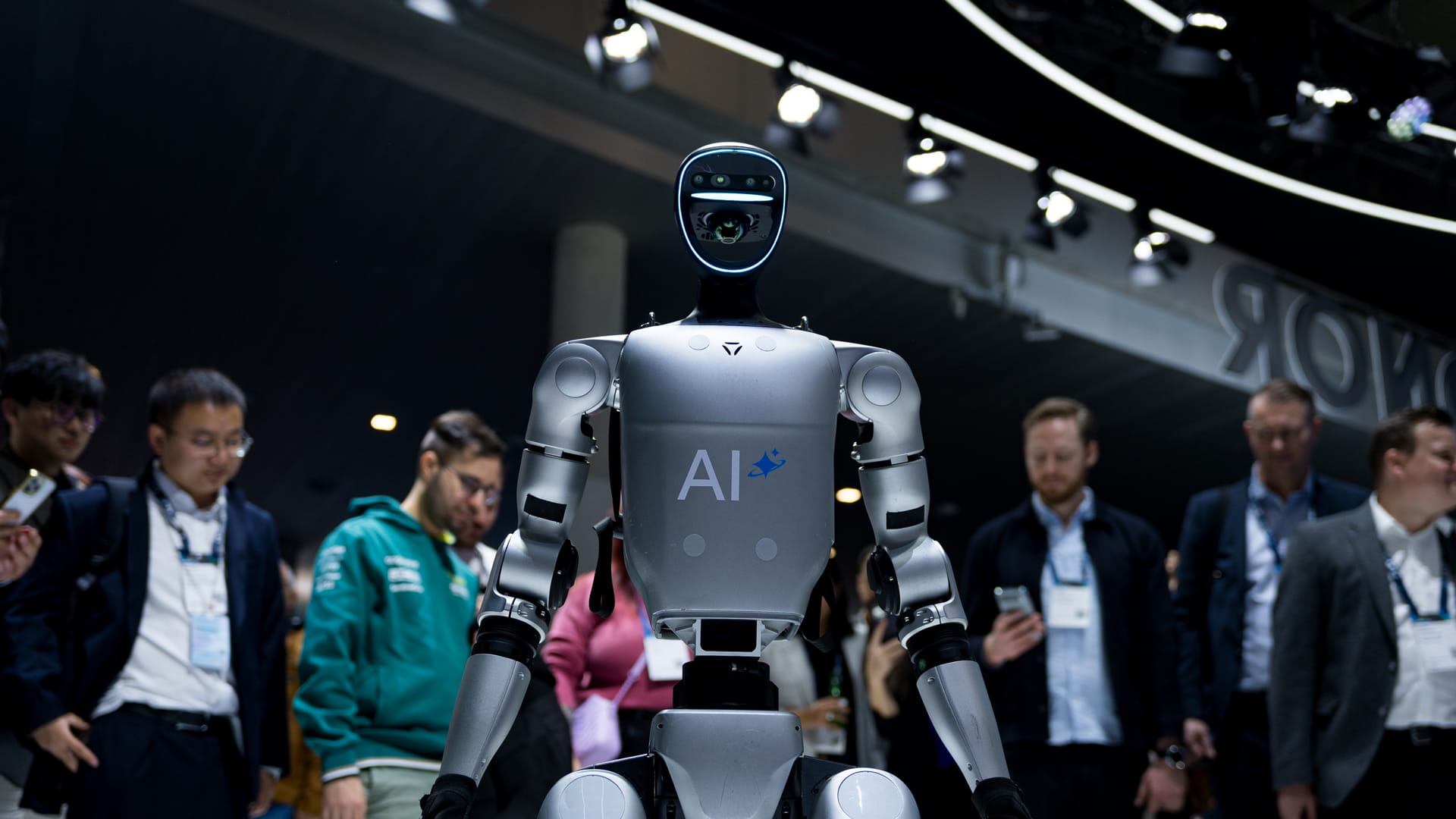
It did not need to be perfect. The H1’s role was simply to secure Unitree a position in the humanoid robot race.
What the company may not have anticipated was how quickly market sentiment would shift.
As momentum generated by Musk and GPT spread from Silicon Valley, a wave of new humanoid robot companies appeared in China, including Agibot, Galbot, and Booster Robotics.
In October 2023, China’s Ministry of Industry and Information Technology released guidelines on the development of humanoid robots, formalizing the sector’s policy significance.
According to public data reviewed by 36Kr, funding for humanoid robot companies reached RMB 5.47 billion (USD 809.5 million) in 2023, the highest level in a decade.
Many founders of newly established embodied intelligence companies came with prominent credentials.
Among older robotics companies, Fourier had released a humanoid robot a month before Unitree.
But Unitree possessed an advantage that newer entrants could not quickly reproduce: it had already proven it could make money.
One investor told 36Kr that after looking at humanoid robot companies across the market in 2023, Unitree was the only profitable one.
According to its prospectus, Unitree’s revenue reached RMB 393 million (USD 58.2 million) in 2024, with net profit of RMB 95.47 million (USD 14.1 million).
In 2024, armed with its new humanoid robot narrative, Unitree completed its first financing in two years.
The round raised RMB 1 billion, one of the larger robotics financings that year, at a valuation of roughly RMB 3 billion (USD 444 million).
Unitree itself had not changed much. What changed was investors’ view of it.
Its cost control was formidable. In August 2024, after another six months of work, Unitree released the G1, a smaller humanoid robot priced at RMB 99,000 (USD 14,651.7). Rivals’ manufacturing costs alone could exceed RMB 100,000 (USD 14,799.7).
Unitree had pushed below the industry’s prevailing price floor while maintaining a positive gross margin.
Despite its low price, Unitree’s hardware reliability was visibly ahead of competitors, according to people interviewed by 36Kr.
Zheng Juncong said Unitree had reduced the cost of the robot body to tens of thousands of RMB, much as IBM once made the PC possible. Only after that could others begin building software ecosystems and applications on top.
A former employee told 36Kr that the biggest reason Unitree’s products were stable was the performance of its motors.
Take instantaneous power, for example. Greater instantaneous power allows a robot to sustain intense movements for longer without overheating, extending how long it can operate under demanding conditions.
At one competition, Unitree employees noticed that a rival’s robot had no arms. They spent a long time studying it, assuming the competitor had deliberately designed the robot that way.
Only later did they discover that the arms had fallen off when the robot toppled over.
Unitree’s robots, using its internally developed motors, could fall during extreme testing without components separating completely.
Unitree had not yet become nationally renowned. But after humanoid robots became a new focus for venture capitalists, the company became one of the most heavily contested targets in China’s private market.
In 2024, some early shareholders partially exited Unitree for reasons related to external circumstances, causing secondary shares to circulate briefly in the market.
Those shares became highly sought after.
One person familiar with the matter told 36Kr that the moment one institution signaled an intention to sell, its phones began ringing nonstop.
Other investors were even willing to pay a premium of RMB 1 billion.
For several days, nearly everyone at the institution was inundated with calls. The callers cared about only one thing: “Do you actually have secondary shares?”
By the end of 2024, Unitree’s valuation had risen to RMB 8 billion (USD 1.2 billion).
“2024 was the last year when people still disagreed about Unitree,” the source said. “Looking back, it was exactly the point before the company took off. Some institutions sold at valuations below RMB 5 billion (USD 740 million). When an opportunity that enormous appears, you should grab every bit of it you can.”
It was the final opportunity for investors to get in at those valuations. A few months later, much of the doubt and hesitation had disappeared.
Becoming a national name
Wang Xingxing may appear inflexible and serious, but he understands how to ride broader forces.
He once told the media that when what you are doing aligns with the main theme of the times, good resources will naturally flow toward you.
At the end of 2024, when the production team for the following year’s Lunar New Year gala invited several humanoid robot companies to participate, Wang was the only one who agreed without hesitation.
The others declined for different reasons.
One company had released a humanoid robot years earlier but failed to keep pace with volume production and therefore missed the timing of the gala early in the year.
Another had a humanoid robot good enough for the gala and a suitable application scenario. But it faced an economic problem.
The gala production team does not pay robotics companies to participate. The companies bear all costs themselves. That means a robotics company must commit not only a large number of machines but also algorithm engineers who have to remain in Beijing for three full months.
Moving a 1.8-meter humanoid robot on and off stage requires two people each time. And in 2024, humanoid robots were still relatively crude. Algorithms were not generally transferable from one unit to another, meaning each robot effectively required its own algorithm engineer.
Even under a conservative estimate, the project would require more than 20 people.
The timing made matters worse. Lunar New Year gala rehearsals coincided with end-of-year activities, precisely when robotics companies were under the most pressure to deliver customer projects.
In an industry that requires intensive project delivery, pulling core employees away for an unpaid performance amounted to an expensive gamble.
According to 36Kr, the latter company estimated internally that parts wear, labor, travel, and miscellaneous expenses would bring the cost of participating to RMB 20 million (USD 3 million). That meant spending one-tenth of annual revenue on a five-minute show.
“When the market hadn’t really taken off yet, most people simply didn’t have the nerve to do it,” one source familiar with the situation said.
While others questioned whether taking part in the gala would be worthwhile, Wang was willing to bear the risk.
Unitree had already benefited from the attention generated by robot performances. After appearing at the gala for the first time in 2021 and seeing its valuation exceed RMB 1 billion, Unitree participated in several major official events, including the 2022 Winter Olympics and the 2023 Asian Games in Beijing and Hangzhou, respectively.
In 2024, 12 Unitree H1 robots appeared at the MGM Theater in Macao, performing a yangge folk dance alongside human dancers. The performance previewed the piece that premiered at the following year’s Lunar New Year gala. Zhang Yimou directed both performances.
One person familiar with Wang said he was usually the kind of boss who, after discovering that a meeting room remote control used branded Nanfu batteries, would tag the administration team and tell it to replace them with cheaper generic ones.
But he did not hesitate over the gala expense.
“Some important decisions require commercial instinct and courage,” Yu Wenchao said. “Even if the return on investment doesn’t work on paper, if something is important enough and the long-term direction is right, he will still support the team in doing it well.”
Wang took the performance extremely seriously.
One source said Unitree pushed back other orders to ensure enough robots were available for the gala.
Before the show, Wang remained on-site as the team rehearsed for several consecutive days without sleep.
The result exceeded expectations. One participant described the impact as “explosive.”
On the night the 2025 gala aired, the founder of one robotics company that had declined to participate had been sending Lunar New Year cash gifts to employees in a group chat. After watching Unitree’s performance, the gifts suddenly stopped.
“He had complicated feelings,” one employee said. “He didn’t expect them to do it that well.”
“Ten years spent sharpening one sword,” one investor said. “All those years of accumulation happened to erupt at exactly that moment and appear in front of everyone.”
The performance also arrived at a moment when China was seeking to demonstrate its technological capabilities.
Unitree appeared at the right time.
Orders poured in after the gala.
Previously, the company had shipped a little more than ten units per day. Afterward, that rose to 40 or 50.
At its busiest, Unitree was shipping more than 100 quadruped and humanoid robots per day.
Wang felt an acute sense of urgency. He told the company’s main group chat that if Unitree could not ship products, customers would go to competitors.
Everyone had to become more efficient. During that period, the number of employees assigned to shipping and assembly doubled.
The entire workforce reported for duty and worked from 8 a.m. to 10 p.m. for two consecutive weeks, taking only one day off.
“I worked until I wanted to throw up,” one former employee said.
Unitree had become a company that ordinary investors could barely hope to access.
Its valuation rose from RMB 8 billion before the gala to more than RMB 12 billion (USD 1.8 billion) when it completed a RMB 700 million (USD 103.6 million) Series C+ round in mid-2025. Only six investors participated, including China Mobile, Tencent, Alibaba Group, Ant Group, Geely, and ByteDance-linked Jinqiu Capital.
Unitree carefully selected the list. One leading automotive group reportedly failed to secure an allocation. At one of the participating investors, the top executive personally called Wang before the firm was able to obtain a stake.
The investors appeared to share the same expectation: Unitree would likely reach an A-share IPO soon.
RELATED ARTICLE
Unitree becomes the benchmark
The significance of Unitree’s listing extends beyond one company reaching the public market. It could help set the tone for the broader embodied intelligence sector.
Over the nearly six months in which Unitree prepared for its IPO, the sector entered a period of intense investment activity:
- In the first half of 2026, total financing for companies in the sector in China approached RMB 100 billion, rising fivefold in a single year.
- Embodied intelligence became the third largest destination for private capital in China in 2026, after large models and the AI chip supply chain.
- In just six months, the sector produced 23 robotics companies valued at more than RMB 10 billion. Eight surpassed RMB 20 billion (USD 3 billion).
“Last year, people still bothered to count how many RMB 10 billion companies there were,” one robotics investor said. “This year, nobody can even be bothered.”
She described what the first half of the year felt like.
For almost any leading embodied intelligence company, if she stopped paying attention for a month, its valuation would immediately surge or double.
“People used to say you should invest small and invest early,” she said. “In 2026, there is only ‘early.’ There is no ‘small.’”
“Everyone expects these companies to list. It’s no longer really within the boundaries of the private market,” another investor told 36Kr.
Robotics was included in China’s 15th five-year plan. State-backed investors joined funding rounds. IPO pathways opened.
The sector had been pushed to high valuations. But on the eve of public listings, investors hoping to profit could no longer avoid the question: what would companies valued at more than RMB 10 billion in private markets actually be worth once they reached public markets?
It was difficult to know whether investors would pay for the same expectations.
For many years, capital markets had a relatively clear method for valuing Chinese startups: benchmark them against comparable US companies.
“Whenever the US produces a company valued at USD 1 trillion, China will produce several corresponding companies worth RMB 1 trillion (USD 148 billion),” one investor told 36Kr.
But embodied intelligence has developed far more broadly in China.
US comparables are no longer particularly useful.
As the Chinese humanoid robot company with the highest revenue and gross margin, Unitree has become a key benchmark. And investors hope Unitree’s IPO will stabilize confidence across the industry.
Previously, sentiment toward embodied intelligence and humanoid robots often swung between two extremes.
“Either people thought robots were about to enter every household, or they became pessimistic and decided real deployment was still a very long way off,” Yu Wenchao told 36Kr.
Unitree’s listing, he said, first proves that the industry already has market demand measured in the tens of billions of RMB and can support at least one, and potentially several, publicly listed companies.
The IPO also provides a pricing benchmark. If another company can match Unitree’s shipment scale and commercialization capabilities, or establish itself along similar lines, it could potentially receive similar recognition in the capital markets.
Unitree entered its Star Market IPO at a valuation of RMB 60.9 billion (USD 9 billion). That is not cheap.
Still, most investors who spoke with 36Kr said they expected Unitree’s valuation to reach around RMB 150 billion (USD 22.2 billion) after listing, with a possible peak of RMB 300 billion (USD 44.4 billion).
When 36Kr asked one investor what benchmark supported that estimate, the answer was candid: “I just pulled it out of thin air.”
Whatever happens, Unitree’s early investors stand to make substantial returns in the public market.
“This is the kind of deal that comes along once every 20 years,” one Unitree investor said.
His return on this single investment had reached several hundred times his original stake.
He gave 36Kr many reasons why he had made the investment. But in the end, he said:
“At my age, sometimes I think about it and wonder whether getting into Unitree back then was simply something heaven gave me, letting me encounter a person who was destined for this.”
The company is not without shortcomings. Its biggest current challenge is catching up on the “brain” side of robotics.
The prospectus states plainly that Unitree’s earlier R&D spending focused primarily on the robot body and motion control.
It invested relatively little in embodied foundation models and has yet to conduct real-world data collection or factory deployment training at scale.
Of the RMB 4.2 billion (USD 621.6 million) Unitree plans to raise, half will be directed toward intelligent robot model development.
36Kr has learned that Wang personally leads a team of several dozen people focused on large model development.
With the technology still maturing, Wang and Unitree now face what appears to be the second phase of the technical challenge they began tackling a decade ago.
And amid abundant investment and high expectations for robotics, Unitree now faces competitors across the industry.
As of 2026, China has about 400 embodied intelligence companies. They include newly established startups flush with capital as well as automotive companies, smartphone makers, and leading hardware supply chain companies.
Sentiment was also divided inside Unitree. One insider told 36Kr that the company set a relatively high threshold for employees wishing to subscribe for shares. The minimum was RMB 1 million (USD 147,996.9). Employees had to buy at the IPO price with no discount, and the lockup period ranged from one to three years. Despite the demanding terms, nearly half of Unitree’s R&D employees subscribed.
Wang personally invested RMB 15 million (USD 2.2 million). Three key technical executives, Zhang Yangguang, Yang Zhiyu, and Wu Jinze, each subscribed for RMB 9 million (USD 1.3 million). Their shares are locked up for three years.
Others remained on the sidelines.
Employees who chose not to buy options described different concerns. Some believed the purchase threshold was too high and objected to receiving no discount. Others worried that the lockup period was too long and feared the industry could enter a downturn one or three years later.
In the year and a half since Unitree broke into the mainstream, its valuation has risen nearly fivefold, from RMB 12 billion to more than RMB 60 billion (USD 8.9 billion), and the company has moved rapidly toward an IPO.
Yet in a recent interview with Time magazine, Wang said the company’s popularity had placed enormous pressure on both Unitree and the wider industry.
“Everyone expects Unitree’s technology to advance extremely quickly, but hard-core technology cannot make leaps overnight,” Wang said.
He estimated that overcoming the difficult technological inflection point of generalization would take at least two to ten more years.
Amid the excitement surrounding the company, that more cautious assessment could easily receive less attention.
At some point, however, China’s embodied intelligence sector will have to show whether it can meet the expectations now built around it.
KrASIA features translated and adapted content that was originally published by 36Kr. This article was written by Qiu Xiaofen and Yuan Silai for 36Kr.
Note: RMB figures are converted to USD at rates of RMB 6.76 = USD 1 based on estimates as of August 13, 2026, unless otherwise stated. USD conversions are presented for ease of reference and may not fully match prevailing exchange rates.