



Imagine coming home exhausted from work. In the elevator, you open a smartphone app to tell your robot you are almost there. By the time you unlock the door, it has brought out your slippers. As you change shoes, it puts the pair you take off onto the shoe rack.
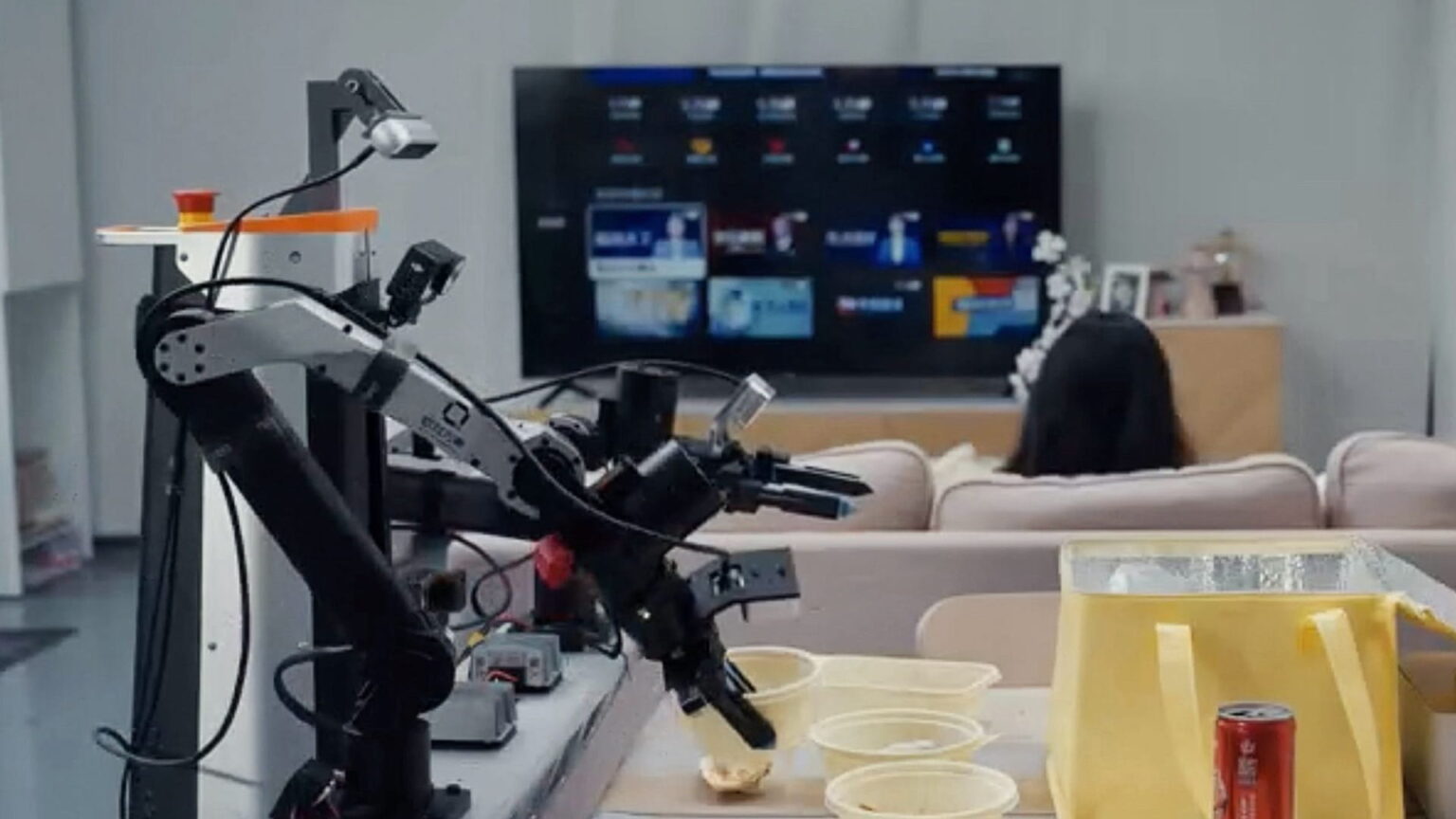
You and your dog settle onto the sofa while the robot picks up scattered toys. After dinner, you ask it to clear the table and lie back down. The robot gathers the takeout containers and puts them into a bag.
These scenes appear in the latest demonstrations from home robotics startup Ola Dimensions, which recently announced its fourth nine-figure RMB funding round, roughly six months after its founding.
Household chores are frequent, creating a potential market for domestic robots. But homes vary considerably, and few robotics companies have demonstrated that their products can handle such diversity reliably. Even a seemingly simple chore requires a sequence of judgments, adjustments, and actions.
Accurate movements alone are not enough. A home robot must also adapt to its surroundings and users. Should it rely on skills acquired before delivery, or continue learning as it is used?
Ola Dimensions is pursuing the latter approach. CEO Zhou Shunbo said the company has focused on developing robots that can acquire new abilities rather than equipping them with every skill before delivery. The goal is for robots to learn from user demonstrations, identify shortcomings through repeated attempts, and improve through a system designed for continuous learning.
Understanding household tasks
Even opening a door can be difficult for a robot. A bedroom door might require turning a handle, a balcony door might slide sideways, and a wardrobe door might open with a push.
Everyday routines require understanding, judgment, action, and adaptation, with people themselves introducing considerable variability. “The diversity of homes and the needs of different users multiply each other, making tasks extremely complex for household robots,” Zhou said.
Ola Dimensions began by identifying recurring household needs that current technology might be able to address, then selected its initial test scenarios. Safety, privacy, and reliability over extended use will also influence which functions are ready for deployment.
The company said it collected more than 1,000 valid responses to detailed questionnaires distributed through robotics communities in China and overseas. Each took nearly 15 minutes to complete, covering household habits, troublesome chores, and details such as whether door thresholds exceeded three centimeters.
The responses helped the company identify tasks for which users wanted assistance. One was keeping tables tidy.
“People hire a cleaner periodically to clean the whole home, but a tabletop may go from tidy to messy every day. It is hard to justify repeatedly hiring someone just to tidy a table.”
Laundry revealed another distinction. While robotics companies often emphasize folding clothes, many respondents were more concerned about having to wait for washing and drying cycles to finish.
“Many people work late and only get home afterward. They worry that leaving washed clothes in the machine overnight without hanging them up promptly will make them smell, so they cannot sleep soundly until the washing is done.”
These findings helped shape Ola Dimensions’ latest demonstrations.
Putting away shoes, for example, requires a robot to identify each shoe, determine its position, approach it, grasp it, and put it away. The robot must also locate the shoe cabinet, select a suitable storage position, and coordinate movements between its mobile base and arms.
Movement and manipulation must work together. As the robot approaches a shoe, it needs to determine whether its arm can reach the object. If their relative positions change during grasping, the robot must adjust its body and hand movements accordingly.
Ola Dimensions is developing what it calls an “action-native foundation model” to coordinate movement and object manipulation within a single model. The aim is to prevent situations in which a robot successfully reaches an object but cannot manipulate it.
Another demonstration showed the robot collecting scattered toys in a living room, adjusting its movements as the toys changed position. It had to locate each toy, approach it, grasp it, and carry it to a storage basket. Throughout the task, the robot needed to continually update its understanding of the environment and adjust its movements.
Clearing a table presents a different challenge. When someone asks a robot to “tidy the table,” the instruction usually does not mean removing everything. Some objects should be discarded, while others should be kept and returned to appropriate places.
The company described two components behind such decisions.
During pretraining, the model develops an understanding of objects and their context, including whether they should be kept or discarded. Object detection and annotated examples provide additional information, such as identifying used takeout containers as items to throw away.
A separate software layer, described as an agentic operating system, handles higher-level planning. It connects to a general-purpose artificial intelligence model and uses other detection models to identify objects. The system then combines that information into a plan for Ola Dimensions’ robotics model to execute.
These demonstrations are intended to test whether the robot can complete multistep tasks as objects move, conditions change, and instructions leave room for interpretation.
Teaching robots new skills
Another demonstration showed a person wearing a data capture headband while feeding a dog. The recorded actions were used to train the robot to perform the corresponding task.
Teaching a robot through human demonstrations involves more than supplying video recordings.
The captured images must first be corrected for lens distortion, which could affect estimates of object positions and movements. Information about the person’s body that is unrelated to the task is removed, and the recorded actions are converted into movements the robot can execute.
The technical team said errors in positional mapping can be kept below one millimeter. The processed data is then used to train the model before the robot attempts the task.
Under the company’s proposed approach, users would define a task at home and provide several dozen demonstrations, depending on its complexity. The system would then handle data processing, model training, and deployment automatically.
In tests involving some relatively simple tasks, users spent approximately ten to 20 minutes collecting data, while the entire process took about six hours. Those results suggest that a robot could potentially learn and attempt a new task on the same day, although more complex tasks may require additional training.
Ola Dimensions’ technical team aims to reduce the barriers to teaching robots new skills, including the amount of training data required. Rather than memorizing fixed movements, the robots are designed to learn the intent behind tasks, interactions between objects, and the physical principles governing those interactions.
Such capabilities could be particularly useful for requests that are difficult to anticipate during product development.
“Almost no two homes are exactly alike, and factory-installed functions cannot easily cover every need. We therefore hope the robot can collect some data after entering a home and develop characteristics specific to that household,” the team said.
One survey respondent, for example, wanted a robot to tap a wooden fish, a wooden percussion instrument, because its sound helped them stay calm while working from home.
That request would be difficult to anticipate as a standard feature. Fulfilling it could provide comfort as well as practical assistance, potentially strengthening the user’s connection with the robot.
Ola Dimensions hopes its tools will eventually allow users to train small policy models from scratch. These models would translate individual requests into skills that a robot could learn and execute.
For now, the demonstrations cover selected tasks identified through user research. More scenarios remain in development, and the robot’s ability to perform chores safely and consistently still requires extended testing in real homes.
Learning a task is also only part of the challenge. Once a robot begins performing it, repeated use can expose weaknesses that were not apparent during training.
Ola Dimensions is developing a process it has termed real-world recursive self-improvement (RSI), intended to help robots identify and address those weaknesses.
The technical team used putting away shoes as an example. A robot might successfully pick up a shoe but fail to place it in the intended position inside a storage bin.
Under a conventional development process, engineers would diagnose the failure, determine what additional data was needed, and retrain the model. Repeating those steps manually across numerous tasks could slow the development of new capabilities.
Ola Dimensions aims to automate more of that process.
According to the team, the system can analyze task outcomes, observations, and evaluation feedback to identify potential causes of failure. Drawing on knowledge incorporated from algorithm engineers, it assesses whether a misplaced shoe resulted from inaccurate spatial judgment, poor mobile base control, or insufficient coordination between the robot’s arms.
It then determines what additional training data could address the problem. A localization error, for example, might require observations captured from different viewpoints.
“We supplement the prior information needed for the next round through data collection or synthesis and conversion, then retrain the model,” the team said.
The team said RSI is being integrated into data processing, model training, evaluation, and deployment. Since training its first model in August, Ola Dimensions has released two versions evaluated on the RoboTwin 2.0 robot manipulation simulation benchmark. Both achieved state-of-the-art results, according to the team.
The broader objective is not simply to make model training more efficient. Ola Dimensions wants to connect its foundation model, data and training infrastructure, evaluation system, and robot hardware so that failures, anomalies, and capability gaps identified during tasks can inform subsequent improvements.
Those findings would guide adjustments to the model, supporting software, or hardware, followed by further evaluation.
The company said a single large-scale ablation experiment, which tests the contribution of individual model components, used 64 graphics processing units (GPUs) for approximately 2.5 days, equivalent to about 3,800 GPU-hours.
It also reported that improvements to its training and experimentation processes had increased model iteration efficiency by approximately two to four times, while its algorithm engineering team remained roughly the same size.
The household task demonstrations used the foundation model developed through this process.
Starting with early adopters
Robotics companies are taking different approaches to the home market. Some are adding capabilities to established, single-purpose products. Others are developing humanoid robots, betting that a humanlike form will be better suited to living spaces designed around people.
Both approaches face similar commercial questions: Can the robots perform useful tasks reliably, with minimal human intervention, at a price consumers are willing to pay?
Zhou has spent more than a decade in robotics. He earned a doctorate from the Chinese University of Hong Kong, worked on embodied intelligence at Huawei, and later founded a home robotics company.
Given the current maturity of robotics hardware and AI models, he does not expect products suitable for ordinary consumers to become available in the near term.
Ola Dimensions is therefore targeting makers first, focusing on people willing to experiment with new technology and who possess some practical technical skills. Their feedback could help the company identify which capabilities work, where the robots fall short, and what needs to improve before broader adoption.
The longer-term goal is to make robots easier to use while allowing more people to help shape their capabilities. Zhou said that objective informs both the company’s product concept and its approach to developing robots that can be taught new skills over time.
Ola Dimensions plans to deploy a small number of robots in homes in the first quarter of 2027. Rather than mass producing an early version and selling it at a low price, Zhou believes the company should focus on improving functionality through repeated testing.
The robots are expected to remain in those homes for extended periods, allowing Ola Dimensions to collect sustained user feedback and refine its foundation model and RSI system.
KrASIA features translated and adapted content that was originally published by 36Kr. This article was written by Xiao Xi for 36Kr.