

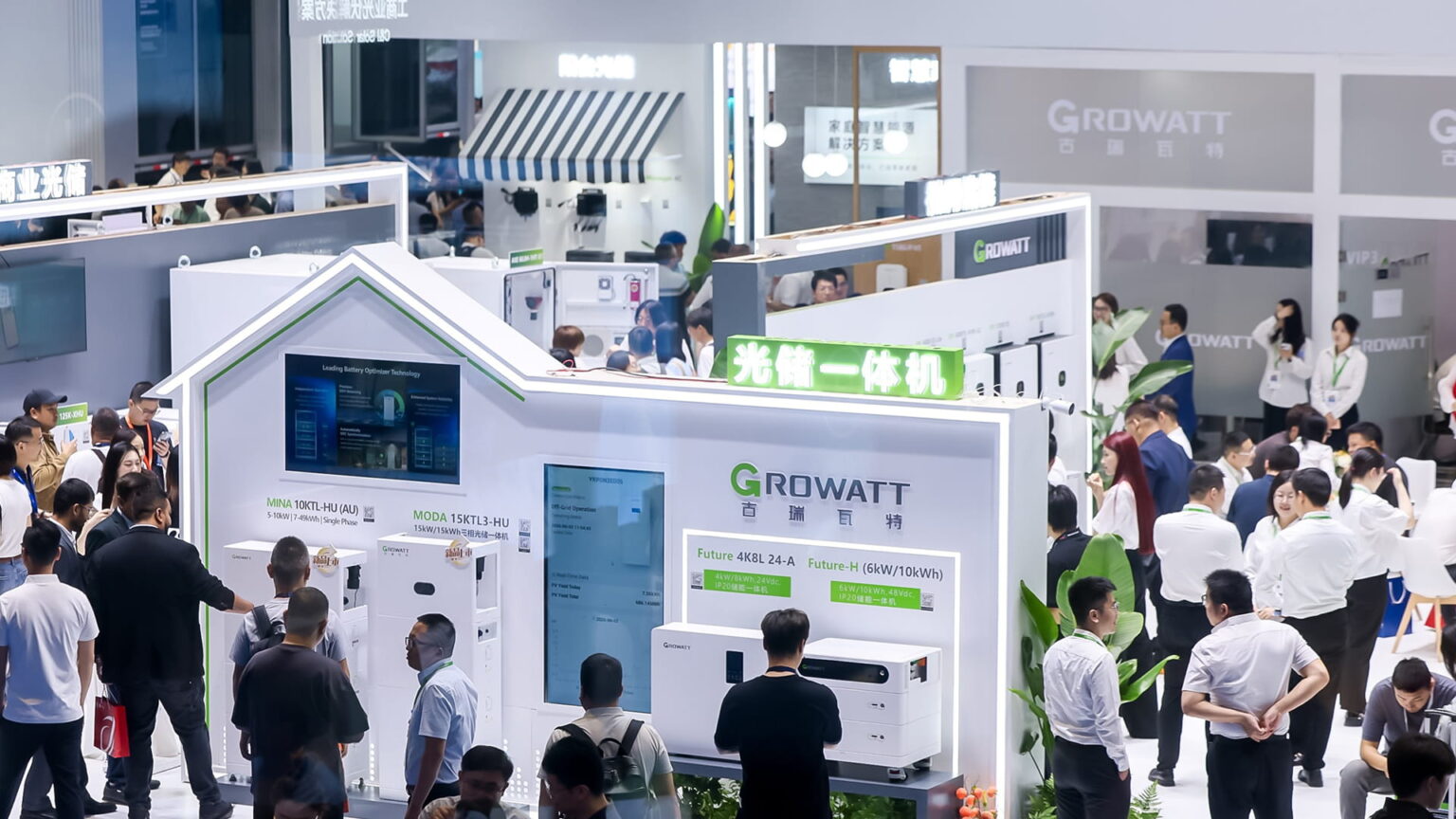
In June, Growatt submitted its prospectus to the Hong Kong Stock Exchange for the third time. Its IPO process has been prolonged. It first filed in June 2022 and passed its listing hearing, but did not proceed with bookbuilding. It filed again in March 2023, only to postpone the listing once more. By the time of its latest filing, its sponsors had changed from Credit Suisse and CICC to Huatai International.
As early as 2017, Growatt’s predecessor company had planned to pursue a listing on the Shenzhen Stock Exchange and completed its listing counseling filing in November that year. But the prospectus notes that the filing did not constitute a listing application to the China Securities Regulatory Commission. The filing was ultimately terminated in September 2021, after which Growatt shifted its focus to Hong Kong.
According to third-party data disclosed in Growatt’s prospectus, the company was the world’s third largest provider of residential energy storage inverters by shipments in 2025, with a 10.2% market share. It was also the largest provider of residential energy storage inverters in the Americas, with a 14.7% share. As of the end of 2025, its sales network covered about 190 countries and regions, and its artificial intelligence-enabled energy management system connected about 4.2 million residential, commercial, and industrial end users.
Growatt mainly provides photovoltaic (PV) inverters and energy storage systems. In plain terms, it turns solar energy into usable electricity and stores excess power. According to its prospectus, Growatt’s net profit has fluctuated sharply over the past three years, falling from RMB 843.3 million (USD 124 million) to about RMB 20 million (USD 2.9 million) before rebounding to RMB 413 million (USD 60.7 million).
Energy storage overtakes PV inverters
Based on Growatt’s financial statements, its profit for 2023, 2024, and 2025 was RMB 843.3 million, RMB 19.9 million (USD 2.9 million), and RMB 413 million, respectively. Its net profit margin fell from 15.7% to 0.4%, then recovered to 7.9%. The reasons behind that volatility are worth examining.
The clearest starting point is 2024, Growatt’s operating trough. In addition to a net profit margin of just 0.4%, its adjusted net profit was only RMB 49 million (USD 7.2 million). Its operating profit margin fell from 9.9% in 2023 to 1.2%. The reason was straightforward: Europe’s energy crisis faded, and demand normalized. Growatt’s shipments fell while the company cut prices and ran promotions to clear inventory, dragging its gross margin down from 26.3% to 20.3%.
In 2025, as energy storage demand recovered, Growatt’s operating profit margin returned to 9.9%, and its adjusted net profit reached RMB 483 million (USD 71 million).
Second, Growatt’s RMB 843.3 million profit in 2023 included a RMB 360 million (USD 52.9 million) fair value gain on financial instruments issued to investors. In 2022, Growatt issued Series A convertible preferred shares to pre-IPO investors. Under accounting rules, before listing, these preferred shares must be treated as financial liabilities measured at fair value, with changes in valuation recognized in profit or loss for the period.
Growatt recorded a RMB 362 million (USD 53.2 million) gain in 2023 because the fair value of those preferred shares declined that year. In other words, as capital markets derated the solar sector in 2023, the company’s implied valuation fell, creating an accounting profit on paper. Excluding this noncash, nonoperating item, and adding back share-based payments, Growatt’s adjusted net profit in 2023 was RMB 500 million (USD 73.5 million), nearly 40% lower than its reported RMB 843.3 million profit.
When assessing the underlying profitability of a hardware company, operating profit is often more useful than net profit.
Growatt’s net cash generated from operating activities in 2023, 2024, and 2025 was RMB 193 million (USD 28.4 million), RMB 1.06 billion (USD 155.8 million), and RMB 1.38 billion (USD 202.9 million), respectively, rising each year. It also diverged significantly from net profit. In 2024, net profit was only RMB 19.9 million, but operating cash flow reached RMB 1.06 billion, as destocking released a large amount of cash. In 2025, operating cash flow was RMB 1.38 billion, far above net profit of RMB 413 million.
As of the end of 2025, the company held RMB 2.28 billion (USD 335.2 million) in cash and cash equivalents, and its debt-to-asset ratio was only 9.2%. Its bank borrowing rates over the past three years ranged from 0.72% to 3.85%, and as of April 30, it still had RMB 958 million (USD 140.8 million) in unused bank credit facilities. Inventory turnover days fell from 217 to 136, while trade receivables turnover days dropped from 87 to 58. Collections accelerated, and inventory levels improved.
Unlike many growth-oriented companies that go public while burning cash, Growatt is profitable, holds ample cash, and relies little on leverage.
Growatt went through this earnings swing because its revenue mix changed quickly. PV inverters, its old core business, lost momentum, while energy storage became the main growth driver. Growatt’s revenue comes from four segments: energy storage system products, PV inverters, AI-enabled energy management systems, and other accessories. Over the past three years, the first two segments underwent a clear handoff.
Revenue from energy storage system products fell from RMB 2.08 billion (USD 305.8 million) in 2023, or 38.8% of total revenue, to RMB 1.67 billion (USD 245.5 million) in 2024, or 37.2%. It then jumped 99% to RMB 3.32 billion (USD 488.1 million) in 2025, lifting its revenue share to 63.4%.
Revenue from PV inverters fell from RMB 2.96 billion (USD 435.2 million) in 2023, or 55.1% of total revenue, to RMB 2.59 billion (USD 380.8 million) in 2024, or 57.7%. It then dropped to RMB 1.56 billion (USD 229.4 million) in 2025, shrinking the segment’s revenue share to 29.8%.
As one segment rose and the other declined, Growatt changed from a company centered on PV inverters into one led by energy storage systems. That shift also reflects a broader industry trend. In mature markets with higher gross margins, demand is moving from standalone solar power generation to integrated solar-plus-storage solutions.
The unit economics help explain the transition. In 2025, batteries in the energy storage systems segment had a gross margin of 32.6%, while energy storage inverters had a gross margin of 24.2%. By comparison, residential PV inverters had a gross margin of only 14.5%. Growatt’s AI-enabled energy management system had a high gross margin of 32.4%, but it accounted for just 1.2% of revenue, or RMB 60.7 million (USD 8.9 million). The AI business has yet to become a meaningful revenue contributor, though Growatt’s 4.2 million end users provide a foundation for future monetization.
Overall, the rising share of energy storage lifted the company’s consolidated gross margin from 20.3% in 2024 to 22.5% in 2025. Energy storage is now carrying more of Growatt’s growth.
By region, Europe has receded, while the US has surged to 15.8% of revenue. Europe was once Growatt’s main market, contributing 44.7% of revenue in 2023. But after the energy crisis faded, its share declined steadily to 32.4% in 2025, though revenue in absolute terms recovered to RMB 1.7 billion (USD 249.9 million) that year.
The sharper shift was in the Americas. The region’s revenue share rose from 15.6% in 2023 to 25.6% in 2025. Within that, the US market grew from RMB 65.4 million (USD 9.6 million) in 2023, or 1.2% of revenue, to RMB 828 million (USD 121.7 million) in 2025, or 15.8% of revenue. That was a more than tenfold increase in two years, and the US gross margin was as high as 29.7%.
This steep US growth curve was one of the main drivers of Growatt’s performance recovery in 2025. It is also one of the company’s largest risk exposures. In the risk factors section, Growatt’s prospectus repeatedly mentions trade restrictions, tariffs, and geopolitical tensions that could affect global supply chains or cross-border trade in energy storage system products.
Growatt’s hedge is production base diversification. In addition to its main base in Huizhou, Guangdong, it has built an overseas factory in Haiphong, Vietnam, that mainly produces PV inverters and was established in 2022. The company also plans to allocate a sizable portion of its IPO proceeds to the expansion of the Vietnam factory, which is scheduled for completion in 2029, as well as to semiconductor procurement reserves. Moving part of its production to Vietnam is about lowering costs, but it also gives Growatt some protection against tariffs and geopolitical risk.
Growatt’s revenue share from its five largest customers rose from 16.6% in 2023 to 23.6% in 2025, while the share from its largest customer rose from 6.6% to 13%. The surge in US orders has also brought the risk of rising customer concentration.
HongShan exits before listing, while IDG stays
Sixteen years ago, Growatt began with a Wenzhou network. Its predecessor company was established in May 2010. Among its initial shareholders, Ding Yongqiang held 39%, while the rest were Wenzhou-linked enterprises and individuals, including Korlen Electric Appliances, Haibo, and Carspa New Energy. A year later, the Wenzhou shareholders exited one after another and transferred their equity to Ding, lifting his stake to 72.8%.
The first major institutional investor was HongShan. In February 2012, SCC Venture, an investment vehicle under HongShan, subscribed for newly increased registered capital in the predecessor company for RMB 31.7 million (USD 4.7 million). China Merchants Group, Sunac, Lanqiao, and others later invested as well. But one of the more notable moves came before the planned listing. In January 2021, SCC Venture transferred the 18.35% registered capital it held in the predecessor company to the company’s employee shareholding platform for about RMB 275 million (USD 40.4 million), fully exiting the company. From RMB 31.7 million to RMB 275 million, HongShan made about 8.7 times its investment over eight years. But it chose to cash out before the IPO rather than remain a shareholder through the listing.
Growatt’s only external institutional equity financing round was its Series A preferred share financing. In June 2022, Bateson Group and Best Select subscribed for Series A convertible preferred shares worth RMB 400 million (USD 58.8 million) and RMB 500 million, respectively, totaling RMB 900 million (USD 132.3 million). The cost per share was about RMB 10.09 (USD 1.5), and the transaction was settled by the end of June 2022.
The layered partnership structures behind the two companies show that Bateson and Best Select ultimately point to Li Jianguang, Niu Kuiguang, Wang Jingbo, and Hexie Shuangma, the Shanghai-listed platform they control. In other words, they are part of the IDG Capital network. In November 2025, another secondary share transfer took place. Best Select and Champ, both IDG-linked entities, acquired some existing shares from several employee and family shareholding platforms, raising the IDG network’s total stake to about 10.42%.
In this IPO, HongShan was the earliest major institutional investor and exited before listing. IDG placed a RMB 900 million bet and remains the only external institutional investor still holding a sizable stake ahead of the IPO. Based on a cost of RMB 10.09 per share and Series A preferred shares accounting for about 6.52% of total share capital, Growatt’s post-money valuation in mid-2022 was about RMB 13.8 billion (USD 2 billion).
Notably, under the relevant agreements, the Series A preferred shareholders will not be subject to any lockup restrictions after listing.
Growatt’s core team is rooted in Huazhong University of Science and Technology and Santak.
Founder Ding Yongqiang, 46, holds a bachelor’s degree in electronic technology and applications and a master’s degree in electrical and electronic engineering from Huazhong University of Science and Technology. He currently serves as co-chair of the residential PV special committee of the China Photovoltaic Industry Association. From 2005 to 2009, he worked at Santak, an established power electronics manufacturer that started out in uninterruptible power supply systems.
CFO Wang Qingyuan graduated from Harbin Institute of Technology with a degree in electrical engineering and worked as a senior engineer at Santak from 2007 to 2010. Zhang Lixia, vice president of marketing and customer service, graduated from Nanjing University of Aeronautics and Astronautics and worked at Santak from 2006 to 2011. Wu Liangcai, vice president of R&D, graduated from Chongqing University with a degree in electrical engineering and worked at Santak from 2005 to 2008.
Growatt’s competitors include Sungrow, Huawei, BYD, and Deye. Its valuation will depend on whether energy storage can sustain high growth, whether its AI-enabled energy management system can generate meaningful revenue, whether European demand can stabilize, and whether US growth can withstand tariffs and trade restrictions.
KrASIA features translated and adapted content that was originally published by 36Kr. This article was written by Peng Xiaoqiu for 36Kr.
Note: RMB figures are converted to USD at rates of RMB 6.80 = USD 1 based on estimates as of July 7, 2026, unless otherwise stated. USD conversions are presented for ease of reference and may not fully match prevailing exchange rates.