



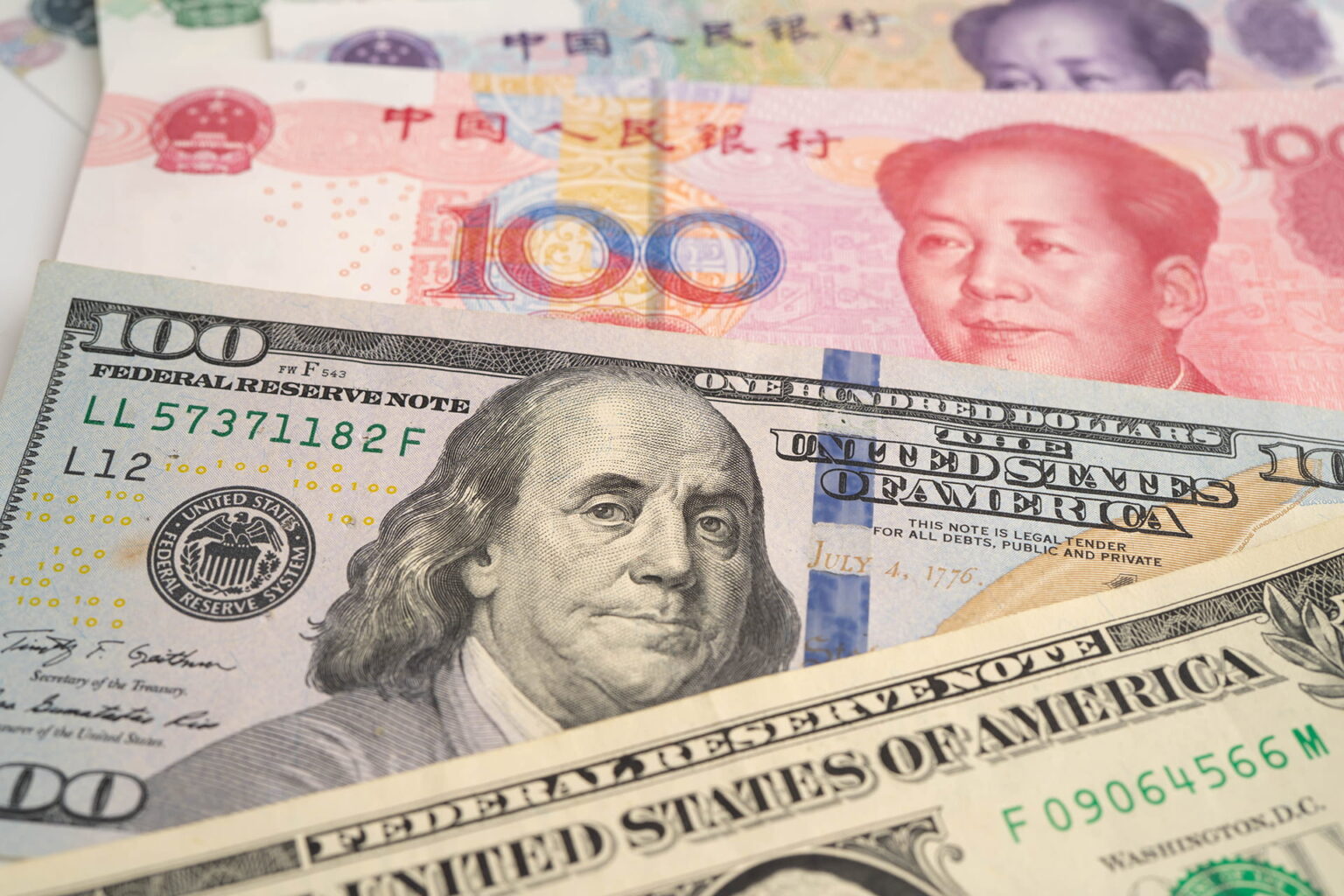
The yield difference between Chinese government bonds and US Treasurys has widened to historic levels, cementing a divergence between two of the world’s largest bond markets.
According to data from Quick FactSet, the spread between ten-year Chinese government bonds and ten-year US treasuries is near its widest gap since 2006. On September 2, it briefly hit about 313 basis points, or 3.13%, before retreating the day after following dovish comments from the Fed, which sent the latter rallying.
Last week, US Treasury yields hit their highest level since 2023 after a selloff driven by investor concerns over record government debt, rising inflation, and the prolonged US war in Iran. They settled at around 4.765% as of September 4. At the same time, yields on ten-year Chinese government bonds dropped to their lowest level in over a year, weighed down by weak growth and tepid consumer demand.
This makes China’s bond market an outlier amid a selloff that is affecting every G7 country, including Japan, the bloc’s only Asian member. The yield on benchmark ten-year Japanese government bonds briefly breached 3% on September 1, its highest mark in three decades.
“The widening yield gap reflects increasingly divergent macro and policy cycles,” said Wee Khoon Chong, senior APAC market strategist at BNY. For treasuries, “persistent inflation, rising commodity prices, fiscal concerns and heavy government and corporate issuance” have led to yields spiking. By contrast, Chinese government bond yields declined “amid weak domestic demand, lingering disinflation and greater demand for defensive assets.”
The disconnect in Chinese government bond performance reflects investor concerns about challenges to the domestic economy. China’s economic growth slowed to 4.3% in the second quarter, with the government’s top officials pledging additional support and accelerated fiscal spending. Despite exports reaching record levels, domestic demand is being dampened by poor consumer sentiment.
“We expect the yield differential to remain wide, particularly at the long end, as the US yield curve continues to steepen while Chinese rates remain relatively flat amid ongoing demand for yield,” said Lei Zhu, head of Asian fixed income at Fidelity International.
Zhu highlighted monetary policy, inflation and GDP growth in both economies as key factors to watch, and noted the spread could narrow if US-China relations improve.
Contrary to the conventional belief that investors are drawn to higher yields, there have been recent signs of renewed investor interest in Chinese government bonds. Foreign holdings logged positive growth for the third month in a row in July, after global investors reduced their exposure for 13 straight months.
“CGBs have been relatively resilient during the global bond selloff, delivering attractive risk-adjusted returns and meaningful portfolio diversification,” BNY’s Chong said. “Their low correlation with other major bond markets has become particularly valuable during a period of rising global yields.”
Meanwhile, the Chinese yuan has been on a rally since the beginning of 2025, having gained nearly 9% against the dollar. If the appreciation continues, it could partly offset the negative impact from the widening China-US yield gap, per analysts.
The market consensus is that the yuan remains largely undervalued, given China’s massive trade surplus, around 1% of global GDP, according to Goldman Sachs. Beijing could tolerate a gradual appreciation of the currency, the American investment bank said. And there could be upside to that. A stronger yuan might temper trading partners’ complaints about an undervalued currency giving Chinese exports a competitive edge. Beijing, however, would like to protect that edge, making it reluctant to give free rein to yuan’s appreciation.
“From the perspective of RMB internationalization, appreciation—if market participants expect it to continue—helps offset the negative rate differential vs the US and would make RMB-denominated fixed income assets more attractive to hold,” according to a September 2 note by Goldman Sachs.
The yuan is also called the renminbi, sometimes abbreviated to RMB.
Fidelity’s Zhu pointed out that as a result of the currency’s appreciation, total returns on Chinese government bonds have outperformed many G10 government bonds in dollar terms.
However, “currency appreciation alone is unlikely to drive sustained bond demand,” Chong cautioned. “Investors will still focus primarily on risk-adjusted returns, policy direction and confidence in China’s economic outlook. Renminbi strength is supportive, but it is not a substitute for attractive underlying returns.”
China’s tight capital controls keep the yuan from freely moving around the world, preventing it from becoming a global funding currency like the Japanese yen. Liquidity tends to stay within the Chinese financial system and, coupled with a lack of high-yielding investment options, creates sufficient demand for government bonds, viewed as a haven asset.
After lagging last year’s pace, government bond issuance has picked up recently: As of the end of August, 61% of this year’s total government bond quota had been issued, up from 56% a week earlier, according to an August 30 note by Goldman.
There is further support from global investors, Fidelity said, as they “look to diversify away from USD assets amid concerns over rising US fiscal deficits and Treasury supply,” and Chinese government bonds are “increasingly viewed as one of the credible alternative reserve assets.”
This article first appeared on Nikkei Asia. It has been republished here as part of 36Kr’s ongoing partnership with Nikkei.
Note: RMB figures are converted to USD at rates of RMB 6.73 = USD 1 based on estimates as of September 10, 2026, unless otherwise stated. USD conversions are presented for ease of reference and may not fully match prevailing exchange rates.