


Having claimed 20% of Thailand’s automotive market by taking market share from Japanese rivals, BYD and its Chinese peers are now looking to learn from Toyota Motor for future growth as an intense price war creates a backlash among local consumers.
At the 42nd Thailand International Motor Expo last November, a Thai executive from a Chinese automobile brand told Nikkei the spread of Chinese cars over the past three years has “happened much faster than expected.”
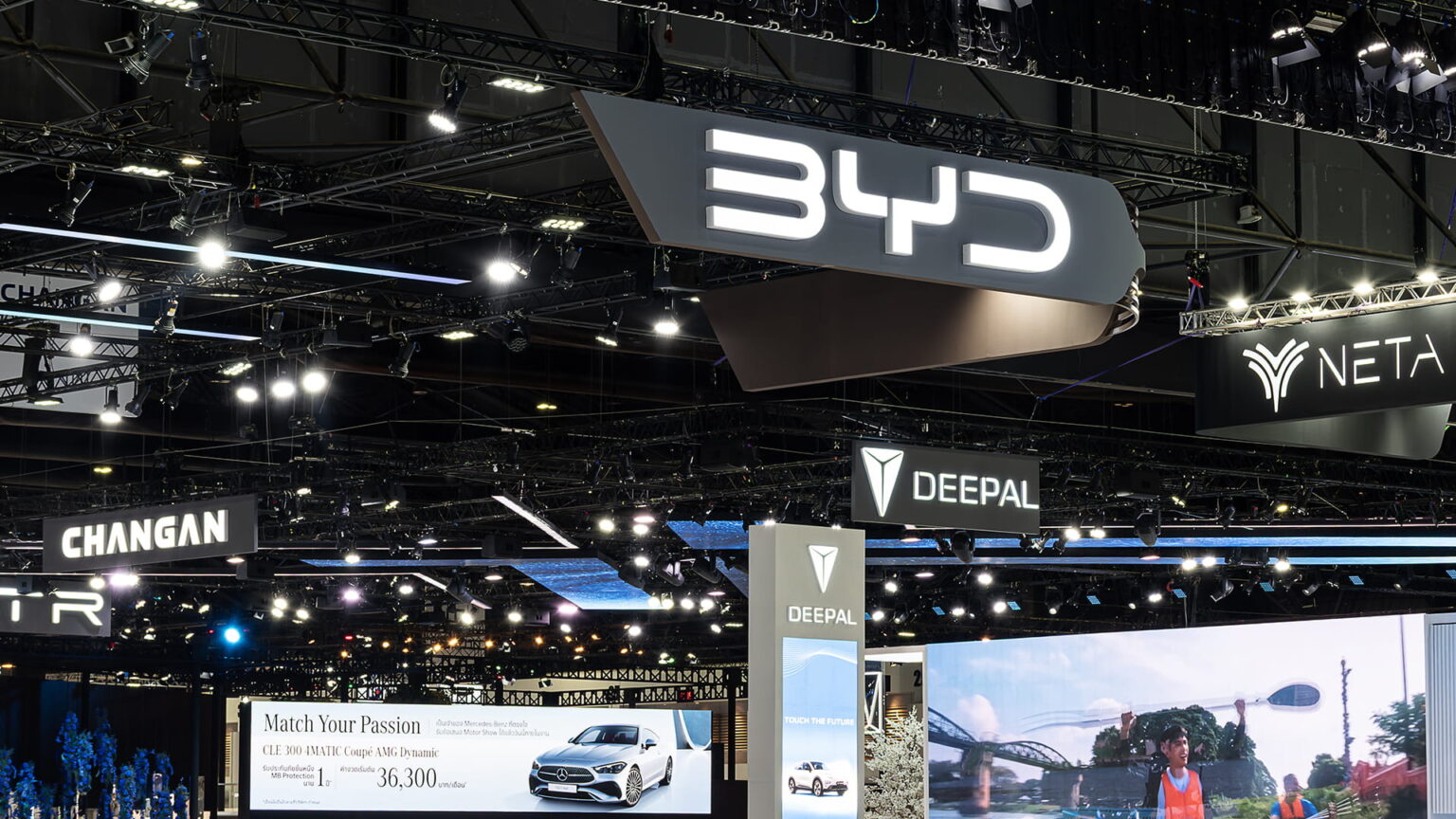
More than 20 Chinese automotive brands have entered the Thai market, including BYD, SAIC Motor’s MG, Great Wall Motor, Changan Automobile, and GAC Group. “Their success in Thailand has become an important experience for Chinese automakers as they expand overseas,” the executive said.
However, Chinese automaker executives share grave concerns about 2026 and beyond.
The Thai government will eliminate subsidies of up to THB 150,000 (USD 4,790) for electric vehicle purchases this year, and local production quotas required to receive subsidies for EV makers will become even stricter.
This year “will be a real test of whether our products will be accepted in the Thai market even without price cuts,” the executive said.
This executive and others from Chinese automakers told Nikkei they were trying to craft Thailand strategies by learning from Toyota.
Great Wall Motor International’s president, Parker Shi, and Ke Yubin, general manager of BYD Thailand, both expressed their respect for Toyota, adding that they were closely watching its approach. Great Wall appointed Vudhigorn Suriyachantananont, former vice president of Toyota Motor Thailand, as vice president of marketing for the region in 2023.
Chinese automakers see Toyota’s trajectory in Thailand as an unrivaled success story.
Since 2023, when Chinese automakers intensified their offensive, Japanese automakers—which previously held nearly 90% of new vehicle sales in Thailand—have seen their market share fall to 69.3% for the full year of 2025, according to sales data compiled by Toyota Thailand.
From 2022, Isuzu Motors’ share fell 13 percentage points to 12%, Mitsubishi Motors’ share fell 1.7 points to 4.2% and Nissan Motor’s share fell 1.2 points to 1.5%.
Amid the headwinds facing Japanese automakers, Toyota has actually held its ground. Its share in 2025 was 37%, up three points from 2022. Over a medium-term span of around ten years, its market share has been growing.
As household debt ratios in Thailand remain high and the rejection rate for car loans is on the rise, Toyota has responded by expanding its lineup of cheaper hybrid vehicles and increasing the number of affordable pickup models. Its number of dealerships has remained roughly flat at around 450.
“We are interested in how Toyota has been accepted in Thailand over the past 60 years or so,” said the Chinese automaker executive interviewed by Nikkei.
The executive specifically mentioned the boycott that Toyota faced in Thailand in the early 1970s, as consumers responded to the rapid growth of Japanese imports.
At a 2022 ceremony marking the 60th anniversary of the establishment of Toyota’s Thai subsidiary, then-President Akio Toyoda shared an anecdote to show Toyota’s efforts at the time.
“[Former Toyota USA chairman] Yuki Togo, a personal hero of mine, was in charge of Toyota Motor Thailand, and he decided to take a rather unusual approach to show our loyalty to Thailand,” Toyoda said. “He actually shaved his head, went to a temple, and became a Buddhist monk! I’m not sure I would have been brave enough to do the same, but his efforts to understand the culture of Thailand better helped reduce opposition to Toyota.”
“Showing our respect and gratitude to the country of Thailand remains our highest priority,” Toyoda added.
According to a 2006 case study of Toyota Thailand by Waseda University professor emeritus Nobuo Kawabe, local Toyota dealers and others contributed to the Thai subsidiary’s capital in 1974 following the boycott. Then in 1975, Toyota established a facility to begin training technicians. Both steps led to localization.
Chinese companies in today’s Thai market are facing a similar situation.
Having lost export markets due to US-China trade tensions and other factors, Chinese companies have expanded exports to Thailand, lifting their market share but also earning the resentment of Thai people due to their price warfare.
Class action lawsuits have been considered against BYD, which is leading the price cuts, amid fears such reductions will lower car resale values for current owners. Meanwhile, fellow Chinese automaker Hozon Auto’s Neta EV brand, which was popular in Thailand, is facing financial trouble, making replacement parts scarce. The Thai government is poised to take legal action as the company is also not fulfilling its local production requirements.
One strategy that Chinese companies are learning from Toyota is to develop Thailand into an export hub. The country is already a mature market within Southeast Asia, making significant growth inside the nation unlikely.
Toyota produces vehicles for emerging markets in Thailand and exports many of them. BYD began exporting to Europe from Thailand last August, while Changan began exporting sport utility vehicles to Europe in December. Great Wall and others are looking to follow suit.
Local sourcing of parts is also an important part of Toyota’s strategy. For key models like pickup trucks, it has achieved a 90% local content rate, contributing to local employment. Changan and other companies plan to cooperate with the Thai government to expand procurement agreements with local parts manufacturers.
Furthermore, just as Toyota moved into the education sector with its Toyota Automotive Technological College in Thailand, China’s SAIC opened an educational facility in mid-January to promote education and research on new energy vehicle technology. The company will dispatch employees to the facility, located on the campus of the Assumption University of Thailand, to foster workers with specialized knowledge.
Thailand’s new vehicle market grew for the first time in three years in 2025, increasing 9% from 2024 to about 620,000 units. The country’s market has shrunk in recent years to a level smaller than that of Indonesia and Malaysia.
The Thai market is expected to grow to 930,000 units by 2035, up 50% from 2025, according to British research firm GlobalData. But the country’s economic growth rate remains the lowest in Southeast Asia, leaving the outlook uncertain.
By powertrain, EVs, a specialty of Chinese automakers, accounted for 19% of the market in 2025 and are expected to account for 28% by 2035. Hybrid models, a strength of Japanese automakers, are expected to rise from 24% to 32% over the same period.
While the Thai market itself is not large, as an export base for neighboring countries, trends there could determine the future of electrification in Southeast Asia.
This article first appeared on Nikkei Asia. It has been republished here as part of 36Kr’s ongoing partnership with Nikkei.