


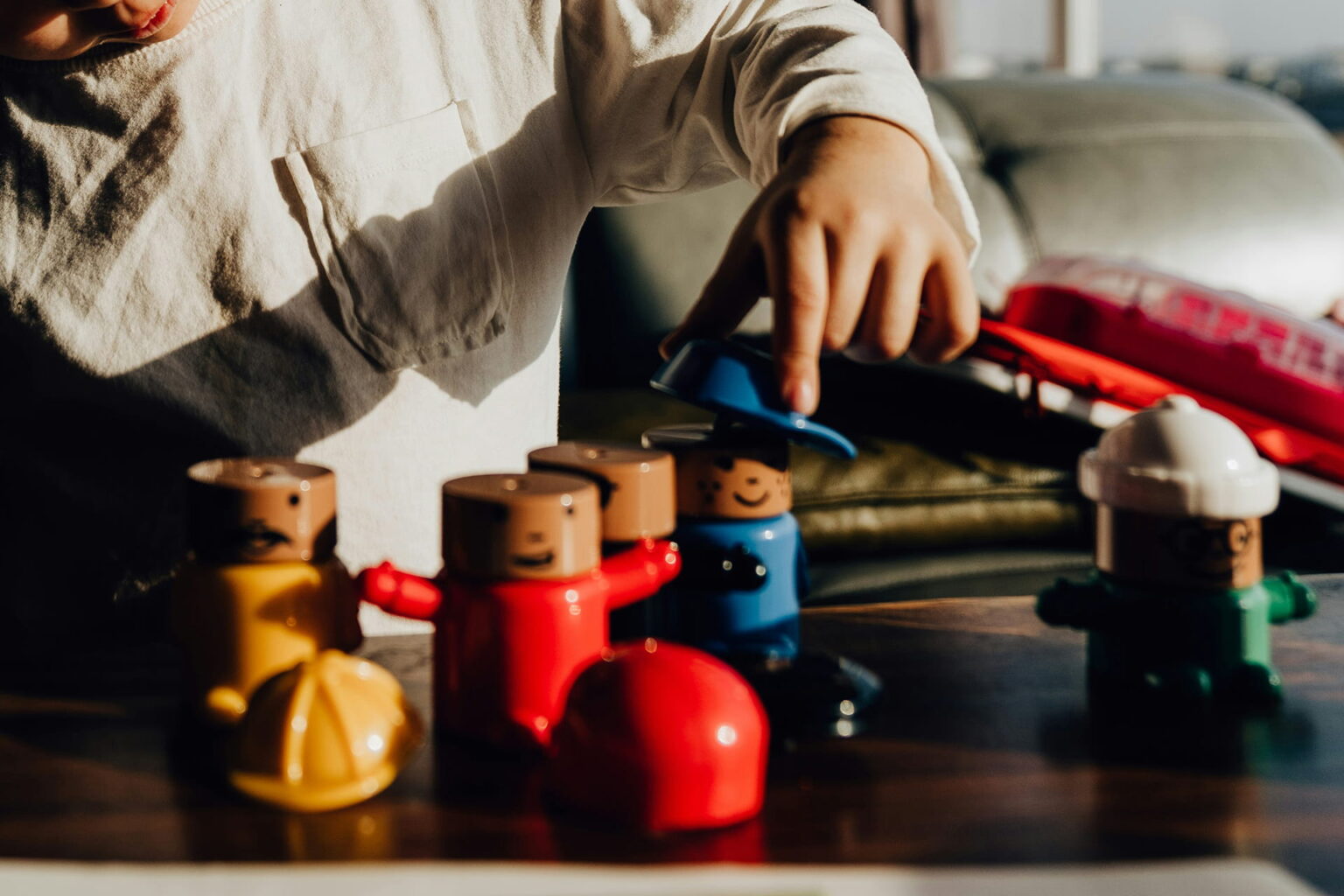
Huanhuan sits on a small stool while her therapist holds up a succession of cards. One shows a red apple, another a Red Delicious. Then come an apple cut in half, one with a bite missing, and a line drawing. Can the four-and-a-half-year-old recognize an apple in each picture? The therapist records a plus for a correct answer and a minus for an incorrect one.
Many children learn to recognize the same thing in different forms through everyday experience. Some autistic children may need more than a hundred repetitions. In a 30-minute session, Huanhuan’s therapist takes her through at least 30 exchanges. According to her mother, Huanhuan attends seven sessions a day, five days a week, with few long breaks during the year. Each exchange produces a record of what the therapist asked, how the child responded, and what feedback she received.
Therapists once used those records mainly to judge how a lesson had gone. Now, companies are using them to train artificial intelligence systems that help plan the next one.
“We wanted to turn scarce supervisory expertise into a product and make it available at scale,” said Wang Zhanwei, vice president of R&D at Dami & Xiaomi, a provider of services for children with additional support needs. By the second half of 2023, the arrival of foundation models had made it feasible to train a system on the company’s therapy records and use it for assessments, scheduling, and lesson planning, Wang said. Dami & Xiaomi worked with Amazon Web Services to develop a system now in use at nearly 100 company-operated centers and more than 300 partner institutions.
In Pingdingshan, a city in Henan, one center introduced AI in January. Six months later, its director, Song Wentao, said he had let the center’s outside part-time supervisor go. The system could take on some of the supervisor’s work at a lower cost.
Therapists work directly with children, usually following plans drawn up by supervisors. Supervisors assess each child and decide which interventions to use. It typically takes at least three to five years of frontline work for a therapist to qualify for that role.
What families in smaller cities can afford
After Huanhuan was diagnosed with autism at age three, her family considered sending her to Zhengzhou, the provincial capital, for therapy. “Even after health insurance reimburses us, it would cost more than RMB 10,000 (USD 1,500) a month,” her mother told 36Kr. In addition to lesson fees, the family would have to cover rent, transportation, and the cost of having someone stay with her full time.
Leading centers in Zhengzhou were also short of therapists and supervisors, her mother said. Huanhuan could get only three or four sessions a day. “We’d have to find a smaller center for extra classes, and each one costs RMB 300–400 (USD 44.9–59.9). I figured we couldn’t do it for less than RMB 30,000 (USD 4,490) a month.” The family chose to stay in Pingdingshan.
As screening reaches more children, more families are seeking services. Qi Yanjie, an associate chief physician in child psychiatry at Beijing Anding Hospital, described the change in a 2025 media interview. “Since our specialist autism clinic opened in 2019, visits have increased every year, from around 300 a year to a little over 3,000.”
In April, the Chinese Center for Disease Control and Prevention cited National Health Commission screening data putting autism prevalence among children in China at about seven per thousand. It estimated that more than 14 million people of all ages in the country are autistic.
Training experienced staff takes time. “A therapist sees an average of four to six children a day. A supervisor may oversee 50 or 60 cases,” said Zheng Tian, a senior supervisor at Dami & Xiaomi.
Before adopting AI, Song hired an outside board-certified behavior analyst (BCBA) to provide part-time supervision. He recalled paying more than RMB 100,000 (USD 15,000) a year for one or two online teaching sessions each month. The limited hours meant the supervisor could cover only so many cases and rarely follow an individual child’s progress closely enough, he said.
The technology also gave Song a new service to sell. In smaller cities such as Pingdingshan, he said, providers facing similar staffing constraints had largely competed by cutting prices. His center already offered sessions at RMB 40 (USD 6) and RMB 60 (USD 9). It added an AI-assisted option at RMB 80 (USD 12), which about 30% of parents have chosen.
Song’s business has grown to ten centers over the past two years. He plans to introduce AI supervision across them to help new therapists get started, standardize teaching, and make the quality of services more consistent.
For an operator, AI can lower costs and support a higher-priced service. For parents, the question is whether it helps their child. Dami & Xiaomi supplied 36Kr with a comparison involving 65 children at three outside institutions. After three months, the company reported greater progress in the AI-assisted group than in the standard intervention group across several areas, including social interaction, language and communication, cognition, and imitation.
From an assessment to the next lesson
A child’s first encounter with the system comes during an assessment. A hospital diagnosis identifies a condition. The center’s assessment asks what the child can already do, what is difficult, and why, so the therapist can plan the next intervention.
Zheng explained that a child who has yet to speak may have little inclination to communicate, have difficulty imitating mouth movements, or struggle to understand an instruction. Another child may understand perfectly well but have trouble expressing a response. Each possibility calls for a different approach.
Therapists used to spend weeks testing skills one by one. A supervisor would then analyze the behavioral data and write a report that could run to ten pages or more. Now, the therapist records the child’s responses on a tablet during the assessment. By the time it ends, the system has produced a draft for a supervisor to review and refine. The writing alone, which used to take at least three hours, can now take seconds.
Huanhuan’s mother said the assessment placed her daughter, then four and a half, at a developmental level corresponding to roughly three and a half. She understood that one-year gap as the ground they hoped therapy would help her cover.
Wang said the system starts with tasks appropriate for the child’s age and works downward, if necessary, to establish a baseline. The resulting assessment informs the child’s individualized education plan (IEP).
Researchers at US therapy technology company TheraDriver have explored a similar application. In 2024, they reported developing and testing a system using records from 617 autistic children aged 2–14, including assessments, diagnostic reports, and parent interviews. The system identified behaviors to address and skills to teach, then generated individual treatment plans. The researchers compared the wording of AI-generated plans with the original plans written by clinical supervisors for six randomly selected cases. They found a high degree of similarity.
An IEP can list dozens or even a hundred skills. Someone still has to decide what comes first, taking into account a child’s strengths, difficulties, and short- and long-term goals. As one interviewee said, “Even if a child comes in for three hours a day, five days a week, you can’t expect to work on all the dozens or even a hundred skills in the IEP at once. AI can tell you which ones to teach first and how many times a day it suggests practicing each one to help the child learn it as quickly as possible.”
A therapist enters the frequency and length of sessions into a chat interface, along with details about the child. Does the child like toy cars, blowing bubbles, being tickled, or being lifted into the air? Are there particular concerns the parents want to address? The system uses those details to draw up a plan.
Next come the teaching materials. A child may recognize an apple on a tree but struggle to recognize it once it has been picked. To test whether a child had grasped the concept, therapists used to search for different images, print them, cut them out, laminate them, and sort them. AI can now produce a range of examples on demand.
A general-purpose model can generate pictures of apples, too. The difference, according to Wang, is that Dami & Xiaomi’s system uses the child’s intervention history and a professional database to choose examples. If one visual change makes an apple suddenly unfamiliar, the system can suggest practice focused on that variation.
It can also create picture books using the child’s photograph and learning goals. For a child anxious about unfamiliar surroundings, a therapist can incorporate pictures of the center’s entrance, classroom, and restroom into a story before a visit. For a group session, the system can suggest games suited to the number of children, their abilities, and what they are practicing.
Therapy often continues for years. Small changes from one lesson to the next can be hard to spot. Over time, the records help the system suggest what to try next and give a new therapist a history to work from if a colleague leaves.
Parents can follow that record, too. After enrolling Huanhuan in AI-assisted classes late last year, her mother said the most immediate difference was that “the goals became clearer.” On a tablet, she could see, for example, that Huanhuan had reached 80% mastery on a task involving the Mandarin initial consonant “k.”
Who decides when a child is ready?
“AI can offer a wide range of interactive games and ideas for activities, which teachers can use to improve how they run a class,” Zheng said. In her experience, a carefully planned lesson from a skilled supervisor can be just as inventive and better suited to an unexpected turn in class. There is always a lag between what a child does and what the system knows. The therapist is there to respond and build the relationship that helps the child feel more comfortable with other people.
Less paperwork can give a supervisor more time to sit with a child who is struggling in class, coach a therapist in person, or reassure a parent worried about a recent lack of visible progress.
The usefulness of the software depends on how well therapists document each session. When training staff at smaller centers, Zheng found that many had never recorded every exchange. Even after a center installed the system, gaps in the record could leave it working with an increasingly incomplete picture of the child.
Wang said staff review AI-generated material before putting it into practice. On one occasion, the system judged that Huanhuan had mastered a task and could move on. Her therapist thought she needed more practice.
Her mother trusted the judgment of the person sitting across from her daughter, meeting her eyes, speaking with her, and responding to her feelings. “If the AI contributes a little and the supervisor contributes a little more, I think that’s even better,” she said.
Mealtimes, bedtime, games, and trips outside also give children opportunities to practice. Companies are developing home products around those routines. Some use tablets to practice naming pictures or rehearsing greetings, borrowing things, and taking turns. Others are incorporating AI into soft toy robots designed to initiate an interaction when a child seems upset. Apps also let parents ask questions and try suggested activities at home.
Huanhuan’s mother would be willing to try such products. She also knows the limits of playing therapist at home. “She just ignores me. She doesn’t see me as a teacher at all.”
One day, a robot might hold up a card and ask Huanhuan whether it shows an apple. But whether she will look up at it and choose to answer is the part that technology has yet to settle.
Huanhuan is a pseudonym used at the interviewee’s request to preserve anonymity.
KrASIA features translated and adapted content that was originally published by 36Kr. This article was written by Liu Lingguo for 36Kr.
Note: RMB figures are converted to USD at rates of RMB 6.68 = USD 1 based on estimates as of November 16, 2026, unless otherwise stated. USD conversions are approximate and, where appropriate, rounded for ease of reference. They may not fully match prevailing exchange rates.