



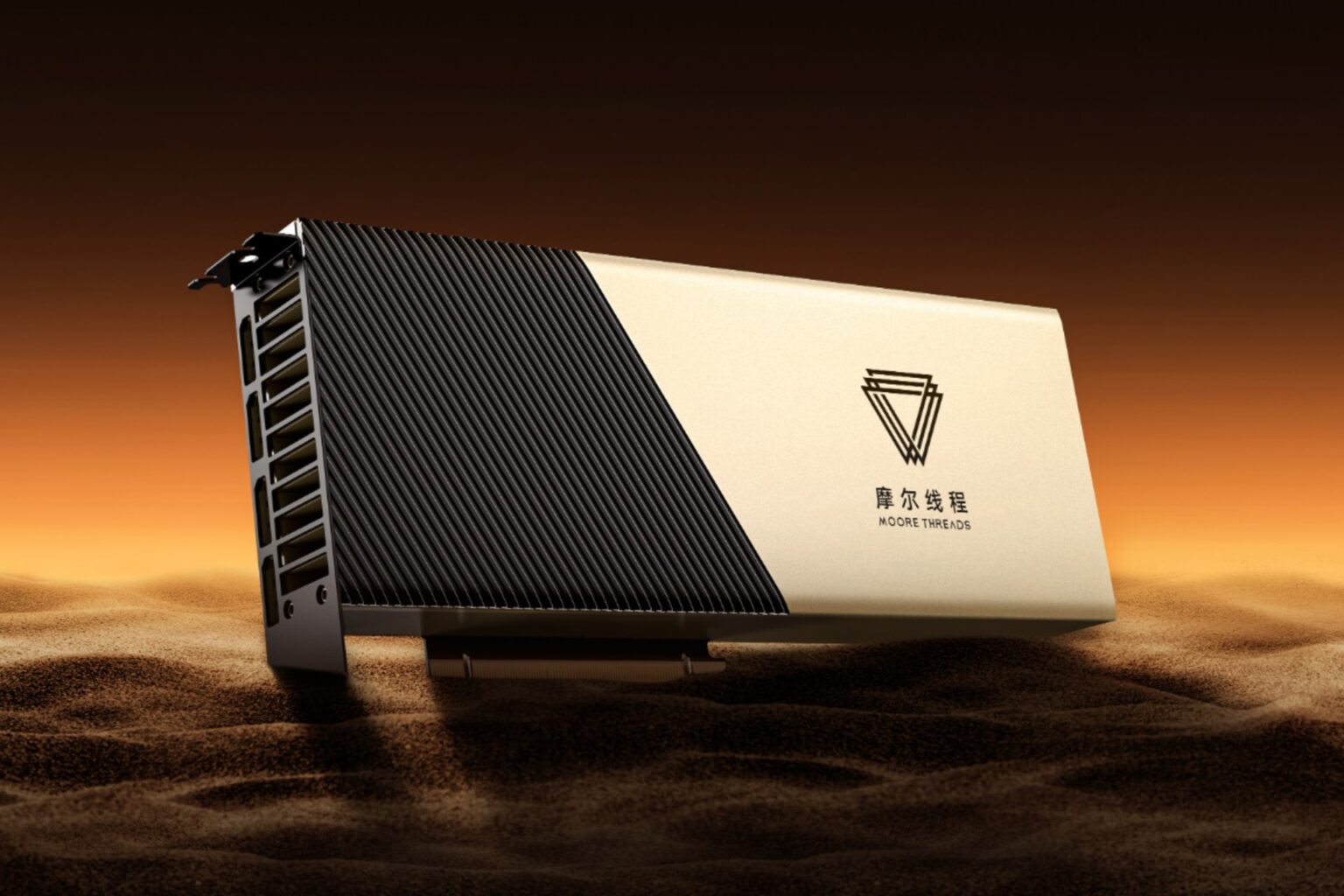
As demand for artificial intelligence continues to surge, capital markets have reached a fever pitch in pursuing stocks tied to computing power.
On December 5, Moore Threads debuted on Shanghai’s Star Market with an opening price of RMB 650 (USD 91) per share, giving the company a market capitalization of RMB 305.5 billion (USD 42.8 billion). Based on its issue price of RMB 114.28 (USD 16), the stock soared 468.78% at the open, earning early investors nearly RMB 270,000 (USD 37,800) per lot, making it the most profitable IPO of the year.
But the euphoria didn’t last. After peaking at RMB 688 (USD 96.3), the stock quickly pulled back, closing its first trading day at RMB 600.5 (USD 84.1), up 425.46%, with a market capitalization of RMB 282.25 billion (USD 39.5 billion).
Moore Threads has been called “China’s Nvidia” and “the next Cambricon,” but behind the labels lies a sobering reality: the company has accumulated nearly RMB 6 billion (USD 840 million) in losses over three years and remains heavily dependent on external financing.
So why is the market so bullish? The thesis centers on Moore Threads’ strategic scarcity in China’s general-purpose computing sector. Its leadership, especially founder and actual controller Zhang Jianzhong—who spent 15 years as an Nvidia global vice president—reinforces this perception. The company also mirrors Nvidia’s full-stack approach to technology, products, and business models.
Moore Threads has end-to-end R&D capabilities, from architecture design to packaging and testing. Based on its self-developed MUSA (meta-computing unified system architecture), the company builds full-function GPUs domestically that support AI computation, graphics rendering, and ultra high-definition video processing. Its GPUs handle multiple computing precisions to meet varied performance needs.
The company has released four generations of GPU architectures: Sudi, Chunxiao, Quyuan, and Pinghu. The latest, Pinghu, delivers FP32 vector computing power of 32T, outperforming Nvidia’s A100 but still falling short of the H100. Its consumer-grade GPU, the MTT S80, performs roughly on par with Nvidia’s RTX 3060.
Moore Threads has also made progress in frontier areas such as FP8-efficient computing, making it one of the few domestic players capable of competing at the leading edge.
Like Nvidia, Moore Threads does not stop at hardware. It invests heavily in developing a compatible software ecosystem around MUSA, offering foundational software required for AI computing and graphics workloads. Its Musify code migration tool helps developers transfer workloads from existing GPU platforms with minimal friction, supporting ecosystem continuity.
The company operates on a fabless model, focusing on R&D, design, and sales while outsourcing manufacturing to specialized foundries for operational efficiency.
These factors—full-stack R&D, an integrated ecosystem, and a fabless strategy—underpin Moore Threads’ strategic scarcity in China’s chip market.
Yet the company faces a long climb to reach industry leaders in technology, ecosystem maturity, and commercialization. Bernstein Research estimates Moore Threads held only about 1% of China’s AI accelerator market in 2024.
According to its prospectus, Moore Threads generated revenues of RMB 46 million (USD 6.4 million), RMB 124 million (USD 17.4 million), RMB 438 million (USD 61.3 million), and RMB 785 million (USD 109.9 million) from 2022 through the first three quarters of 2025. Growth rates reached roughly 170%, 253%, and 182%.
Revenue growth accelerated sharply after 2024, with the first three quarters of 2025 surpassing the previous three years combined. This expansion was driven by surging AI demand and strengthening domestic chip self-sufficiency policies. In the first half of 2025, AI computing products contributed 94.85% of total revenue, making them the company’s primary growth engine.
This suggests Moore Threads has begun securing large-scale orders and ramping up mass production, marking a shift toward meaningful commercialization.
Meanwhile, gross margins improved sharply as scale increased and higher-margin products gained share, recovering from –70% in 2022 to 25.9%, 70.7%, and 61.9% through Q3 2025. Operating expense ratios fell from more than 4,000% to about 150%, while R&D spending as a percentage of revenue declined from 2,423% to 110%, reflecting improving scale efficiency.
Still, Moore Threads lags behind competitors such as Hygon and Cambricon in absolute scale. Heavy R&D investment continues to weigh on profitability. The company reported net losses of RMB 1.894 billion (USD 265.2 million), RMB 1.703 billion (USD 238.4 million), RMB 1.618 billion (USD 226.5 million), and RMB 724 million (USD 101.4 million) from 2022 through Q3 2025.
It attributes persistent losses to high entry barriers in full-function GPU design, long adoption cycles for domestic GPUs, and the impact of US Entity List restrictions, which have constrained overseas sales.
Moore Threads’ IPO performance reflects capital markets’ heightened revaluation of domestic chipmakers amid industrial opportunity and geopolitical pressures.
Citing data from Frost & Sullivan, 36Kr reported that China’s AI chip market is projected to reach RMB 1.33 trillion (USD 186.2 billion) by 2029, with GPUs accounting for roughly 77.3% of the total. Bernstein Research expects Chinese domestic AI chipmakers to capture 55% of the local market by 2027.
This massive potential has led investors to bet that Moore Threads could become the next Cambricon.
From a valuation standpoint, the company’s 2025 revenue is projected to reach RMB 1.0–1.2 billion (USD 140–168 million). Using Cambricon’s P/S ratio of 90 as a benchmark, Moore Threads’ implied market value would land between RMB 90–108 billion (USD 12.6–15.1 billion).
Looking further ahead, its prospectus forecasts revenue of RMB 5.983 billion (USD 837.6 million) by 2027, with gross margins stabilizing at 61%. Applying a P/S multiple of 70 would imply a valuation of roughly RMB 400 billion (USD 56 billion).
This means Moore Threads’ RMB 300 billion (USD 42 billion) debut valuation effectively prices in several years of future growth. Its stock may have limited room for upside without substantial performance expansion.
Cambricon’s experience offers a cautionary parallel. When it went public in 2020, its P/S ratio peaked between 200–300 despite modest revenue and significant losses, driven largely by speculative enthusiasm. Once sentiment cooled and operational challenges emerged, its valuation corrected sharply, stabilizing only when AI demand rebounded in 2023.
Moore Threads now faces similar headwinds:
- Profitability uncertainty: Sustaining high R&D investment is essential but will continue to pressure margins.
- Reliance on external funding: Negative operating cash flow and limited self-sufficiency make the IPO a critical liquidity event.
- Valuation-performance mismatch: Despite strong revenue growth, its first-day P/S exceeded 600, well above sector norms, suggesting expectations may be overheated.
- Intensifying competition: China’s AI accelerator market is far more crowded than in 2020. In addition to Nvidia and AMD, domestic competitors such as Huawei, Hygon, Cambricon, MetaX, T-Head, and Kunlunxin are scaling rapidly, while major internet companies are developing their own chips.
Google’s development of its tensor processing units (TPUs) illustrates how in-house chip design can enable tighter software–hardware integration, potentially improving performance and cost efficiency for AI workloads. As tech giants deepen their chip strategies, Moore Threads’ addressable market for general-purpose GPUs may shrink, intensifying competition and requiring even greater R&D investment.
After the IPO excitement fades, Moore Threads may find itself constrained by a valuation paradox: priced for years of future growth before that growth is secured. Sustaining momentum will depend on whether it can deliver the performance gains that its current valuation already assumes.
KrASIA Connection features translated and adapted content that was originally published by 36Kr. This article was written by Ding Mao for 36Kr.