



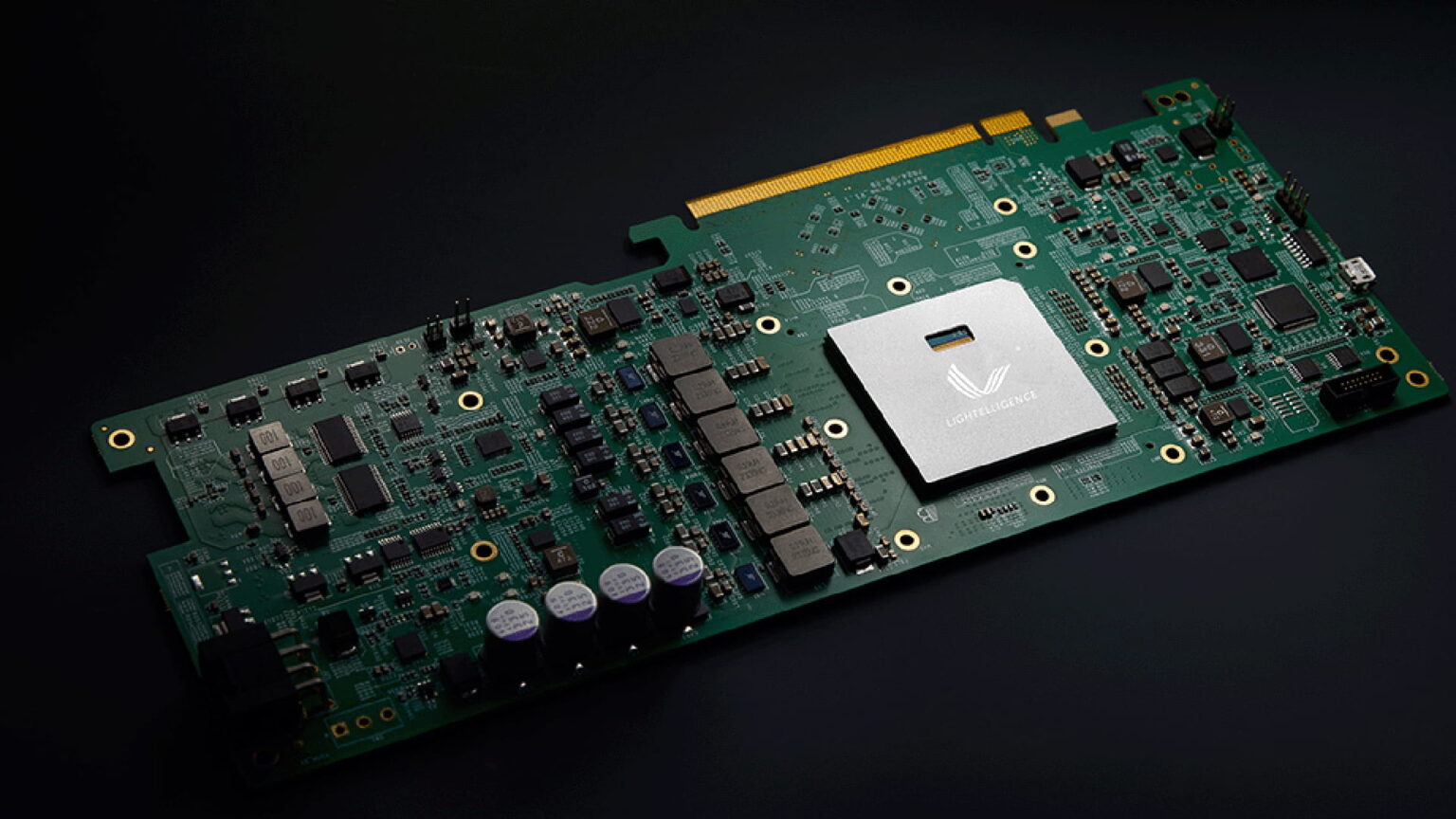
Lightelligence listed on the main board of the Hong Kong Stock Exchange on April 28 under stock code 1879. It said it is the world’s first publicly listed company focused on silicon photonics chips for artificial intelligence, and the first in the optoelectronic computing segment to access public capital markets.
As of the market close on April 28, Lightelligence’s market capitalization exceeded HKD 80 billion (USD 10.2 billion).
Founded in 2017 by Yichen Shen, who holds a PhD in physics from the Massachusetts Institute of Technology, Lightelligence develops optoelectronic computing technologies.
According to Frost & Sullivan, cited by the company, Lightelligence, through its optical interconnect and optical computing product lines, has achieved large-scale deployment of optoelectronic computing. The firm also said that in 2025 it ranked first by revenue in China’s independent optical interconnect solutions market, with an 88.3% share, supporting multiple 1,000-GPU-scale clusters. It added that its cumulative global shipments of optical computing chips have ranked first worldwide for two consecutive years.
Since its founding, Lightelligence has raised capital from several institutional investors, including Yijing Capital, a long-term backer.
Yijing Capital said it identified early that rising demand for large models and high-performance computing would strain traditional electronic architectures, particularly in power consumption and compute density. In parallel, optical interconnect and optical computing have drawn increasing industry and investor attention. It added that Lightelligence has continued to invest in R&D and explore applications, while moving to commercialize the technology in select use cases.
In Yijing Capital’s view, photonics is moving toward industrial-scale adoption and could influence the direction of future computing infrastructure. Its continued participation in funding rounds reflects its assessment of the long-term value of optoelectronic computing.
Demand for computing power is rising alongside advances in AI, including generative models. As data volumes grow, transmission requirements increase, and application scenarios expand, bottlenecks in existing infrastructure are becoming more apparent, particularly with large language models.
Yijing Capital said that as technologies mature and use cases become clearer, more companies in the field are turning to public markets. It views this as a signal of a shift from research to broader deployment. Optoelectronic computing, it said, could become part of future computing infrastructure and support further industry change in the AI era.
This article was adapted based on a feature originally written by and published on IPO Zaozhidao. KrASIA is authorized to translate, adapt, and publish its contents.