

While much of China’s consumer sector has struggled in 2026, JNBY Design has reached new heights. Its shares recently hit their highest level since listing, gaining approximately 30% since the start of the year.
Its financial results help explain the rise. For the fiscal year ended June 30, 2026, revenue increased 9% year-on-year to RMB 6.046 billion (USD 904.2 million), while net profit attributable to shareholders rose 11.7% to RMB 997 million (USD 149.1 million). Its gross margin stood at 66.6%, with a net margin of 16.5%.
Growth continued beyond the fiscal year. SPDB International reported high-single-digit growth in retail sales from July onward, exceeding 10% during China’s National Day Golden Week holiday.
JNBY is smaller than Anta Sports, Bosideng, and HLA. Yet its share-price and earnings gains have made it a standout as discretionary spending comes under pressure and outdoor clothing draws attention away from traditional fashion.
That success contrasts with its mixed public reputation. Some shoppers find its designs exaggerated or difficult to understand. Others still associate the brand with the 2021 controversy over imagery on its children’s clothing.
JNBY’s business depends on keeping its admirers buying, even when its clothes leave other shoppers cold.
Who buys from JNBY?
Li Lin and her husband, Wu Jian, began selling clothing in Hangzhou in 1994 before developing their own designs.
Independent analyst Tang Xiaotang recalls a brand that challenged convention, emphasizing humanistic influences, natural materials, and tailoring. Its early customers included intellectuals working in culture and media.
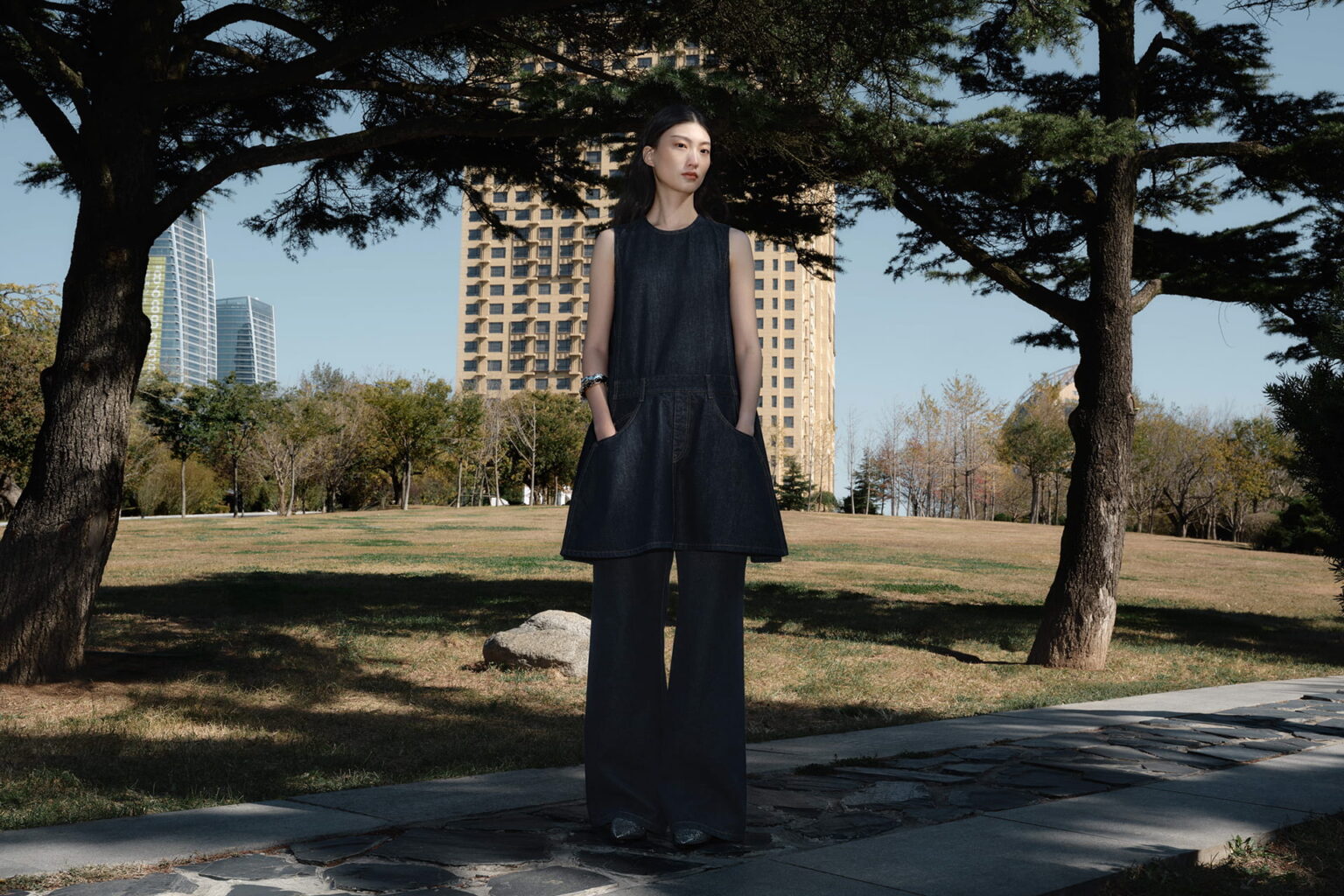
That identity remains visible in loose silhouettes, natural colors, and the textures of cotton and linen. The clothes are recognizable without prominent logos. Customers buy into an aesthetic they associate with JNBY rather than a single seasonal hit.
The company’s latest annual report describes the JNBY brand’s target customers as women aged 25–40 who are curious and find surprise and poetry in everyday life.
Another description has circulated on Chinese social media: women in their 30s and older with stable purchasing power who dress to please themselves.
One longtime customer told 36Kr that JNBY’s early designs were distinctive. “Some outrageous color combinations look great on,” she said, although “the designs swing between brilliant and bizarre.”
In her view, its customers tend to be “women living in first- and second-tier cities, working in the public sector or at established companies, with a certain amount of spending power.”
“They don’t necessarily go to the luxury section when they visit a mall, but they also look down on Lancy and Eifini, finding them insufficiently design-led or too young,” she said.
One customer’s impressions cannot represent the entire membership base. The financial figures offer a clearer picture of where spending comes from.
A July report from Soochow Securities put JNBY’s main price range at RMB 500–2,000 (USD 75–299), below Dazzle Fashion’s RMB 1,000–4,000 (USD 150–598). Neither is inexpensive, but even in smaller cities, these brands offer clothing that differs from mass-market trends, fast fashion, and sportswear.
In fiscal 2026, first- and second-tier cities accounted for 52.3% of JNBY’s retail sales, while third-tier cities and below contributed 47.7%, a relatively even split.
Repeat purchases matter more than a neatly defined customer profile. JNBY had more than 610,000 active member accounts in fiscal 2026. For comparison, Youngor disclosed 1.9 million active users in 2021, although the different reporting years limit the comparison.
JNBY’s members generated more than 80% of its retail sales. More than 360,000 member accounts with annual purchases exceeding RMB 5,000 (USD 748) contributed RMB 5.2 billion (USD 777.7 million), representing over 60% of offline retail sales. The rounded figures imply annual spending of roughly RMB 14,400 (USD 2,150) per high-spending account.
These figures measure retail sales to shoppers, rather than the group’s recognized revenue. They illustrate how heavily the business depends on a concentrated group of repeat buyers.
Keeping customers beyond the first purchase
Design attracts customers, but descriptions such as “natural,” “simple,” and “poetic” leave considerable room for interpretation.
JNBY is hardly alone. Peacebird emphasizes quality fashion without a fixed design vocabulary. Dazzle leans toward urban fashion, with Soochow Securities characterizing its designs through patterns, decoration, and asymmetry. The brand calls its approach an “aesthetic of contradiction.”
Different labels do not always translate into visibly different clothes. Since the pandemic, customers have placed greater value on dependable, versatile pieces, and this year’s autumn and winter collections show signs of convergence. On Xiaohongshu, some customers complain that JNBY has become conservative and “looks far too much like office wear.”
As distinctive design becomes harder to sustain, service becomes more important for retaining customers.
JNBY’s tiered membership program offers exclusive discounts, birthday benefits, cleaning and care perks, and repairs for up to ten years. Such services are unusual among mid- to high-end womenswear brands. Even luxury ready-to-wear warranties generally last about a year, according to 36Kr.
The company also helps customers choose clothes, particularly working women with limited time to shop.
According to 21st Century Business Review, JNBY spent two to three years refining an algorithm that records members’ preferences for materials, cuts, and colors. Sales associates use these profiles through an online dashboard to recommend products.
CMO Huang Sheng said the system achieved a 70% recommendation hit rate. She also reported a return of RMB 7 (USD 1) for every RMB 1 (USD 0.1) spent on advertising informed by member profiles on Tencent’s platforms, ranking behind only UR and Uniqlo in women’s fashion.
Box+ extends that service to customers’ homes. An annual fee of RMB 399 (USD 59.7) covers six deliveries of coordinated outfits. Customers can try them on for free, purchase what they want, and return the rest. Higher-tier members can also receive one-on-one styling services.
More sales, barely more stores
The company’s efforts to retain members contrast with its restrained store expansion.
JNBY ended fiscal 2026 with 2,118 stores worldwide, a net increase of just one. Its store count had reached 2,163 at midyear before declining by 45 in the second half.
The mix also changed. Company-operated stores increased by nine to 501, while distributor-run stores declined by eight to 1,617. Revenue from company-operated stores rose 10.7%, compared with 1.3% growth through distributors. A year earlier, company-operated revenue had fallen 6.2%, while distributor revenue grew 9.6%.
The reversal suggests a shift in channel priorities. JNBY is also working to sell more of the inventory it already holds.
JNBY has no online-exclusive product line. Its stores across China and online business share an inventory pool to reduce missing sizes, stockouts, and unsold goods at individual locations.
The company attributed RMB 1.405 billion (USD 210.1 million) in incremental retail sales to its inventory sharing and allocation system in fiscal 2026, up 23.6% year-on-year. By its calculation, matching existing stock more effectively to sales channels is contributing to growth alongside new store openings.
Online revenue rose 20.5%, but offline channels still accounted for about 76% of total revenue. Online channels maintain customer relationships and help allocate stock, while physical stores let shoppers try on clothes, feel fabrics, and receive styling advice.
JNBY is expanding selectively, closing underperforming stores, directing resources toward high-end malls and better locations, and upgrading existing shops. The aim is to generate additional sales from new stores while sustaining returns from existing ones.
Mall operators continue to value the brand. “JNBY has always been a major name in shopping center leasing. Anyone looking to bring in retail tenants will contact it,” said Du Bin, secretary general of the brand committee at the Shanghai Council of Shopping Centers.
Du said JNBY’s store sales had remained relatively steady, a quality that became more valuable after the pandemic. “Since 2026, shopping centers have paid attention to any brand that continues opening stores,” he said.
Where will the next customers come from?
Loyalty, however, offers no guarantee of continued growth.
Tang believes JNBY’s established customer base is largely fixed and approaching a ceiling, leaving limited scope for large-scale customer acquisition. Revenue growth has also slowed markedly compared with the years before the pandemic.
The group has yet to develop another brand that contributes on the scale of its main label.
It has been developing Less, which focuses on workwear for younger customers. Tang compares its position within the group to the relationship between Miu Miu and Prada.
Less generated revenue of RMB 731 million (USD 109.3 million) in fiscal 2026, up 17.4%. Its gross margin of 70.2% exceeded the main JNBY brand’s 69.9% and was among the group’s highest.
Some customers, however, see little difference between the two brands’ styles. Whether Less can attract a sufficiently distinct audience remains an open question.
Croquis, the menswear brand launched in 2005, has struggled. Revenue fell 1.1% to RMB 712 million (USD 106.5 million), while its store count declined from 308 to 283.
“I cannot change men’s dressing habits and preferences,” CEO Wu Huating said. Her comment points to the limits of expanding sales across customers’ households. JNBY has yet to replicate its womenswear appeal in menswear.
The group continues to explore new opportunities. In September 2026, it announced a partnership with Italian high-end footwear and leather goods brand Marsell, taking exclusive responsibility for the brand’s operations in Greater China.
At an earnings presentation, CFO Fan Yongkui said, “JNBY wants to become a century-old brand with international influence.” Overseas markets and lifestyle products are long-term priorities. For now, overseas sales account for just 0.6% of revenue, while new categories have gained little traction.
Competition also extends beyond other womenswear labels. Euromonitor data shows that China’s womenswear market contracted at a compound annual rate of about 0.7% between 2019 and 2025, while sportswear grew at approximately 4.6%.
Those figures do not establish that sportswear directly displaced womenswear. Still, consumers’ willingness to pay for functional clothing and sporting activities puts pressure on mid- to high-end fashion’s share of their budgets.
One JNBY customer told 36Kr that her wardrobe increasingly contains Lululemon and Pleats Please, whose pleated clothes require little care. One offers athletic utility and physical comfort, while the other offers a distinctive design identity. Both compete for the same customers’ money and attention.
Shareholder returns tell a separate story. JNBY’s fiscal 2026 dividend payout ratio reached 110%, including a special dividend marking the tenth anniversary of its listing. The payout reflects its strong cash position, but a special dividend cannot substitute for investment in new customers, brands, and categories.
KrASIA features translated and adapted content that was originally published by 36Kr. This article was written by Xie Yunzi and Zhang Fan for 36Kr.
Note: RMB figures are converted to USD at rates of RMB 6.69 = USD 1 based on estimates as of November 10, 2026, unless otherwise stated. USD conversions are approximate and, where appropriate, rounded for ease of reference. They may not fully match prevailing exchange rates.