


With automotives entering an age where competition is defined by software, companies like Chinese electric vehicle giant BYD are developing an edge with wireless updates, hoping to expand the lifespans of their vehicles and ultimately open new revenue streams.
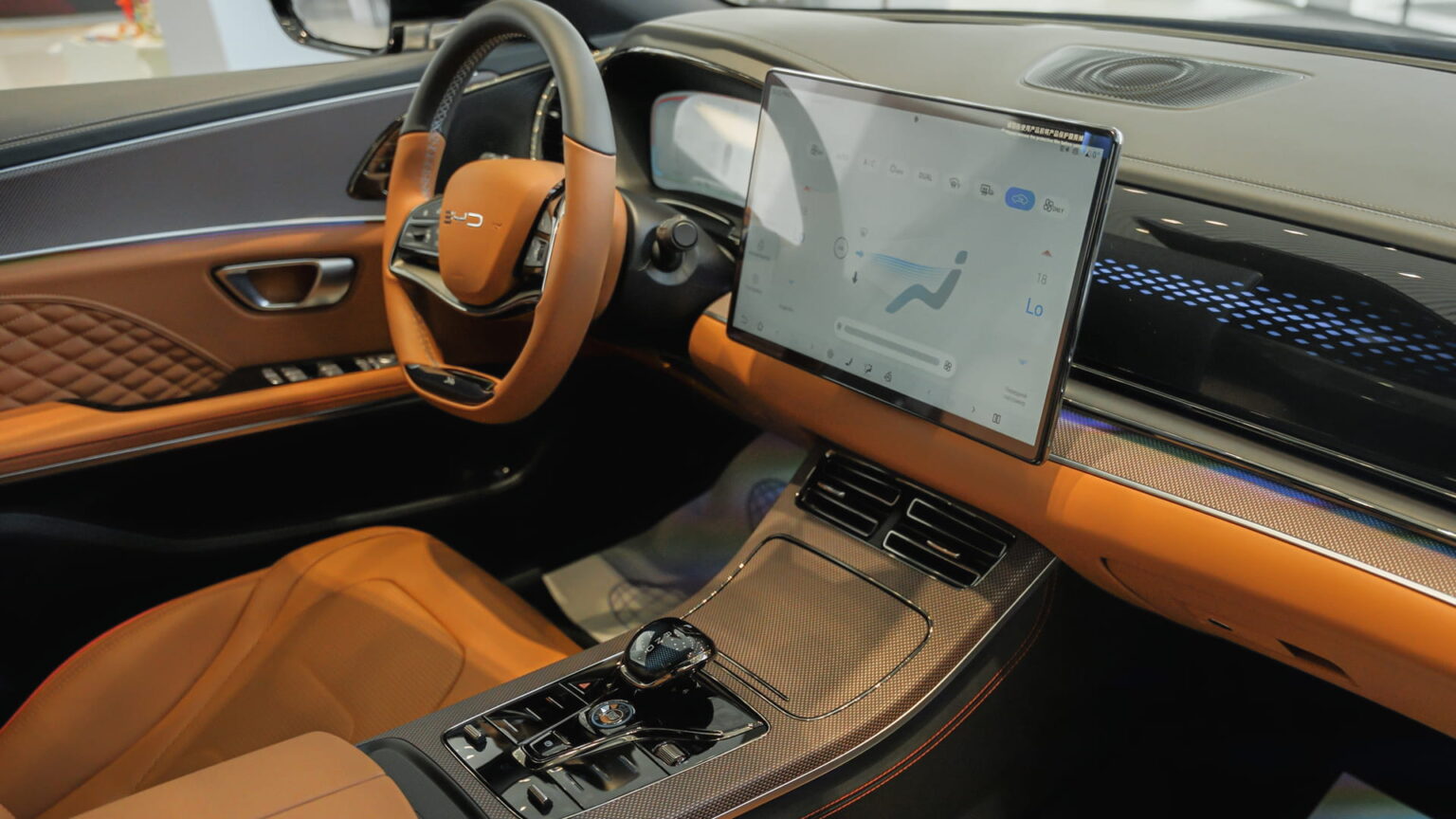
In mid-February, BYD announced a wireless update to the functionality of its Han L sedan, which was released in April 2025 as part of the Dynasty series. It was the fourth update in less than a year since the vehicle’s launch.
The highlight of the new update is BYD’s latest driver assistance system, unveiled in late January. The system improves the accuracy of end-to-end technology, where artificial intelligence handles perception and decision-making, enabling it to be used in more complex road environments.
The wireless update requires about two hours, but users can enjoy a vehicle with the latest technology by simply waiting.
Software-defined vehicles, whose performance can be enhanced even after purchase, are beginning to determine automaker competitiveness. While Tesla pioneered the over-the-air (OTA) updates used by such vehicles, Chinese automakers are implementing them more actively.
BYD released 200 software updates for vehicles under its Ocean and Dynasty brands in 2025, the most of any automaker, according to Chinese research firm Ways.
Aito, an EV brand developed by Huawei Technologies and Seres Group, as well as outfits like Leapmotor have also released relatively large numbers of updates.
Comparatively fewer software updates in the Chinese market were announced by Tesla with 16, Toyota Motor with eight, and Volkswagen with five. The majority of OTA updates in China focus on vehicle design and control, driver assistance, and system-related technologies.
BYD’s ability to update software so frequently stems from its in-house development of all of the semiconductors and operating systems required for OTA updates, as well as the hardware that actually performs the functions. “If we design everything ourselves, we can implement updates quickly and accurately,” said a company representative.
As domestic sales decline due to intensifying price competition, BYD hopes to boost sales by enhancing its appeal through OTA updates.
OTA is fundamentally altering the concept of a car’s lifecycle. Traditionally, after launching a new vehicle, minor improvements are made about two years later based on market reaction. After six to seven years, a completely redesigned model is usually introduced.
But software-defined vehicles can be updated to allow for continuous functionality enhancements, like smartphones. Failure to maintain freshness with the latest features quickly leads to consumer attrition.
“Consumers recognize that new energy vehicles evolve through OTA,” said Isao Sekiguchi, managing director of Dongfeng Nissan, Nissan Motor’s Chinese joint venture. “OTA updates must be developed even before product launch as part of the car’s lifecycle, in order to keep up.”
To compete with Chinese players, Nissan implemented its first OTA update for the N7 EV just two months after the vehicle was launched in April 2025. The update included enabling the use of new apps and expanding voice recognition capabilities. Nissan looks to enhance customer experience by implementing OTA updates every two to three months.
OTA has the potential to extend vehicles’ lifespans. Toyota, as part of its global strategy, will leverage OTA to extend the new vehicle sales cycle for its flagship models. Believing that vehicle performance can be improved without installing new equipment, it looks to extend the cycle of complete vehicle redesigns to nine years from the conventional average of seven years.
Toyota is being flooded with orders for popular models, resulting in long delivery times. A longer sales period would reduce the likelihood of customers immediately trading in popular models after purchase. This means that vehicle values would depreciate less, and the higher resale prices would reduce the burden on drivers when trading in vehicles.
At the same time, an extended new vehicle sales cycle also reduces opportunities for automakers to recoup their investments. In China, almost all updates are offered for free. Making OTA offerings a new source of revenue is not easy.
He Xiaopeng, CEO of Xpeng, said that if his company can offer Level 4 or higher autonomous driving, that may present an opportunity to shift from the traditional one-time payment for new cars to a subscription-based model.
Level 4 represents fully autonomous driving under specific conditions, which Xpeng aims to achieve through end-to-end technology. The company plans to charge a fee only to those who want to use the technology.
Tesla, a pioneer in OTA technology, has also begun changing its business model. Since mid-February, in the US and Canada, it is offering its Full Self-Driving (FSD) driver assistance system to customers who want it for USD 99 per month. It was previously installed by default and unlocked through a one-time purchase.
With prospects for substantially expanding sales of EVs slim due to a slowdown in demand, the company hopes to generate stable revenue through subscriptions.
This article first appeared on Nikkei Asia. It has been republished here as part of 36Kr’s ongoing partnership with Nikkei.