


A legendary name in rock history is finally building its offline presence in China, 13 years after first entering the market.
Fender was founded by Leo Fender in a small California workshop, where he developed the first mass produced electric guitar, the Telecaster. Hallmark releases such as the 1951 Precision Bass and the 1954 Stratocaster cemented Fender’s place in music history, and the brand’s Custom Shop later became synonymous with top-tier craftsmanship.
When Fender first entered China, it relied on distributors that sold its instruments through music shops, a common route for foreign instrument brands at the time.
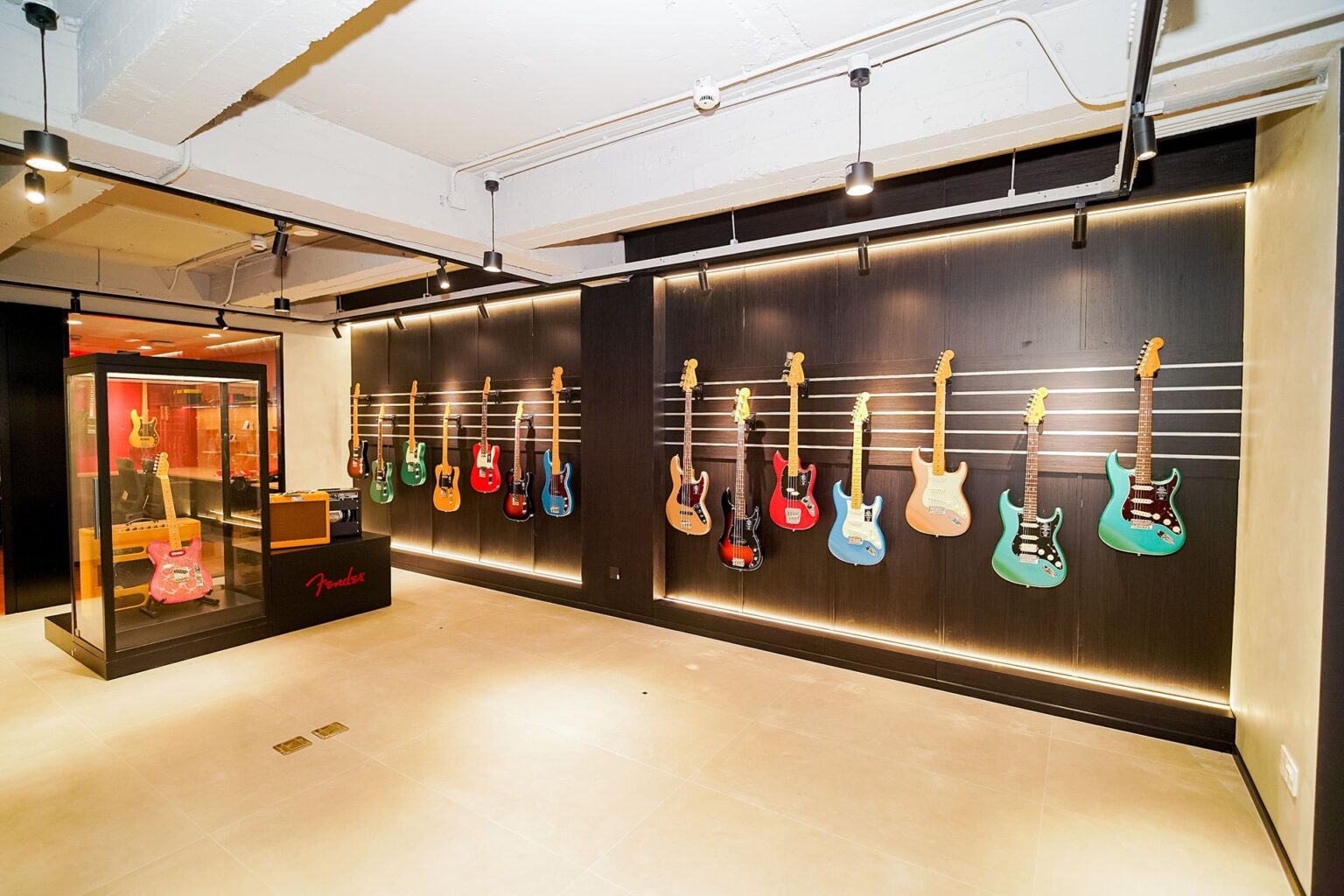
The company has now opened a new experience space in a shikumen-style building in Shanghai’s Xuhui district. Following Tokyo, London, and Nashville, it is Fender’s fourth Artist Showroom worldwide and signals its growing investment in the Chinese market.
Fender’s optimism is underpinned by strong growth. According to Dai Yunjie, Fender’s general manager for China, the company is seeing double-digit expansion, with e-commerce sales outpacing the industry average. This aligns with what global CEO Andy Mooney predicted two years ago, that Asia is the brand’s biggest growth opportunity of the coming decade.
Fender’s investment in the Shanghai space is substantial. It occupies an entire standalone building in a central district. Dai is direct about why the brand considers such a costly venue essential:
“The guitar is the instrument that requires the most physical contact. Resonance can’t be tested through online specifications.”
For both professional musicians and hobbyists, the first touch of an instrument must offer a true sense of feel and acoustic feedback, an experience that cannot be replicated digitally.
Unlike Fender’s spaces in Tokyo and London, which are reserved for professional musicians, the Shanghai showroom will host regular open days. Dai said he wants it to emphasize community, reflecting China’s strong appetite for music-driven social interaction. Electric guitar communities on platforms such as Xiaohongshu and Douban are already active.
To accelerate its presence in China, Fender plans to adopt a more locally resonant image, balancing its global brand identity with broader commercial appeal. Dai said a long-term goal is to open Fender-branded retail stores and reintroduce the experiential value of traditional music shops. The brand is also shifting its positioning to be more lifestyle-centric, promoting the idea that music expression should be accessible anytime.
A look at Fender’s website shows the change underway. The company has expanded into lifestyle products such as apparel and accessories and has pursued collaborations with anime IPs and fashion labels overseas. Similar initiatives are expected in China.
Despite operating official stores on Tmall and JD.com, along with its distributor network and the new experience space, Fender still lacks a central element in building brand mindshare: a flagship store.
Dai said Fender plans to open its first flagship store in Shanghai, which will be only the second worldwide.
Drawing on experience in other markets, Dai said flagship stores do not cannibalize distributor sales. Instead, they often generate new business for distributors, sometimes increasing their sales by 20%.
Fender hopes China will become its benchmark growth market. While the US, Europe, and Japan are mature territories, the company sees ample room for expansion in China. The industry is benefiting from several tailwinds, including smart guitar technology, a renewed interest in vintage design, and a younger generation with high digital literacy. These users show strong willingness to adopt electric instruments. Meanwhile, China’s expanding live performance scene has increased demand for guitars in mainstream music settings.
In the broader electric guitar category, a few major brands dominate. Fender, Gibson, Yamaha, and Ibanez collectively account for about 65% of industry revenue, with annual sales around USD 1 billion. Fender and Gibson target the mid- to high-end market and offer more affordable sub-brands, such as Squier and Epiphone. The category also includes budget-friendly brands such as Cort and Tagima for adult beginners, as well as niche-focused labels like Schecter.
The guitar originated as an accompaniment instrument in US country music and later became a staple in pop, rock, blues, and folk genres. Among modern instruments, it is known for its strong price-to-performance ratio, wide usability, and relatively low learning curve. Electric guitars account for 15–20% of the broader electric instrument market, and that share continues to rise. Compared with acoustic guitars, electric models offer a lower barrier to entry, broader tonal possibilities, and stronger social appeal.
As the player base grows, China’s electric guitar market is becoming more segmented. According to Moojing Market Intelligence, stringless guitars reached nearly RMB 1 billion (USD 140 million) in sales on major e-commerce platforms in 2024, with an average selling price of RMB 2,234 (USD 312.8). Buyers are predominantly 18–30 years old. These products have shaped early consumer perceptions of the category.
However, musical instruments carry an inherent educational component. Stringless guitars suit those who want to try the instrument, but as players progress, they tend to seek better equipment. Dai said young Chinese players now have a more sophisticated understanding of guitar aesthetics, feel, and pricing, and their demand for higher-quality gear and broader product lines has increased significantly.
RELATED ARTICLE

In the electric category, Fender occupies the mid- to high-end tier, dominating the RMB 6,600–20,000 (USD 924–2,800) range. Its US-made Professional II series, Mexico-made Player II series, and Japan-made Hybrid II series consistently rank high on sales charts. Professional users pay close attention to tonal characteristics, versatility, and performance in both stage and studio environments. For these players, Fender offers the higher-end Custom Shop, which enables customization beyond mass market instruments.
Functional differentiation among guitar brands remains limited. Compared with domestic brands that tend to focus on one-off product hits, Fender’s advantage lies in its legacy and its full product ecosystem. This allows the brand to maintain professional credibility while appealing to a broader user base.
Within the electric guitar category, Fender offers the Stratocaster, Telecaster, Jazzmaster, Jaguar, Mustang, and more. Each model yields numerous SKUs depending on pickup configuration, body construction, fretboard material, and finish. Fender’s broader catalog includes guitars, basses, amplifiers, effects pedals, and accessories.
To appeal to younger consumers, Fender also produces artist signature models and IP collaborations. The brand partnered with Bulgari on a limited-edition Stratocaster and collaborated with the Monster Hunter IP to release a Telecaster and related merchandise.
For beginners, Fender’s sub-brand Squier offers colorful, budget-friendly guitars priced between RMB 4,000–6,000 (USD 560–840). These lightweight, easy-to-learn models incorporate more digital features and are available in Fender’s Tmall flagship store.
Fender’s mature product matrix is supported by its global supply chain. The company produces guitars in the US, Mexico, and Japan, with the Corona, California factory housing the Custom Shop. This ensures production stability and material consistency that smaller manufacturers often cannot match.
In China, Fender is localizing selectively, releasing market-specific limited editions such as the Japan-made 2024 Traditional Series 60s Stratocaster and 70s Jazz Bass.
Although electric guitars are electronic products, their purchase drivers differ from typical consumer electronics. For many players, the first electric guitar is an emotional purchase inspired by admired musicians. Countless artists have recorded and performed with Fender instruments. The company continues to strengthen ties with professionals through programs such as Fender Next and Fender Boost.
Despite strong growth, electric guitars remain a relatively young category in China and require sustained user education. Fender is investing in content and cultural engagement and exploring partnerships with local artists and cultural communities. In mature markets, the brand focuses more heavily on product marketing.
Looking ahead, Fender plans to deepen its presence by anchoring in Shanghai with its experience space, hosting regular pop-ups and marketing events, and eventually opening an official flagship store. Its distributor network will continue expanding to reach more players across Chinese cities.
KrASIA Connection features translated and adapted content that was originally published by 36Kr. This article was written by Peng Qian for 36Kr.