



Chinese companies are racing to mass produce thin, lightweight perovskite solar cells, with both startups and established players firing up large production lines.
In all, more than 100 companies, including lithium battery giant Contemporary Amperex Technology (CATL) and electric vehicle maker BYD, are developing perovskite cells, prompting their Japanese counterparts to formulate strategies to avoid head-on competition.
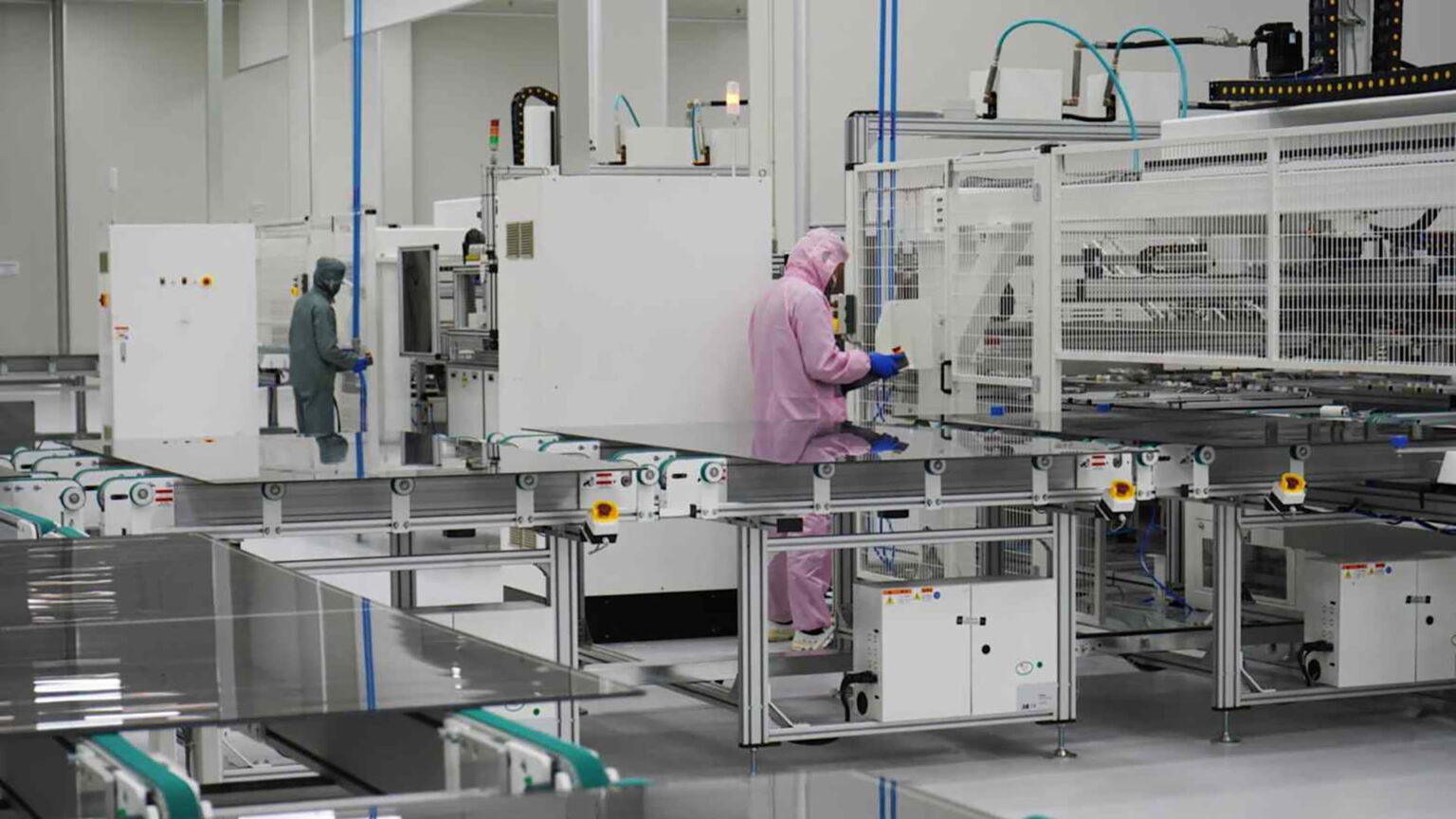
China’s UtmoLight started what was believed to be the world’s first gigawatt-scale perovskite solar cell production facility in February 2025 in Jiangsu. The startup is aiming to make 1.8 million of those cells annually, with a conversion efficiency of 17.44%.
Many Chinese makers use glass substrates, which are believed to be easier to manufacture than the thin film types being developed by Japan’s Sekisui Chemical. China is seeing a succession of new plants coming online that could rival Sekisui Chemical’s gigawatt-scale facility planned for 2030.
In 2022, Hangzhou Microquanta Semiconductor Technology started up a production line with an annual capacity of 100 megawatts in Zhejiang.
“We have completed construction of production lines with a gigawatt-level annual capacity, and are preparing to begin manufacturing,” co-founder and CEO Yao Jizhong told a local newspaper in March 2025. The company then announced in November the same year that it had developed the largest commercial perovskite panels in the world, with conversion efficiency of 18.6%.
In June last year, Kunshan GCL Optoelectronic Materials brought a RMB 5 billion (USD 724.7 million) plant online in Jiangsu. The operator is aiming to double that plant’s annual capacity to two GW.
“More than 100 companies in China are developing perovskite solar cells, with over 100,000 researchers working in the field,” said Izumi Kaizuka, principal analyst at Japanese consulting firm RTS.
As the power conversion efficiency of silicon solar cells approaches its theoretical limit, perovskite solar cells offer countless combinations of materials that create significant room for improvement. They can be produced on flexible substrates, allowing for installation on walls, for example.
The field is relatively easy to enter, as it requires no large-scale research facilities. Many researchers in China have returned after studying in Europe, the US, and Japan to add to the country’s overall expertise.
“The open nature of development is a factor in its strength,” said senior analyst Risa Kurihara at RTS.
Perovskite cell developers in China are more diverse than those in Japan, which tend to be mainly chemical or electronics manufacturers. UtmoLight, for example, was spun off in 2020 from car battery maker Svolt Energy Technology, which is affiliated with automaker Great Wall Motor.
Kunshan GCL Optoelectronic has its roots in a startup founded by two researchers who met as students at prestigious Tsinghua University.
Several major silicon solar cell manufacturers are working on developing products that use combinations of perovskite and silicon to make tandem cells.
Big names such as CATL, BYD, and display panel maker BOE Technology have also applied for patents and have shown off products at trade shows, according to local media reports. As oversupply and excessive competition remain issues in fields such as EVs and silicon solar cells, companies are investing in perovskite solar with expectations of growth.
Around 2010, Japanese manufacturers including Sharp, Kyocera, and Panasonic Holdings dominated silicon solar cells globally, but Chinese companies have drained their market shares with the overwhelming scale of mass production.
Many Japan companies are now strategizing to avoid repeating the same mistake with perovskite solar. Panasonic, for example, is betting on small-lot development tailored to customer needs to avoid competing on scale and cost.
This article first appeared on Nikkei Asia. It has been republished here as part of 36Kr’s ongoing partnership with Nikkei.
Note: RMB figures are converted to USD at rates of RMB 6.90 = USD 1 based on estimates as of March 25, 2026, unless otherwise stated. USD conversions are presented for ease of reference and may not fully match prevailing exchange rates.