



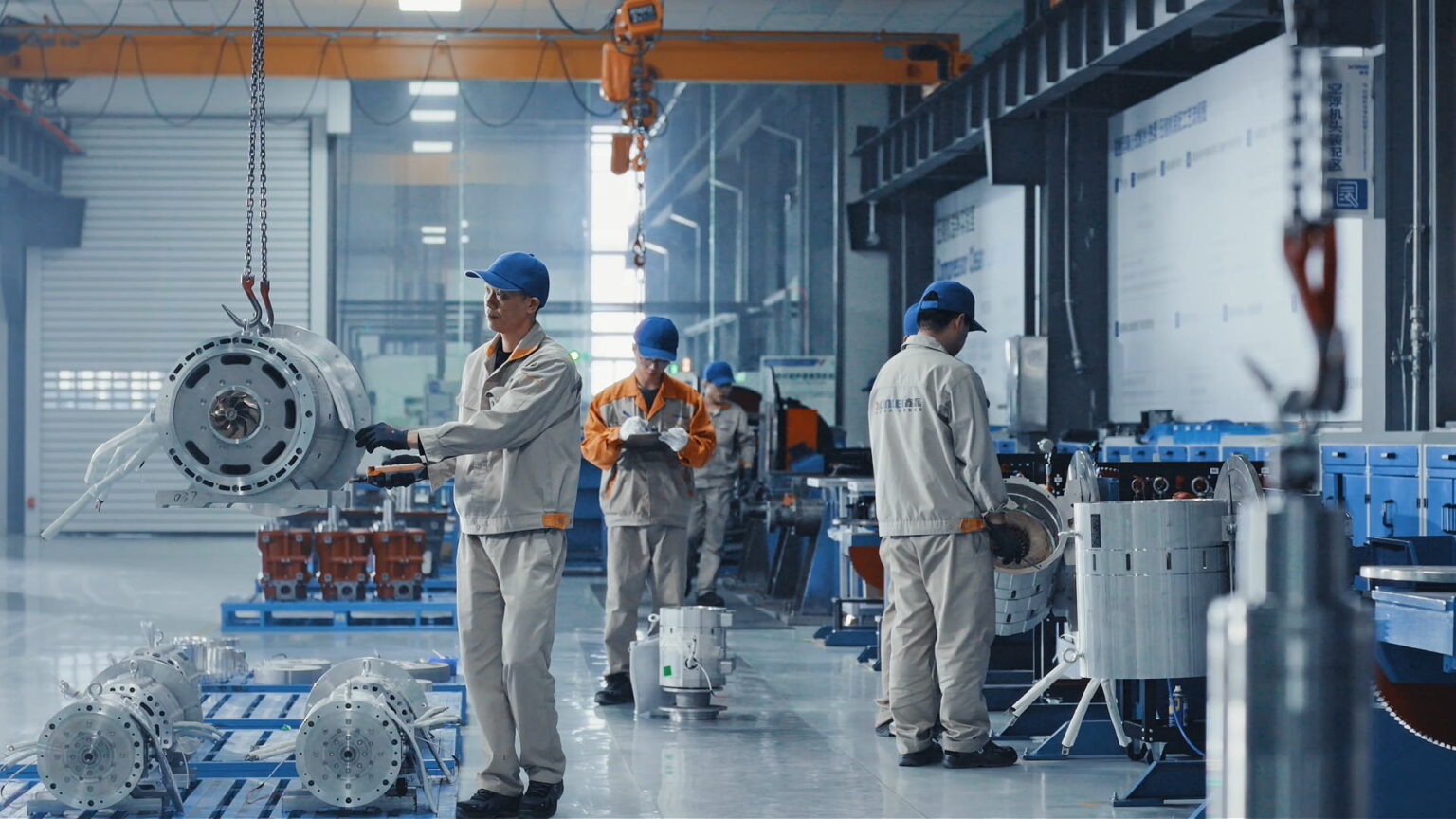
When Zhong Jiayu was growing up in Wenling, Zhejiang, trucks collecting air compressors from her family’s factory sometimes lined up until the early hours. Her father had rented a site of about 3,300 square meters beside a highway. Few Chinese factories at the time held the certifications required by European buyers. His did.
The equipment traveled farther than the family name. Founded in 1996, Xinlei spent much of the next three decades manufacturing compressors for other companies to sell under their own labels in Europe, the US, and Southeast Asia.
Today, equipment bearing Xinlei’s name ships from Wenling to Southeast Asia, the Middle East, and Europe. Its product range includes air compressors, blowers, vacuum pumps, and heating, ventilation, and air conditioning (HVAC) equipment. Revenue from HVAC equipment rose 24.75% in 2025. In Europe, where heat pumps are increasingly replacing older boilers, unit sales grew at a double-digit rate across 16 markets that year.
Zhong, born in 2000, joined the marketing department after graduating from university in 2021 and became general manager two years later. Her challenge was to turn a manufacturer known to overseas distributors into a brand recognized by customers.

What happened when orders stopped
Xinlei was among the early Chinese manufacturers to secure American Society of Mechanical Engineers certification for pressure vessels and European CE marking, according to Zhong. That helped it become one of the first Chinese factories to sell small compressors in Europe. Before 2008, much of its business came from exports, largely under other companies’ labels.
Between 2008 and 2010, anti-dumping duties exceeding 70% cost Xinlei European customers. Orders and revenue fell sharply. The company considered opening a factory in Vietnam but abandoned the idea amid exchange-rate fluctuations. It also arranged for an Italian manufacturer to assemble components supplied by Xinlei, but the arrangement yielded little as costs rose.
Xinlei turned its attention back to the equipment itself. Working with universities, it developed new rotary, scroll, and screw compressors. When the European duties expired, those products helped bring orders back.
The company had also built a domestic sales operation from scratch, learning to market, sell, and deliver products under its own name. Unlike its overseas business, where much of the customer relationship belonged to distributors, selling directly in China gave Xinlei experience managing those relationships itself.
Its manufacturing capabilities continued to develop. In 2020, Xinlei helped replace South Korean equipment on a Sinopec mask production line with Chinese-made machinery. In 2022, it joined China’s fourth cohort of specialized small and midsize manufacturers designated as “little giants.” On January 19, 2023, it listed on ChiNext, the Shenzhen Stock Exchange’s growth board.
By then, Xinlei had spent decades establishing its credentials overseas and building its own sales channels at home. What remained was to bring those capabilities together abroad, turning a manufacturer known to its distributors into a brand recognized by customers. That was the challenge Zhong inherited.
Learning the factory one order at a time
Zhong studied communications and interned at an advertising agency and in a company’s marketing department. Back in Wenling, she reorganized Xinlei’s marketing team and gave its trade show booths, publications, and dealer stores a consistent look. She also removed the word “compressor” from Xinlei’s registered name.
“We’d been making more than compressors for a long time,” she said.
Initially, she took problems she identified straight to the chairman, her father. Simply passing complaints upstairs, he told her, would never make her part of the company.
She began investigating what had happened and presenting two or three possible solutions to the person responsible. When a problem was small enough, she fixed it herself and took responsibility for the outcome.
When the board appointed her general manager in October 2023, she understood sales and marketing far better than manufacturing or R&D. Work passed from one stage to the next, while production data was reported manually. The gap between Xinlei’s operations and the advanced production lines she had visited elsewhere frustrated her.
A dealer offered advice she remembered: study and understand Xinlei before attempting to change it.
She started with a sales order and followed it through R&D, purchasing, production, and delivery. At each stage, she observed who did the work, where delays occurred, and why.
She replaced some employees. To those who stayed or joined, her message was direct: “You report to me at work, but outside, you’re all my teachers.”
During her first year, production managers spent time in sales, while sales managers worked on the factory floor. When problems arose, Zhong asked the people involved to propose solutions and explain their reasoning. After several rounds, colleagues began to understand how senior managers made decisions.
Getting salespeople out of Wenling
Zhong considers getting the sales team out of the factory one of her most effective changes.
Previously, a handful of top salespeople secured orders while colleagues processed them. Most stayed in Wenling, relying on trade fairs, Xinlei’s website, and a business-to-business marketplace for leads.
Now, the team uses customs data to identify importers, how much they purchase, and where they source their products. Salespeople then visit prospective customers overseas, often staying to develop the market.
In nearby markets such as Southeast Asia, where Chinese-speaking communities are well established, employees compete for overseas postings that come with an allowance. Chinese employees take management positions, while Xinlei hires multilingual local administrative staff and recruits locally for field sales, warehousing, and after-sales service.
Farther afield, where potential recruits are less likely to recognize its name, Xinlei posts regularly on LinkedIn to help candidates learn about the company before considering a job offer.
Zhong sees opportunities in Russia, the Middle East, and Southeast Asia, where she said Western brands have lost some influence and local managers are becoming more willing to join Chinese companies.
In Europe, energy shortages following Russia’s invasion of Ukraine have also encouraged households to replace gas boilers with heat pumps.
Winning over installers
Xinlei established a separate division for its own brand and set up operations in Vietnam, the Middle East, and the Netherlands. Local hires handle sales, warehousing, and support before and after installation.
It has also persuaded some private-label distributors to carry Xinlei-branded products, sharing the costs of websites, trade shows, and local marketing campaigns.
The company continues to manufacture private-label piston compressors for retail chains, whose distribution relationships remain under their control.
For its own brand, Xinlei favors industrial equipment, where buyers pay close attention to engineering and manufacturing capabilities, alongside central heating and cooling systems that use heat pumps. According to Xinlei, subsidies for systems paired with solar power can cover 50–60% of costs in some overseas markets.
Europe and the US remain its main private-label markets. For Xinlei-branded products, the company is focusing on Central Asia, the Middle East, Southeast Asia, and other markets along China’s Belt and Road routes.
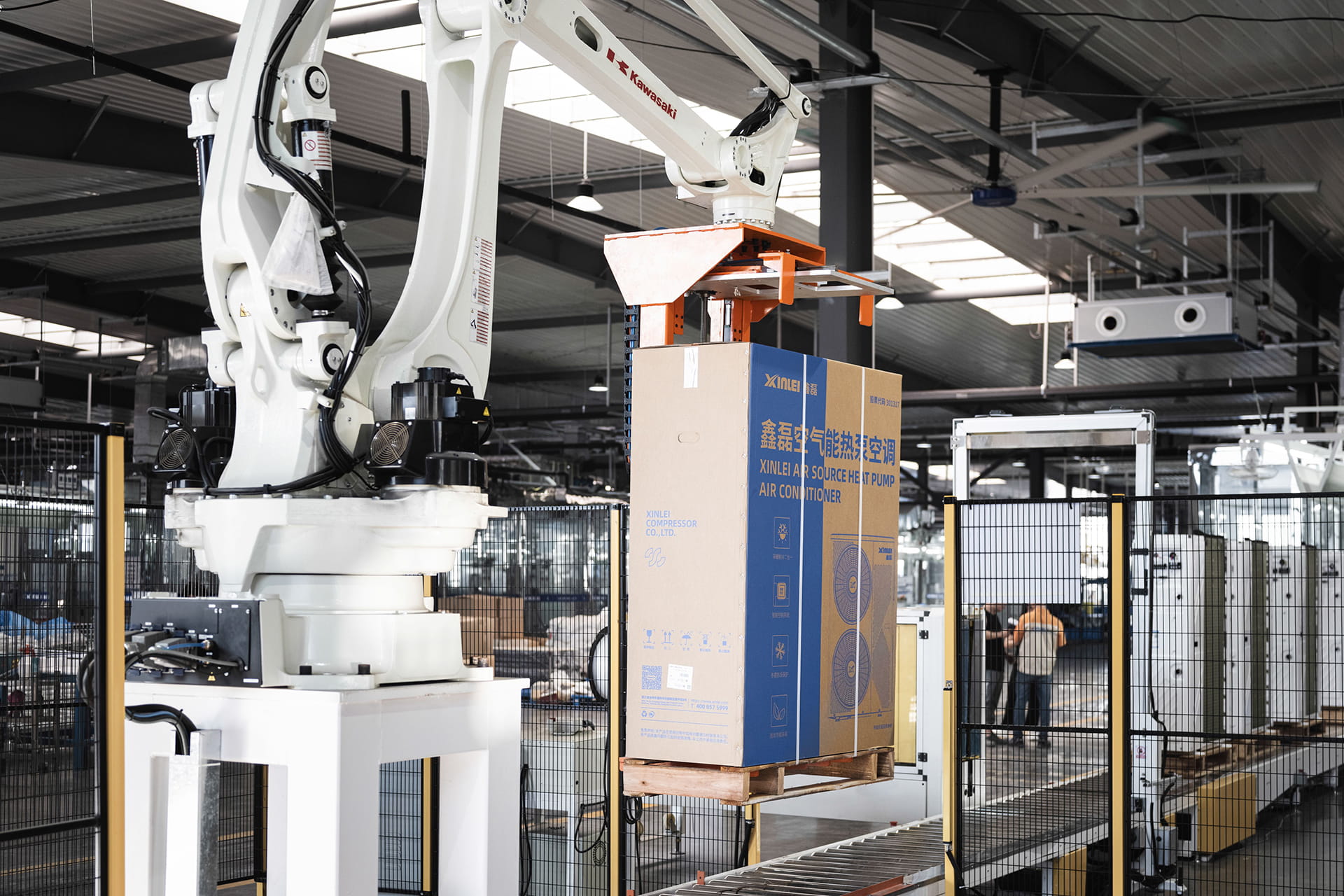
Zhong wants Xinlei to become a brand installers recommend. That requires local training and technical support, as well as building visibility well before prospective buyers make contact.
Industrial purchasing decisions take time. If an installer’s initial search turns up little information about a supplier, the company may never make the shortlist. Xinlei uses platforms such as LinkedIn to strengthen its overseas presence, giving prospective buyers a way to learn about its products and capabilities before a salesperson reaches out.
One expansion Zhong chose to forgo was a proposed Vietnamese factory for a US customer. A site had already been selected. But on the weekend before the contracts were due to be signed, the US announced a tariff policy, prompting her to abandon the project.
The US subsequently opened anti-dumping and countervailing duty investigations into products from Vietnam and Malaysia. Zhong believes walking away spared Xinlei an investment that could have been left stranded.
“When everyone is rushing to expand, knowing what to pass up is a skill, too,” she said.
Her father’s generation proved that Chinese-made products could sell around the world. The opportunity her generation inherited, as she sees it, is to give buyers a Chinese brand they will ask for by name.
KrASIA features translated and adapted content that was originally published by 36Kr. This article was written by Feng Yaling for 36Kr.