




A quiet fault line runs through China’s music consumption market.
On one side sits a large pool of potential users. Musical instrument consumption in China has been growing at an annual rate of more than 12%.
On the other side is a steep conversion cliff. Learning a traditional folk guitar typically requires clearing three hurdles: memorizing chords, mastering finger placement, and controlling rhythm. At any of these points, many beginners give up within two months of buying an instrument, consigning it to the recommerce platform Xianyu (also known as Idle Fish), or sliding it under the bed.
For years, instrument makers have oriented their products toward professional players, structuring entry-level instruction around graded examination systems. Yet for a much larger group of consumers, those who simply want to express themselves through music in a fleeting moment, that demand has largely gone unmet.
LiberLive positions itself along this divide. The stringless guitar, a product category that has existed for just four years, is now appearing on mainstream consumer electronics shelves.
According to the company, LiberLive’s new U1 stringless guitar topped Tmall’s sales rankings on its first day of launch. In its first month on the market, the U1 and C2 series occupied three of the top spots on the category’s bestseller list. C series shipments have surpassed 500,000 units cumulatively, based on official figures released by the company.
The U1’s design attempts to distill elements of a professional musician’s toolkit and adapt them for casual users.
Compact and portable, the U1 features a 60-centimeter body, weighs 1.5 kilograms, and adopts a detachable folding structure. With a single press and strum using a magnetic pick, users can generate real-time chord progressions. Indicators light up where the user presses, lowering the learning barrier. The companion app’s “smart mode” can automatically match more complex chords.
At its core, the interaction model turns performance into an immediate dialogue between user and instrument. During a commute, at an outdoor campsite, or in a parent-and-child moment at home, the U1 is designed to fit into fragmented daily scenarios, separating musical expression from traditional venue and skill constraints.
If music theory is no longer a prerequisite for playing, another question emerges. Users can produce sound with the U1, but how do they shape it into the emotion they want?
The device includes a function intended to address that gap. By tapping the body of the guitar, users can switch among seven preset emotional styles. The same chord progression can be rendered as upbeat or subdued. The sound library expands to nearly 40 instruments, integrating piano, harp, and ukulele tones into a single device. Three built-in drum machine modes support manual switching, allowing a solo user to layer multiple tracks. Environmental, rhythm-based, and pet-inspired sound effects further simplify how users trigger musical interactions.
These functions are powered by LiberAOS, the company’s proprietary high-dynamic audio sampling and synthesis system. A magnetic pick captures fingertip movements, which are processed through what the company describes as a tri-core heterogeneous computing architecture to deliver near-zero-latency feedback, meaning sound responds as soon as the pick strikes. A high-volume sampled audio engine restores harmonic overtones and resonance details, intended to preserve a sense of realism in synthesized tones. The dual-frequency speaker system includes a 10-watt mid-to-high frequency unit and a 15-watt bass unit, which the company says achieves Hi-Fi-level acoustic standards within a compact body. These technical claims are based on company descriptions.
RELATED ARTICLE
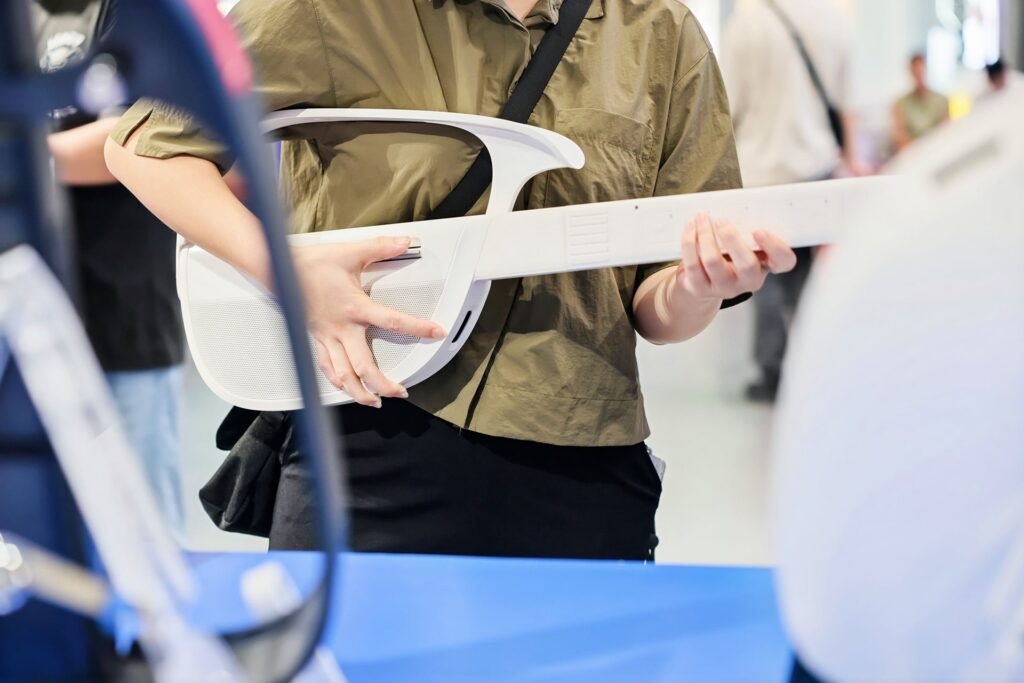
From perception to computation to sound output, multiple layers of technical configuration operate behind the scenes. Yet when a user picks up the U1, there is no need to understand the parameters. The intended experience is immediate and intuitive: a playable sound without formal training.
Around the hardware, an ecosystem is taking shape. The U1 supports nearly 40 instrument tones, including piano, harp, and ukulele, enabling varied performance needs with one device. It integrates three drum machine modes, allowing a single user to approximate a band effect. The dedicated app hosts millions of user co-created scores, according to the company, and sing-and-play videos can be exported and shared with one tap. The newly launched U1 dock and U1 quick-release strap are designed to reduce setup time before playing.
The timing of the U1’s launch appears deliberate. As sheet music libraries, sound packs, and user communities accumulate around the same hardware, LiberLive’s positioning is shifting from supplying stringless guitars to offering a faster pathway to music expression.
By reframing music performance as an interactive, emotion-driven, real-time activity rather than solely a skill-based system, LiberLive is attempting to flatten the learning curve, starting with the guitar. The next instruments to be reimagined could include the piano, the drum kit, or other tools long associated with high learning costs.
The broader instrument market is also adjusting its value anchor. As hardware parameter competition approaches saturation, incremental users are shifting their decision criteria from technical performance to immediacy. Legacy brands such as Yamaha and Roland continue to emphasize narratives of long-standing craftsmanship. LiberLive is taking a different approach, focusing less on making instruments more technically sophisticated and more on moving them from the professional shelf into the everyday flow of ordinary life.
KrASIA features translated and adapted content that was originally published by 36Kr. This article was written by Huang Nan for 36Kr.