


Rino.ai, an autonomous driving company, has completed a new funding round, with Ubiquant Partners, QF Capital, Oriza Rivertown, and Zhengjing Capital among the participating investors.
The funds will be used to accelerate mass production and market rollout of Rino.ai’s autonomous driving platform, strengthen its Level 4 R&D, expand operations in high-value scenarios such as on-demand delivery, and support international market expansion.
Founded in April 2019 by former Baidu execs Zhu Lei and Xia Tian, Rino.ai develops full-stack autonomous delivery systems and operates autonomous vehicle fleets at scale. In March, the company announced that Huang Gang, the former general manager of Dongfeng Commercial Vehicle, had joined as president.
With the latest raise, Rino.ai has completed three financing rounds in 2025, bringing its total funds raised for the year to more than USD 100 million. Courier company SF Express has previously invested in Rino.ai three times within a single year.
The pace of fundraising mirrors the company’s operational expansion. In December 2023, Rino.ai operated about 100 autonomous vehicles. That number increased to 200 in the first quarter of this year, 500 in the second quarter, and surpassed 2,000 by December. The fleet now operates routinely in more than 170 cities worldwide, representing more than 20-fold growth over two years.
The company said it has secured three of the largest direct key account clients in the courier and logistics sector and currently ranks first by new order volume, with large-scale deliveries underway.
The broader autonomous logistics industry targeted by Rino.ai is also entering a phase of scaled deployment.
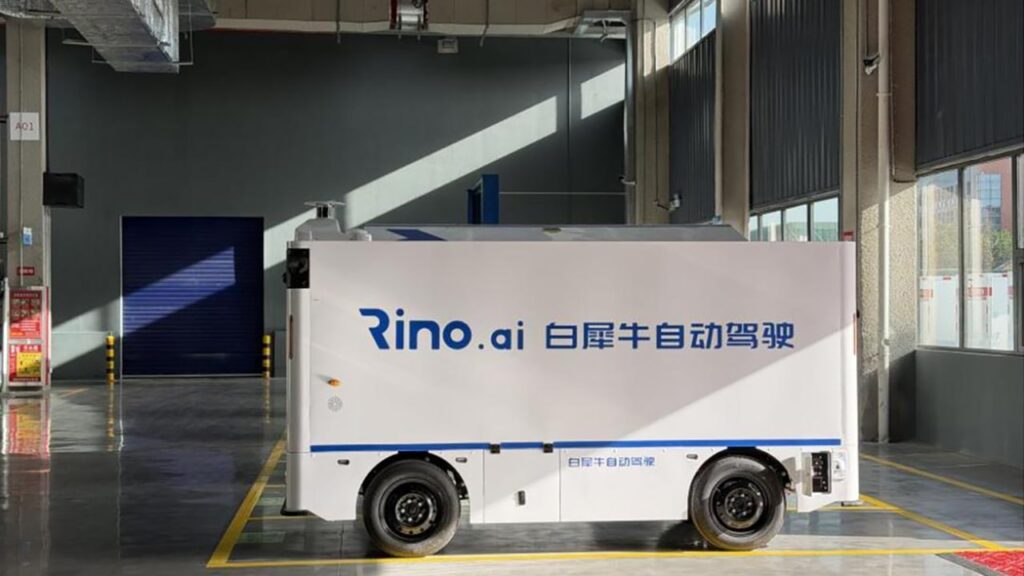
Rino.ai’s core product is the R5 autonomous cargo van, which offers a cargo capacity of 5.5 cubic meters, can carry more than 500 parcels, and has a fully loaded driving range of more than 120 kilometers per charge. The vehicle serves logistics companies including SF Express, ZTO Express, and China Post, and has reportedly been deployed in more than 170 cities in China.
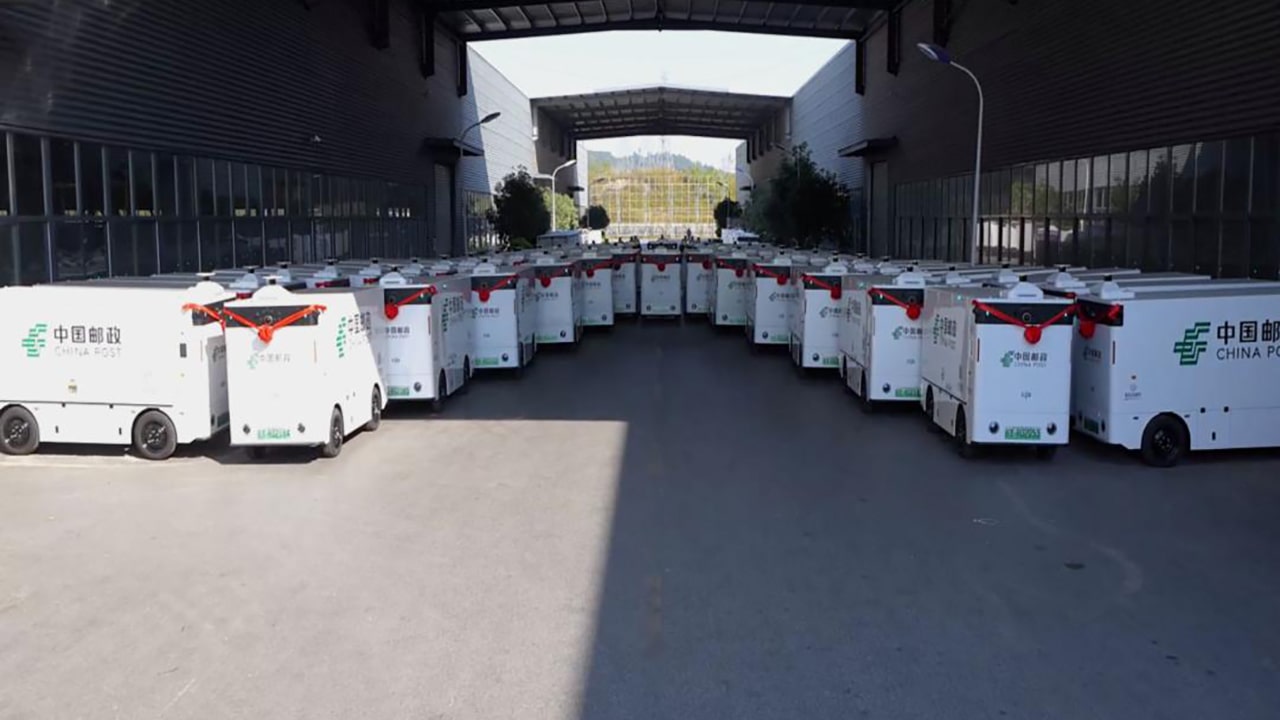
The R5 is designed for the segment between distribution centers and pickup stations. In urban areas, these routes are typically less than ten kilometers and follow largely fixed paths. Traditionally, this segment has relied on manually driven tricycles or small trucks, often requiring four to five trips per day while facing rising labor costs and efficiency constraints.
For autonomous vehicles, these short, fixed routes reduce technical complexity. High utilization rates also allow operators to amortize vehicle costs more quickly. At the same time, advances in assisted driving for passenger vehicles have lowered the cost of key components, including LiDAR (light detection and ranging) sensors used in autonomous systems.
As technology matures, costs decline, and demand increases, local governments have taken a cautious but supportive stance toward deployment. More than 103 cities have granted road access permissions for autonomous delivery vehicles, signaling the start of broader commercial rollout across the sector.
According to a report by McKinsey & Company, the global autonomous logistics vehicle market could reach RMB 3.6 trillion (USD 504 billion) by 2030. China is expected to account for about 40% of that total, or nearly RMB 1 trillion (USD 140 billion).
Rino.ai said its vehicles can reduce last-mile delivery costs by 30–50%. In one example provided by the company, a courier franchisee in Wuhan said it reduced per-parcel delivery costs from RMB 0.2 (USD 0.03) to RMB 0.1 (USD 0.01) after deploying Rino.ai vehicles, including vehicle depreciation and electricity expenses. This data has not yet been independently verified.
As annual delivery volumes increase, customer expectations are shifting from pilot programs to lower total lifecycle costs, higher safety thresholds, and longer service life.
This shift is accelerating demand for automotive-grade standards. While non-automotive-grade vehicles typically have lower upfront prices, they are more prone to failures under intensive use, driving up maintenance costs and causing service disruptions. A single vehicle taken offline can interrupt hundreds of daily deliveries. As a result, logistics operators are increasingly seeking vehicles designed to meet commercial benchmarks of up to eight years or 300,000 kilometers of service life.
Meeting automotive-grade requirements has emerged as a key competitive threshold for autonomous logistics providers.
Regulation remains a challenge. Autonomous delivery vehicles are not yet included in the motor vehicle catalog overseen by China’s Ministry of Industry and Information Technology, leaving their legal classification unclear. They currently fall between traditional vehicles and industrial equipment, and standards governing safety, testing, and liability are still evolving. In this environment, companies have been forced to define internal benchmarks, which may shape competitive differentiation in the next phase of the market.
Technical engineering presents a second hurdle. Automotive-grade components must operate reliably across temperature ranges from minus 40 degrees Celsius to 85 degrees Celsius and withstand electromagnetic interference and long-term vibration. From sensors to chassis systems, these requirements exceed those of consumer electronics and place heavy demands on supply chain coordination and manufacturing quality.
Rino.ai said it has developed an automotive-grade autonomous vehicle platform based on the “V process” used in passenger vehicle development. The modular platform is designed to support multiple use cases, including logistics, cold chain transport, and industrial parks. Related products are now approaching market launch.
The company added that it expects to be the first in China to mass produce and deliver automotive-grade Level 4 autonomous logistics vehicles.
KrASIA Connection features translated and adapted content that was originally published by 36Kr. This article was written by Xu Caiyu for 36Kr.