


On April 29, at the third China Embodied Intelligent Robot Industry Conference and Exhibition, Reconova delivered a keynote on breaking through bottlenecks in the scenario-based commercialization of embodied intelligence.
For the company, which has spent 14 years in artificial intelligence, the message was clear: machines are improving in their ability to understand the world, and may soon be ready to perform physical work. At a time when much of the industry emphasizes general-purpose capability and scale, it is positioning itself around real-world deployment and practical execution.
Reconova was founded in 2012. Since then, it has operated through two distinct eras of AI. In the early phase, the central technical challenge was perception: enabling machines to interpret images, recognize objects, and understand scenes. This period coincided with the rapid expansion of deep learning, and intense competition among computer vision companies.
Over time, that segment underwent a sharp consolidation. At its peak, thousands of companies claimed to compete in the space, capital flowed aggressively, and valuations rose quickly. A prolonged correction followed, marked by tighter financing, limited commercialization at scale, and increasingly homogeneous competition that compressed margins. Around 2019, many companies began to falter. Former unicorns were sold at discounts or shut down, outcomes that became increasingly common.
At the time, security and finance were among the most targeted sectors. Reconova instead focused on less prominent use cases: passenger processing in civil aviation airports, commercial real estate applications in shopping malls, and driver assistance safety systems for commercial freight vehicles.
From the outside, that appeared to be a conservative choice. That restraint, however, helped Reconova survive a period of high attrition while maintaining a leading market position, the company said.
That focus appears to have translated into a defensible position. According to Frost & Sullivan, by 2024 revenue, Reconova ranked first in China’s visual intelligence products market for civil aviation enterprises, with an 8.9% share. Its products are deployed in roughly one-third of China’s civil airports. Among large hub airports handling more than ten million passengers annually, coverage rises to two-thirds.
In the current AI cycle, the technical focus has shifted. Large models have expanded capabilities beyond perception to include action. For Reconova, this marks an inflection point.
Jhan Dennis, founder and chairman of Reconova, described the transition: “Over the past 12 years, we have been building eyes, using vision to perceive and understand the physical world,” he said. “But now we are starting to move forward, toward the brain and the hands. On the basis of understanding the world, we are starting to make decisions, carry out execution, and help people get things done.”

The company is expanding its focus from perception and cognition to decision-making and execution, with the aim of building a closed-loop system. It is positioning itself as a provider of embodied intelligence products for commercial scenarios and complex operations.
Much of the current narrative around embodied intelligence emphasizes general-purpose capability. Systems that can adapt across multiple scenarios tend to attract stronger investor interest. That framing can disadvantage companies focused on vertical applications.
Jhan takes a different view. General-purpose capability, he said, defines competition among platform companies and depends on scale, ecosystems, and early data network effects. In contrast, barriers in vertical scenarios are built through detailed understanding of workflows and repeated problem-solving with customers, not through model size alone.
On the technical front, Reconova outlines a three-layer framework:
- The first layer is perception, built on its experience in visual algorithms, including object recognition, spatial understanding, pose estimation, and real-time perception in unstructured environments.
- The second layer is decision-making, centered on a self-developed visual-language-action (VLA) model. The company is developing VLA systems tailored to vertical scenarios, integrating visual perception, natural language understanding, and motion planning into an end-to-end framework. The aim is to enable robots to interpret scenes, make context-aware decisions, and generate corresponding actions. Reconova said it has extended this approach by incorporating force and tactile sensing, an architecture it refers to as VTFLA.
- The third layer is execution, supported by in-house development of physical components. This includes work on grasping strategies, force control, and adaptable end effectors. Reliable execution in unstructured environments remains a key engineering challenge and a barrier to large-scale deployment.
Reconova’s commercialization strategy reflects these constraints. Jhan said complex, unstructured, and specialized scenarios are likely to reach commercial viability before general-purpose applications.
General-purpose robots face dual constraints of technical capability and cost. They must generalize across tasks while meeting procurement thresholds for enterprise customers. Achieving both simultaneously remains difficult. In contrast, specialized systems can be optimized within known constraints, making them more viable commercially.
Civil aviation is Reconova’s initial entry point for embodied intelligence. Its first deployment scenario is baggage handling.
Baggage handling is among the most labor-intensive processes in aviation. Recruitment is difficult, turnover is high, and efficiency varies with weather and shift schedules. Airports have struggled with these issues for years.
In practice, the environment presents multiple challenges. Baggage varies widely in shape and material, from rigid suitcases to soft bags and irregular items. Each requires different handling approaches. The physical environment is also inconsistent, with narrow pathways and tight equipment spacing, requiring real-time navigation. In addition, operations require close coordination between humans and machines, where delays in perception or decision-making could introduce safety risks.
These constraints limit the effectiveness of general-purpose robots in such settings. While they may function across multiple scenarios, consistent performance in demanding environments remains difficult. Cost structures also limit their return on investment in labor-replacement use cases.
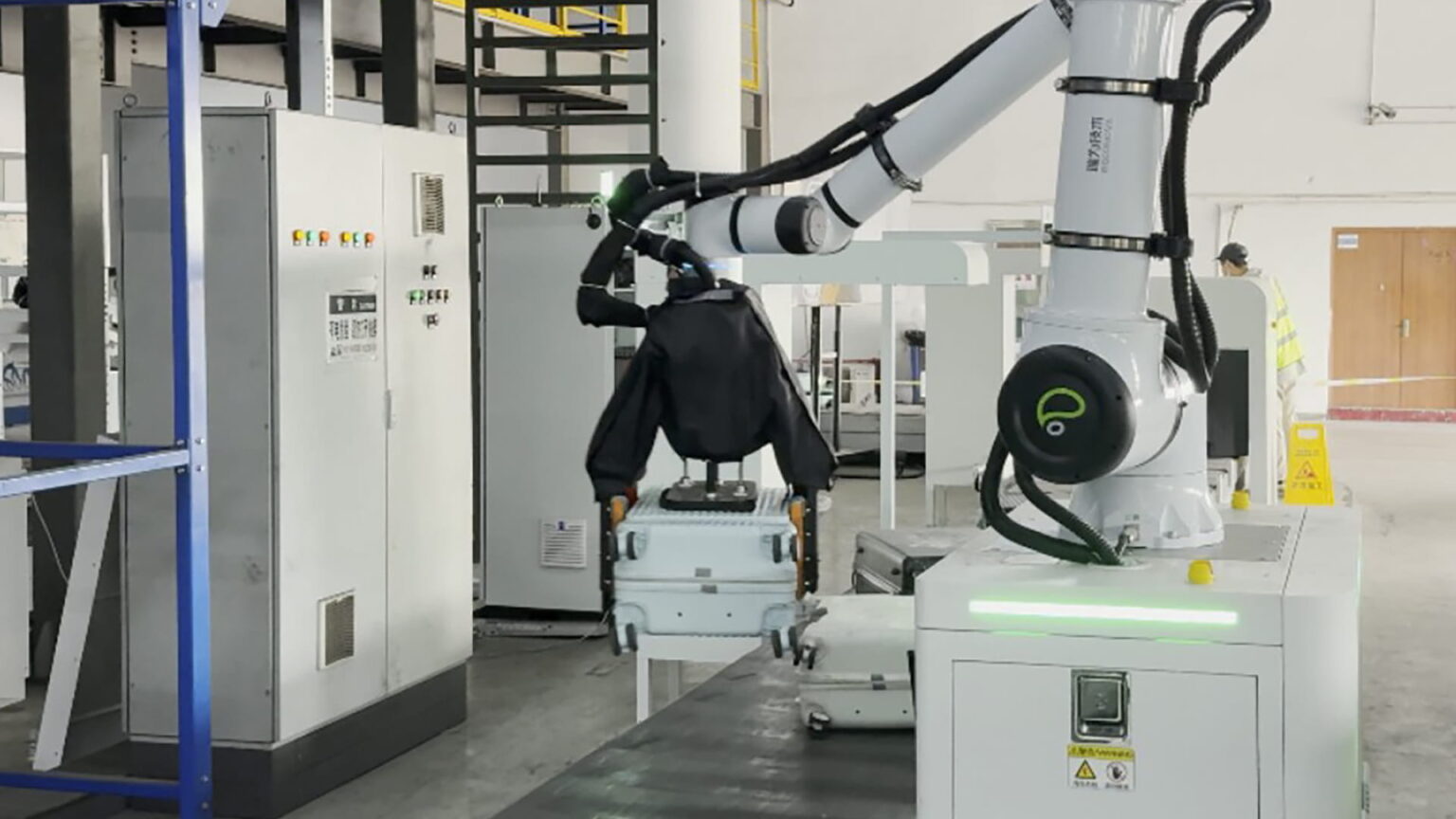
Reconova has responded by developing a robot designed specifically for airport baggage handling. At the 2025 International Airport Expo, its AntOne robot demonstrated the ability to move and stack baggage of varying shapes in a simulated transfer zone.
The company said the system incorporates a human-machine collaborative operating model. The robot performs repetitive transport and stacking tasks, while human workers intervene in edge cases. According to Reconova, this division of labor improves overall efficiency compared with fully manual operations.
Jhan said pilot deployments at airports indicate that AntOne reduces labor dependence and physical strain on workers. He added that system throughput has increased by 30%, while baggage damage rates have declined to 0.12%.
Reconova is conducting trials at multiple airports and plans to begin commercial deployment in the second half of the year. It is also exploring international markets, including Southeast Asia and the Middle East, where similar operational challenges exist.
In a field often defined by broad ambitions, Reconova has taken a narrower approach, focusing on a specific problem and measurable outcomes in real environments.
Within the embodied intelligence landscape, it does not fit neatly into either general-purpose robotics or traditional computer vision. It positions itself as a provider of systems designed for complex scenarios and precise physical operations.
As with previous technology cycles, interest in robotics may fluctuate. Systems that demonstrate reliability in demanding conditions are more likely to persist. Reconova’s strategy, centered on depth over breadth, reflects that view and defines its position in the current market.
KrASIA features translated and adapted content that was originally published by 36Kr. This article was written by Xiao Xi for 36Kr.