



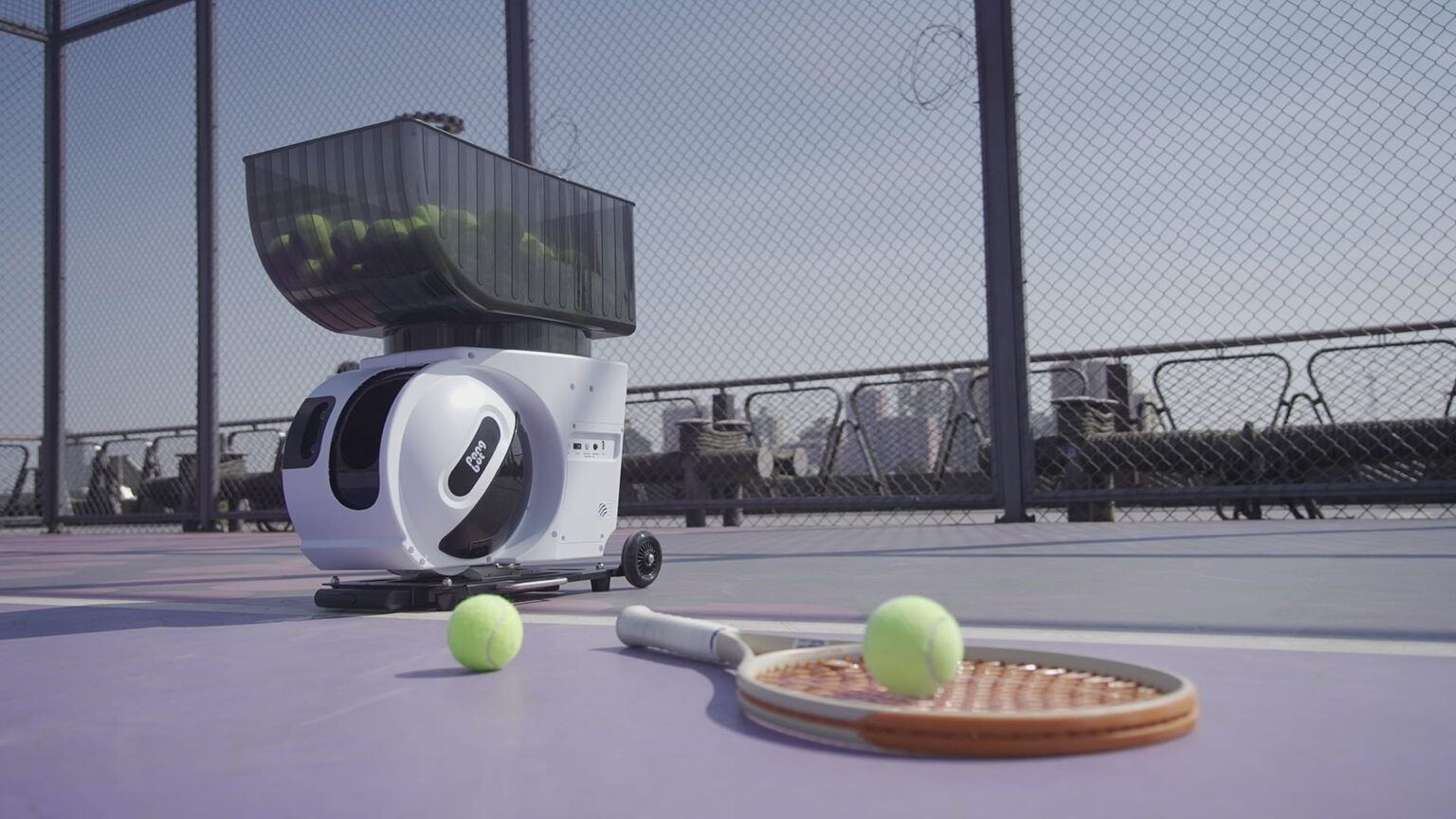
To find Zhang Haibo, founder of Pongbot, one place to look is the ball courts near the company.
Zhang is an avid player across multiple ball sports. In October 2025, shortly after the company completed its own tennis court, he began learning tennis using one of Pongbot’s ball launching robots. When 36Kr met him, he said that after six months of training, he had reached an NTRP 3.0 level, typically considered intermediate and often requiring one to two years for recreational players to achieve. He did not hire a coach or practice partner. The robot served as his sole training companion.
Zhang’s background in table tennis predates this. Early in his career, he was among the first engineers in China to apply reinforcement learning to table tennis rallies. While working at a listed company, he developed a robotic arm system capable of rallying with human players. The system, priced at more than RMB 200,000 (USD 29,293.3), was used for data analysis by China’s national team and could compete with professional players. Zhang later concluded that such systems were more demonstrations of technical capability than viable consumer products.
Rather than focusing on high-performance demonstrations, Zhang spent time observing players across courts in China and overseas. He found that most users did not need robotic opponents. They needed access to coaching, practice partners, and structured training tools. Existing ball launching machines, he said, were limited to repetitive, mechanical delivery, lacking variation in rhythm, spin, and guidance.
These observations led Zhang to found Pongbot in 2019. His goal was to use robotics to deliver a training experience that is consistent, accessible, and grounded in coaching principles.
Market response came quickly. In October 2024, Pongbot launched its Pace series of tennis ball launching robots on Kickstarter, raising more than USD 2.7 million. During the 2025 Black Friday period, its overseas monthly sales reportedly reached an eight-figure RMB sum. The company now has more than 300,000 users worldwide.
36Kr has learned that Pongbot recently completed a Series A round. Across three rounds, the company has raised nearly RMB 200 million (USD 29.3 million), with investors including Pegasus Capital, Future Capital, Lanchi Ventures, Jinqiu Fund, and China Growth Capital. Cygnus Equity served as financial adviser.
Investor interest reflects broader market dynamics. According to the International Tennis Federation, global tennis participation reached 106 million as of November 2024. In the US, there are roughly 800 active players per coach, indicating a shortage of professional instruction. In China, tennis participation is rising among urban professionals and middle-class families, though lesson costs, often hundreds of RMB per hour, remain a barrier. Pongbot positions its products as a potential alternative.
The following transcript has been edited and consolidated for brevity and clarity.
36Kr: You first started building robots about a decade ago.
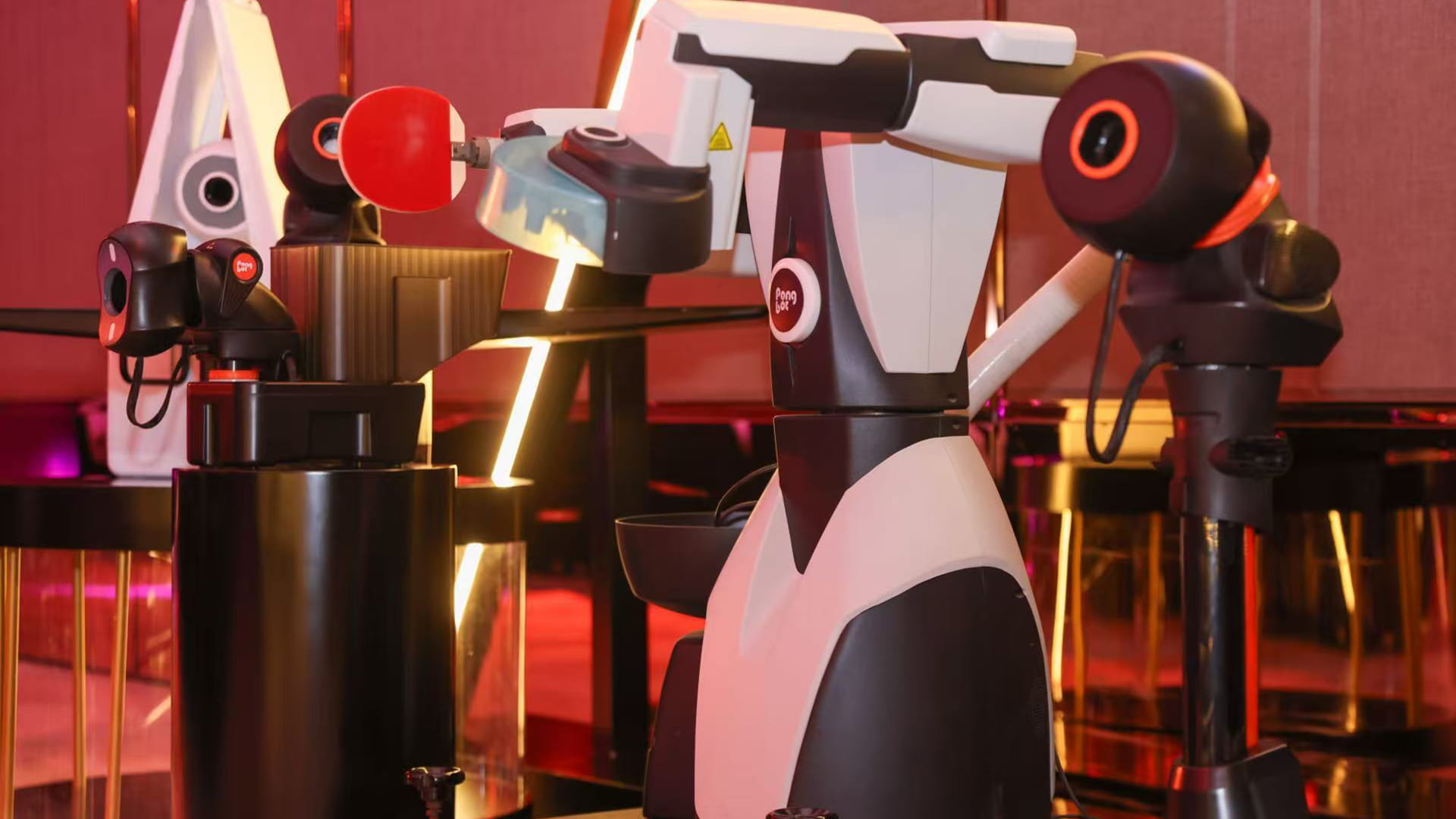
Zhang Haibo (ZH): The first-generation robot I built was a table tennis rally robot. Unlike the ball launching robots commonly seen today, or humanoid robots used to play ball sports, it used a robotic arm structure to rally with human players. It was an embodied system with autonomous judgment and decision-making capabilities.
We captured information from images, fed it into a model, and let the model control the robotic arm to send the ball to the location we wanted. Because the ball spins in table tennis, we developed many patents around how the ball flies, how to predict its path, and how to intercept it. We also did a lot of data analysis for the national team.
But back then, we were not pursuing productization. We were pursuing higher, faster, and stronger performance. We wanted to beat others, so the equipment cost was also very high, with each unit priced at more than RMB 200,000.
36Kr: Sports is a field that depends heavily on industry know-how.
ZH: During those four years, we built up a deep understanding of sports, from beginners to serious enthusiasts to professional athletes. Very few people get to see that full path.
I could feel how much those enthusiasts wanted tech products. Every time we spoke, they were excited. That gave me the idea to start a company and stop making equipment that cost more than RMB 200,000. Products like that are cutting-edge, but their user base is limited, and they solve pain points for only a small number of people. I wanted to build a sports technology product that ordinary enthusiasts could afford and actually use.
36Kr: Sports hardware on the market has very distinct positioning. How should we think about the boundaries between different scenarios and product positioning? What considerations led Pongbot to settle on its current direction?
ZH: Broadly speaking, we can divide the wider sports market into four directions:
- Sports, meaning activities with complete competitive rules and the possibility of professional competition, such as soccer, basketball, and tennis. That is the track Pongbot is targeting.
- Recreation, which leans more toward leisure and entertainment, such as darts, frisbee, and billiards. Overseas, some table tennis scenarios also fall into this category, where the sport is used more for social gatherings and casual fun.
- Outdoor, which focuses on personal breakthroughs in activities such as mountaineering and rowing, where users care more about pushing physical limits and setting personal records.
- Fitness, meaning exercise aimed at body shaping and physical conditioning.
These four categories are not completely disconnected, but from the perspective of building specialized products for enthusiasts, the boundaries are clear. Pongbot is focused on sports, along with some entertainment-oriented scenarios related to sports and recreation. At this stage, it has nothing to do with fitness or being outdoors.
36Kr: Traditional ball machines have existed for decades, but most are stuck at mechanical ball delivery, with almost no real innovation in user experience. What is the core problem Pongbot wants to solve?
ZH: In sports scenarios, users are in only one of three states: just playing for fun, training, or competing. Those three scenarios are mutually exclusive. On the court, a user can do only one of them at a time. That determines where we put our emphasis when building products.
Pongbot focuses on training. What users really need is not a machine opponent. Competition itself has a strong social element. Even if a machine can rally with users, they will eventually go back to competing against other people. Many people think a robot that returns balls is novel, but the underlying need is not really having a practice partner. It is being able to have the machine support their practice. Practice is the core need.
In mainstream sports, it is easy to find opponents, and sometimes free practice partners are not in short supply. Good coaches, however, are hard to find. Either you cannot find one, the coaching style is not a good fit, schedules are difficult to match, or the cost is too high. Even if users hire a coach once a week, during the rest of their independent training time, whether they are juggling the ball, shadow swinging, using a ball machine, or hitting against a wall, they still hope to have a coaching figure beside them. That coach does not have to feed balls constantly, but should be able to keep watching and provide real-time guidance. Right now, almost no product truly meets those needs.
36Kr: What are the characteristics of these user groups?
ZH: There are clear differences between domestic and overseas users in how they train. Overseas, most sports barely have a purely recreational phase. People either do not participate at all, or they begin with professional coaching, so awareness of training is generally stronger. In China, users often start from casual interest and then gradually move toward systematic training.
That also determined that our first-generation products mainly served experienced sports enthusiasts, people who had already mastered certain skills and wanted to improve. These users understand the sport itself. They want to win more points in real matches, but often lack clear training goals and need equipment to help them practice.
For these users, the economics are easy to calculate. Even lower-end offline coaching sessions cost around USD 100 an hour, while advanced lessons can run anywhere between USD 200–500. Pongbot’s ball launching robots are priced in a range of USD 1,000–5,000. Whether used as a daily training tool or as an artificial intelligence-driven coach that replaces part of a human coach’s role, they offer strong value for users who train over the long term.
36Kr: From table tennis to tennis, and then to pickleball, badminton, and more, how has Pongbot chosen which sports scenarios to expand into?
ZH: Pongbot positions itself as an AI-powered robotics company for multiple sports. Sports themselves have no borders. We started with table tennis because it was the sport we knew best. The team already had plenty of sports data and technical know-how, so we could launch products quickly and get the company off the ground.
When choosing the second sport, we had only one criterion: it had to be global. Compared with badminton, whose audience is concentrated mainly in China and Southeast Asia, and baseball, which is more concentrated in the US and Japan, tennis has a highly global footprint. Later on, we will continue to break through one global category at a time, including pickleball for the US, padel for Europe, and baseball for Japan.
36Kr: Different sports involve very different movement patterns and shot logic. Is there real transferability in the algorithms behind them?
ZH: Table tennis, tennis, pickleball, padel, and badminton can all be grouped as net sports. At the foundational level, they are highly similar. The court environment is relatively fixed, and the tactical framework of moving forward, dropping back, attacking, and defending is basically the same. Rules around whether shots land in or out, forehand and backhand mechanics, and the timing of offensive and defensive transitions are also highly similar.
But table tennis is the most difficult scenario among them. Its variables are more complex. The dimensions of spin are more varied, the differences in rotation speed are greater, rallies are extremely fast, and offensive-defensive transitions happen within a few hundred milliseconds.
By comparison, tennis has fewer variations in spin, and a single exchange lasts close to two seconds, so the control difficulty is much lower. Once we solved the hard technical problems in table tennis, including ball launch control, visual perception, and AI models, moving into other net sports such as tennis allowed us to create an overwhelming advantage very quickly.
36Kr: At the product level, how do these capabilities show up?
ZH: We break our AI coach programming down into three core capability modules: hands, eyes, and brain.
- The “hands” correspond to the ball launch and ball feeding system, which can accurately reproduce the trajectories and spin a professional coach would deliver.
- The “eyes” are the visual perception system, responsible for capturing sports scenarios and movement data in real time.
- The “brain” relies on large models to enable natural language interaction, analyzing and providing feedback on a user’s stroke mechanics and tactical thinking.
In practical scenarios, it mainly offers two capabilities. One is ranking a user’s ability level and creating a personalized training plan. The other is delivering real-time movement guidance and voice feedback.
36Kr: Of the three modules, which one is currently the most mature in real training?
ZH: The one where we have built the deepest foundation is still the “hands,” meaning the ball launch and feeding system.
Multi-ball training is the core training method in net sports such as tennis, table tennis, and badminton. Usually, we see a coach standing in a fixed position with a basket or cart of balls, feeding balls to different spots: one to the left, one to the right, one short, and one deep to the baseline.
In that process, the coach’s most important role is not dwelling on a single mistake. The coach assumes the movement remains effective and keeps delivering the next ball steadily.
That may sound counterintuitive. Many people assume an AI coach should correct mistakes in real time. But in fact, during basic training, ignoring mistakes is far more important than correcting them. The essence of training is forming muscle memory through large volumes of repetition along fixed ball paths, not breaking rhythm with random interruptions.
Our robots are designed according to that principle. They deliver balls steadily from a fixed position, along preset routes and rhythms. They do not chase the player and do not disrupt the rhythm. That helps users efficiently complete thousands of standardized repetitions.
The ball launching capability of the “hands” is the basis of all intelligent guidance. Without stable, precise, and repeatable ball feeding, the visual perception and intelligent analysis that come later have nothing to build on. Only when the balls are delivered correctly and consistently can users enter an effective training state, allowing the visual system to capture meaningful movement data, and large models to analyze and respond with the right context.
That is why we insisted on building the “hands” first, rolling out products, accumulating data on shot patterns and user training behavior, and then gradually adding the capabilities of the “eyes” and the “brain” while continuing to iterate.
36Kr: When expanding from one sport into another, what is the core difficulty at the product definition level?
ZH: Every time we focus on a new sport, understanding the sport itself is crucial. Different sports test different human limits. Tennis emphasizes repeated sprinting and power. Table tennis tests instant reaction and fine hand control. Badminton requires coordination in shifting between high and low positions, along with jumping ability.
The core question is this: what exactly are we using AI to deliver? What capabilities should the brain, eyes, and hands provide in this sport?
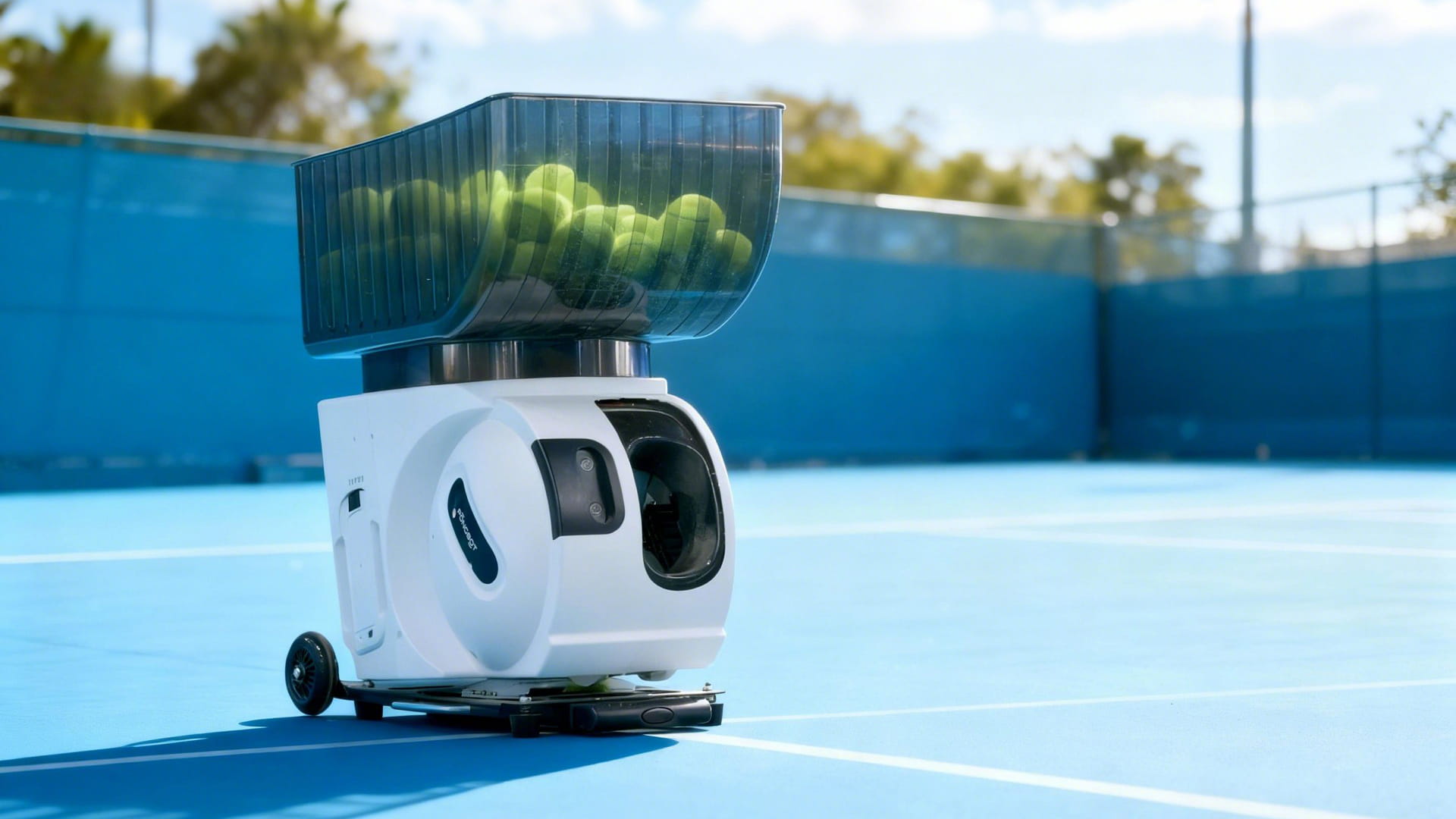
Take our tennis ball launching robot as an example. We did not choose to use cameras. Instead, we developed our own sensors to track the user’s movement in real time. That is because the movement range on a tennis court stretches across hundreds of square meters, and when a coach feeds balls, the coach needs to decide the timing and placement of the next ball based on where the player is moving. That is the key difference we identified, and also one reason the product has gained user recognition. Simply scaling up the previous generation’s functions would not have worked. In the end, it still comes down to understanding and defining the scenario.
36Kr: Where do the hardware barriers show up?
ZH: The hardware barriers in sports are actually very high, but users do not perceive them as strongly.
Our tennis ball launching robot uses custom motors and a self-developed drive system. It can generate topspin and backspin of up to 60 revolutions, closely reproducing the spin intensity and ball trajectory of professional-level shots, with measured ball speeds reaching 130 kilometers per hour. Some products previously on the market had actual ball speeds of about 80 kilometers per hour. But for ordinary users, those specifications are abstract, so the differences are hard to perceive directly.
36Kr: Given that users differ in athletic ability, standards for what counts as effective training and improvement may also differ. What dimensions do you use to judge whether your product is truly effective for different users?
ZH: Users really care about only one thing: can I actually get better? Improvement means practice becomes more efficient.
Pongbot’s platform has already accumulated one million shot patterns, with more than 200,000 in tennis alone. Once the dataset becomes large enough, we can make the balls launched by the robot feel like they are coming from a real person. More specifically, that sense of realism means the balls match the user’s current level. They are comfortable enough to return, but not so comfortable that they stop being challenging.
On that basis, the system will clearly tell the user after each session where progress has been made and what still needs improvement, whether that means stepping a little farther forward or keeping the center of gravity slightly higher. After just two or three days of following that guidance, users can clearly see the difference. The same shot becomes noticeably more stable, and that feeling is very direct.
That is the kind of concrete improvement users want, not a flashy concept. In the end, the key point is simple: after using the machine, their performance is actually improving.
36Kr: In the past two years, many new forms of ball launching robots have emerged, including mobile chassis, net-based ball collection, and fully autonomous movement. How are those products different from Pongbot’s?
ZH: Some structurally novel products have appeared, and at first they are certainly eye-catching. But once the novelty wears off, those products still have to answer one core question: do they really help users improve?
If the answer is no, they will not achieve long-term usage or repeat purchases. Market data supports that as well. Many similar products do not have high repurchase rates or strong user activity. More often, courts or venues buy them as experiential attractions.
That is why, in our multi-sport product matrix, every time we enter a new sports category, the first product still starts from the professional training scenario. We prioritize professional athletes and serious enthusiasts, using stable and reliable performance and quantifiable training results to build recognition and trust among core users.
One defining feature of the sports industry is that no single product can serve the entire market. User demand is highly fragmented. If your first product does not establish that position in users’ minds, it will quickly be replaced.
No matter what market you target, or what age group the users belong to, the core demand in sports remains professionalism and reliability. When consumers buy a tennis racket today, for example, they are more inclined to choose one associated with Roger Federer, because it represents authority. That has less to do with the signature itself than with the fact that professional positioning gives users a sense of identification and trust.
36Kr: How does that translate into product and pricing strategy?
ZH: In table tennis, for example, our product line extended downward from the high end. We first made equipment priced at RMB 100,000 (USD 14,646.6) and above to establish the label. Then we gradually introduced midrange models priced above RMB 6,000, (USD 878.8) followed by mass-market versions priced above RMB 1,000 (USD 146.5). The price points continued to move downward.
Tennis ball launching robots follow the same path. We define the positioning and boundaries of every product very clearly, so users at different price points can all get an experience that is both suitable and professional.
Professional athletes willing to choose equipment priced at RMB 100,000 care most about movement fidelity and training realism. Serious enthusiasts buying products in the RMB 5,000 (USD 732.3) range care more about spin, speed, and data analysis, hoping to use the equipment to keep improving. Models priced at around RMB 2,000 (USD 292.9) can satisfy beginners’ practice needs while also fitting family leisure and parent-child use.
36Kr: Looking at the broader market, is it developing at the speed you imagined when you started the company?
ZH: I think it has been slower than expected, but I am still satisfied. In the past, the penetration rate of ball launching machines among professionals and enthusiasts was below 10%, because traditional products offered a poor experience. The technology was outdated, the functions were limited, and little had changed for decades. Now, with digitalization and AI, along with China’s mature supply chain capabilities, the room for growth has opened up.
36Kr: A large number of startups are entering intelligent sports hardware. How do you view this wave?
ZH: In the past, very few people started businesses in sports. There is no reason sports should not become one of the industries with the highest density of technology. I think that trend is already happening, and it has become much more visible over the past two years.
The technological density of an industry is, in essence, the density of technical talent. That is an important indicator. Sports deserves more attention, especially from the tech sector. Only then can R&D generate new solutions and better products for users, forming a positive cycle.
More companies are emerging, and that is a good thing. They are helping drive incremental growth and expand the market. That is the first milestone we have been waiting for.
KrASIA features translated and adapted content that was originally published by 36Kr. This article was written by Huang Nan for 36Kr.
Note: RMB figures are converted to USD at rates of RMB 6.83 = USD 1 based on estimates as of April 20, 2026, unless otherwise stated. USD conversions are presented for ease of reference and may not fully match prevailing exchange rates.