

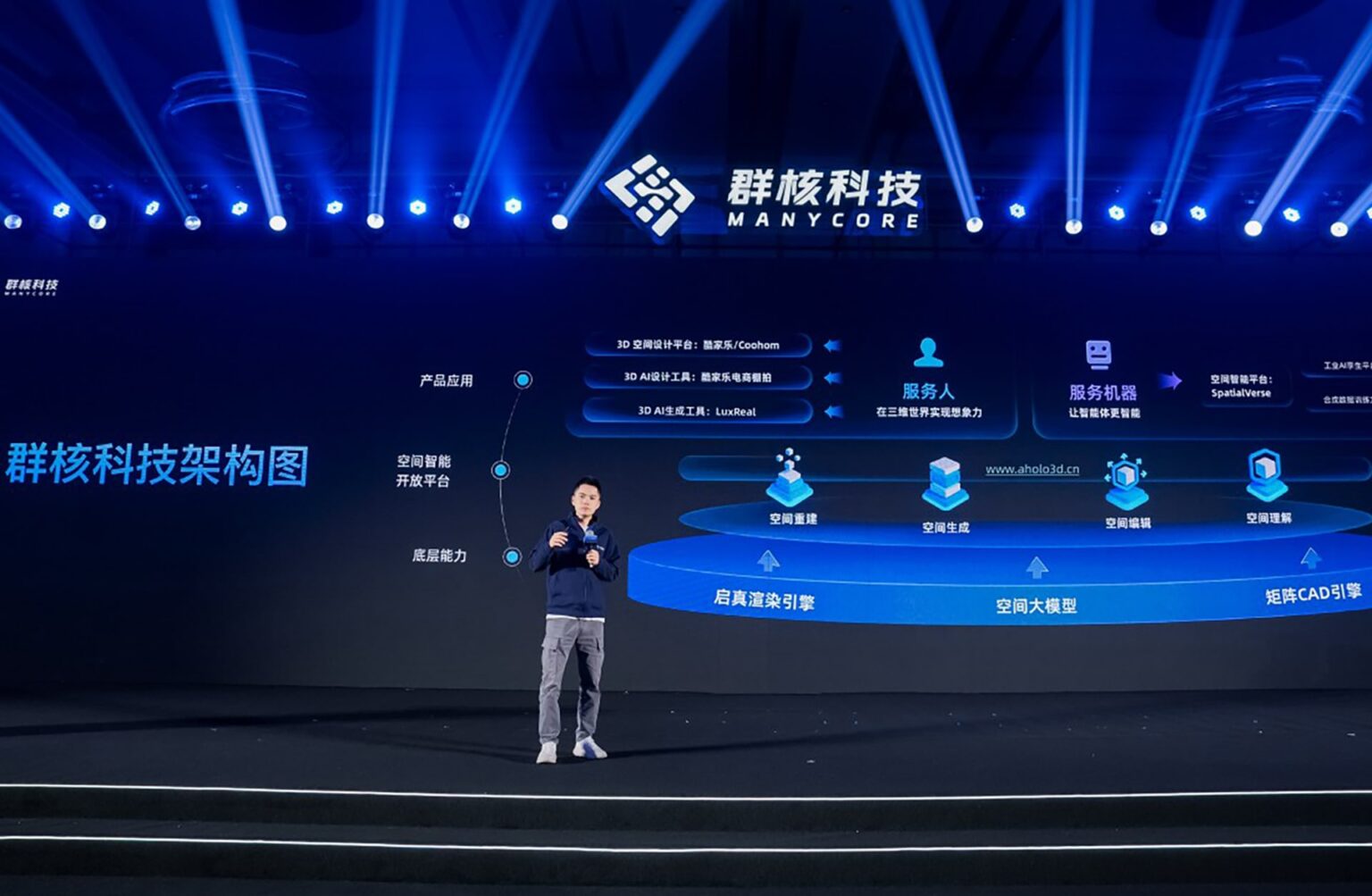
On December 9, Manycore officially launched Aholo, a spatial intelligence platform, and LuxReal, an artificial intelligence-driven tool for 3D content creation. The announcements were made at the Intercontinental Hangzhou Liangzhu during the company’s 2025 Cool+ Conference.
Founded 14 years ago as a cloud-based 3D design software company, Manycore is best known for its flagship product Kujiale. It has since evolved into a diversified technology provider with four product lines: Kujiale, SpatialTwin, SpatialVerse, and Aholo. Its technology now spans applications in home design, industrial manufacturing, and robotics training.
As generative AI matures and large language model development converges, the industry’s focus has shifted toward world models that enable AI to understand and interact with the physical world.
At the conference, co-founder and CEO Chen Hang said Manycore is transitioning from a 3D space software company to a provider of spatial intelligence infrastructure.
The newly released Aholo platform integrates four capabilities: spatial reconstruction, generation, editing, and understanding, available to developers and enterprises through APIs and SDKs. According to Manycore, Aholo enables the rapid creation of high-fidelity holographic 3D spaces from multimodal inputs such as photos, videos, or panoramic images.
Spatial reconstruction employs 3D Gaussian reconstruction to transform real-world environments into navigable digital spaces. With only a few photos or short video clips, users can complete a reconstruction in minutes.
During the event, Manycore demonstrated how engineers used this technology to recreate a 60-year-old photo studio in Hangzhou, preserving the memory for its 70-year-old owner. The project inspired Zein, a Syrian travel blogger in China, to digitally restore Shisi Temple, a heritage site in Zhejiang’s Lishui city.
Spatial generation allows users to automatically create physically coherent 3D scenes from text, image, or video prompts. On stage, Chen displayed an old photo of Manycore’s first office and used the company’s SpatialGen model to generate an immersive digital version of the space.
“That office no longer exists. We only had a photo, but with spatial generation, we can once again revisit where our journey began,” Chen said.
Spatial editing focuses on building, modifying, and rendering 3D spaces. In a live demo, the team reconstructed the conference venue using 3D Gaussian technology, then transformed it into a virtual car showroom through hybrid rendering techniques.
Spatial understanding enables AI to interpret 3D environments. Manycore’s SpatialLM model can recognize spatial objects, analyze relationships, and generate structured physical data, which is crucial for robot training, where AI must understand, for example, the physical conditions required to “sit on a chair.”
These capabilities draw on 14 years of accumulated data. Chen said Manycore currently maintains the world’s largest dataset of indoor spatial scenes, including around 500 million structured 3D environments and 440 million product models. Millions of users across more than 200 countries create design plans daily on Kujiale and its international platform, Coohom.
Aholo is now in closed beta, with applications in film and television, extended reality, cultural heritage preservation, industrial twins, and robotics simulation. Manycore also announced collaborations with Huace Film & TV, which will use Aholo for virtual set generation, and Pico, with which it plans to build the world’s largest interactive XR asset library.
Fixing spatial inconsistencies in AI-generated video
Alongside Aholo, Manycore unveiled LuxReal, designed to address one of AI video generation’s biggest flaws: the lack of spatial consistency.
Current video models often produce distorted characters or shifting objects between shots. In one demo, a video prompt asked AI to animate a Gundam robot performing a Sailor Moon dance with cinematic camera motion. Results from existing models varied: some lacked cinematic flair, while others nailed the camera work but produced warped, inconsistent subjects.
The root cause, Chen explained, is that most models are trained only on 2D image or video data and lack an understanding of 3D structure and physics.
LuxReal integrates 3D modeling to solve this issue. Built on Manycore’s Lux3D generation model and combined with image and video generation models, LuxReal features what the company calls the industry’s first 3D multi-agent system. This system generates spatially consistent, controllable videos from multimodal inputs such as images or 3D models, balancing stability and creative flexibility.
“We want AI-generated videos to truly ‘understand space,’ producing content that’s stable, controllable, and realistic,” said Long Tianze, Manycore’s AI product director.
He added that LuxReal’s two technological pillars, the Lux3D model and multi-agent system, form a unified generation pipeline that spans 3D understanding, rendering, and video enhancement. This architecture improves spatial consistency and expands applications in e-commerce, industrial design, gaming, and advertising.
Integrating 3D increases computational demands. Long acknowledged that LuxReal consumes more GPU power than standard video models but said Manycore’s optimization in real-time rendering keeps compute costs manageable.
To achieve optimal results, LuxReal combines multiple video models for different scenarios, using third-party models for creative generation while maintaining spatial integrity through its own system.
LuxReal is now inviting global testers and will begin closed beta testing later this month.
Commercialization remains at an early stage
During the post-conference media session, Manycore’s leadership spoke candidly about the difficulty of monetizing AI.
“Everyone has heard of AI and it sounds great, but getting customers to pay real money for it takes serious work,” Chen said. “Products must deliver core value that translates into measurable business outcomes.”
He cited Kujiale’s AI-driven design platform, launched earlier this year, claiming that it helps sales consultants to complete full home designs in five minutes. The process reduces manual clicks from 10,000 to as few as 10.
“The point isn’t fewer clicks, but whether those ten actions can help customers make tens of thousands of RMB,” he said.
This philosophy, improving efficiency in ways that generate tangible business value, has reshaped Manycore’s business model. The company previously charged on a per-seat basis, but with AI-driven workflows, machines now make more API calls than human users.
“If we only charge annual or monthly fees, the system gets overloaded. But if we switch entirely to token-based pricing, the entry barrier becomes too low,” Chen explained. “We’re adopting a hybrid model combining subscription and usage-based billing.”
Chen noted that Chinese enterprises are often cautious about adopting AI and typically take longer to validate its return on investment. “It’s tough to get clients to spend more without proof of value,” he said. “Fortunately, our strong client base and margins give us room to keep investing in AI.”
Manycore said Kujiale’s AI design platform has been adopted by more than 30 brands, including Kuka Home, Oppein, and Beike. Earlier this month, its international version was launched for clients in South Korea, Thailand, and Europe.
Powering embodied intelligence through spatial training
Manycore’s spatial intelligence technology also supports embodied AI and robot training.
At the conference, Motphys and D-Robotics announced collaborations with the company’s SpatialVerse platform to advance robotic simulation and training.
“Robots must be trained in virtual environments before they can operate in the real world,” said co-founder Huang Xiaohuang. “That requires massive volumes of 3D synthetic data that accurately reflect physical laws.”
He noted that few companies worldwide can generate physically accurate synthetic datasets. “Most domestic players rely on photography rather than structured 3D data,” Huang said.
Manycore’s edge lies in its vast spatial dataset and its use of 3D Gaussian reconstruction, which enables realistic digital replicas of physical environments, narrowing the gap between simulation and reality.
“For a robot to learn how to move a chair, it needs at least 100,000 training samples. If each dataset costs RMB 1,000 (USD 140), that’s a RMB 100 million (USD 14 million) data bill,” Chen said, emphasizing the scale of the challenge.
While the robotics field is increasingly competitive, Huang remained optimistic. “The market is unpredictable, but we’re still in the game, and we haven’t missed this era’s opportunity,” he said.
Earlier this year, Manycore also launched SpatialTwin, its industrial AI platform, recognized as one of the top innovations at the Light of Internet Expo during the World Internet Conference. The platform has partnered with Hangcha Group and Standard Robots on industrial digital twin projects.
KrASIA Connection features translated and adapted content that was originally published by 36Kr. This article was written by Deng Yongyi for 36Kr.