

The assisted driving industry has gone a long time without a clear leader.
At the Auto Guangzhou show, DeepRoute.ai announced new commercial milestones. So far, 200,000 mass produced vehicles equipped with its city navigate-on-autopilot (NOA) system have been delivered. In October, the company said it captured nearly 40% of the monthly market share among third-party suppliers of city NOA systems.
Just over a year ago, both figures were zero. It took DeepRoute.ai 14 months to go from no mass production to deployment across more than ten vehicle models. The company has quickly reshaped the market landscape and become one of the most visible frontrunners this year.
As consolidation in advanced assisted driving approaches its final stage, third-party suppliers are widening their advantages and forming a market in which only a few players hold most of the share. Riding momentum that took it from zero within 14 months, DeepRoute.ai is widely viewed as having secured the last major position in the top tier, standing with Huawei and Momenta in a three-way standoff.
The year 2024 was a critical period for DeepRoute.ai’s commercial breakthrough. The company secured the project for Great Wall Motor’s (GWM) Wey Lanshan, becoming a core assisted driving supplier to the automaker.
DeepRoute.ai then completed mass production of full-scenario city NOA solutions in eight months. After the city NOA-equipped Lanshan launched, its monthly sales rose to 6,019 units, nearly tripling month-on-month.
The model’s strong performance boosted GWM’s confidence. In November, DeepRoute.ai received a USD 100 million Series C investment exclusively from GWM, signaling both financial support and a deepening of the partnership.
Other GWM models, including the Wey Gaoshan MPV and the Tank 500 SUV, also come equipped with DeepRoute.ai’s city NOA system. These refreshed smart driving models have seen rising sales. The Tank 500 moved into the top ten of its segment, and sales of the Wey Gaoshan climbed nearly tenfold to about 10,000 units, topping the MPV sales chart in October.
As advanced assisted driving shifts from a value-added feature to a focal point of competition, it is increasingly influencing product sales and brand positioning. GWM’s recent success has helped accelerate industry recognition of DeepRoute.ai, and the company’s partner network continues to expand.
In September, Geely’s Galaxy M9 launched with DeepRoute.ai’s city NOA, covering more than 300 cities nationwide. User testing reportedly showed a pass rate exceeding 95% in complex scenarios. Within three months, deliveries surpassed 10,000 units, making the M9 another strong model for DeepRoute.ai.
With these three models, DeepRoute.ai reached cumulative deliveries of 200,000 units.
Reflecting on the company’s rise, CEO Zhou Guang told 36Kr that DeepRoute.ai was repeatedly rejected by automakers early on due to its lack of mass production experience. “In the past, the reason was that we had no mass production experience, so they couldn’t pick us. But why not now? DeepRoute.ai is definitely at the table today.”
RELATED ARTICLE
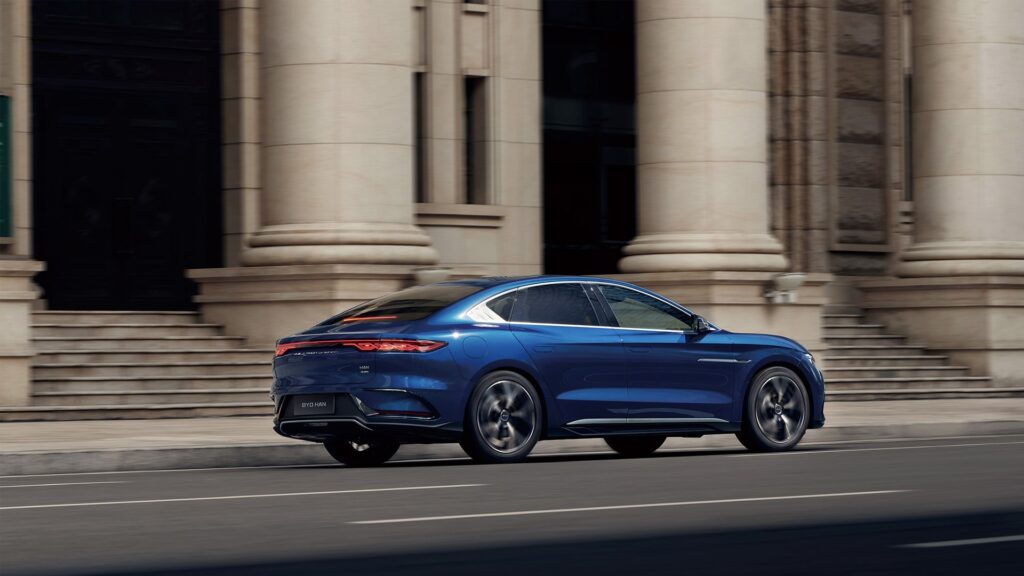
Recently, DeepRoute.ai secured another major partnership, a full-line assisted driving standard configuration program with an undisclosed Chinese car manufacturer. Zhou said this tie-up will help DeepRoute.ai reach delivery volumes in the millions next year.
Commercial adoption of assisted driving is also propelling DeepRoute.ai’s robotaxi business. In 2026, the company plans to launch robotaxi operations in Wuxi and Shenzhen. The combination of mass production data and robotaxi development will mark a new phase of data-driven progress.
Robotaxi services are moving from technical validation toward a critical scaling stage, and multiple automakers and chipmakers worldwide are investing heavily in development and deployment. In 2026, robotaxi operations may experience accelerated growth, which will serve as an important commercial test for DeepRoute.ai after years of investment in autonomous driving technologies.
Standing at this new height, DeepRoute.ai has adjusted its strategy and approach. Zhou spoke with 36Kr to outline the company’s direction.
The following transcript has been edited and consolidated for brevity and clarity.
36Kr: What does the third-party supplier landscape for advanced assisted driving look like now? Will consolidation continue?
Maxwell Zhou (MZ): On the software side, our market share in October was about 40 percent. At this point, only three core players remain in the industry. The number is already small enough, and all of them will stay.
DeepRoute.ai follows an Apple-like model, one or two products per year, with an emphasis on refinement and hits. It is similar to carmaking. The Apple model will become mainstream, and model lineups will continue to shrink.
36Kr: Will DeepRoute.ai continue to focus on a small number of well-crafted projects or broaden its customer base?
MZ: We are still expanding our customer base, but the key question is whether an automaker is willing to work with us on its bestselling models.
36Kr: Will you continue focusing on Chinese brands or broaden your customer types?
MZ: We should be securing projects with joint venture brands, and we cannot avoid that market. We are also expanding among state-owned automakers.
For mass production, our goal is to secure more market share. Mass production is the foundation, and robotaxis are the ultimate goal for an autonomous driving company. What we want is full autonomy. But without enough mass production customers and enough accumulated data, you cannot reach full autonomy.
36Kr: Any plans to expand overseas?
MZ: China is where the technology race happens, and overseas is where companies make money. Overseas expansion will take time because consumers abroad are far less receptive to autonomous driving.
36Kr: Some automakers say they will soon mass produce Level 3 autonomous driving vehicles. Consumers may assume the first to reach that becomes the most advanced. How is DeepRoute.ai preparing?
MZ: We are preparing for Level 3 as well, but the main challenge is engineering. For future robotaxi expansion, the core on the technical side is data-driven development, not manual intervention. Mass production sustains a company, while robotaxis allows it to thrive.
36Kr: So you’re using mass production data to drive robotaxi development.
MZ: Exactly. You need annual sales of more than one million vehicles to properly build robotaxi capabilities. After that threshold, robotaxis becomes vital. If we reach two million per year, even better.
36Kr: Some automakers developing robotaxi capabilities sell far fewer than one million vehicles annually. With DeepRoute.ai’s scale and data, will you reach readiness faster?
MZ: We have an advantage, but nothing is certain. Between 500,000 and one million vehicles, the data gap is not huge. I believe at least some automakers will succeed.
36Kr: What makes data-driven robotaxi development difficult? If the path is clear, why do only a few companies execute well?
MZ: Because their artificial intelligence capabilities are weak.
36Kr: How do you define that?
MZ: AI capability is tied to organizational structure, culture, talent, and cognitive foundations. Without adequate capability, data remains dormant. We started as an AI-native team, unlike some peers whose personnel mainly come from traditional engineering backgrounds.
36Kr: What if competitors strengthen their AI capabilities?
MZ: Some traits are embedded in a company’s DNA. For companies built entirely around traditional engineering, shifting into an AI company is difficult. Cultural systems do not change easily. As an AI-native company, it is somewhat easier for us to build engineering capabilities, but it is still painful.
In 2024, when we pursued certain projects, we often heard that our demos were great but we could not be chosen due to our lack of mass production experience and engineering capability. Over the past year, through our work with GWM, we addressed these shortfalls. Then we onboarded another major customer with strict quality control standards, which strengthened our capabilities further.
Through these two customers, we built our engineering muscle. It is no longer a weakness, and we will not lose opportunities because of it. Today, when automakers evaluate city NOA suppliers, DeepRoute.ai is at the table.
36Kr: Cost sensitivity is increasing industrywide. Some argue that self-developed chips can reduce assisted driving costs. How will DeepRoute.ai respond?
MZ: For assisted driving, self-developed chips do not make economic sense. A seven-nanometer chip costs USD 300 million to USD 500 million to develop. If annual installations reach one million units, that is already strong, but even at three million, the cost per vehicle is still at least USD 100. How do you amortize that R&D?
From a cost standpoint, self-developed chips do not hold up. Some companies assume they will dominate the market before they make in-house chips, but unless you are a Huawei-type company with strong brand power and not using Nvidia’s general-purpose GPU architecture, you cannot command pricing power. The economic logic does not work.
Self-developed chips also bring export control risks. What happens when you expand globally? This matters as well.
36Kr: So only major players can build chips, but software companies can work with chipmakers. Is DeepRoute.ai pursuing this?
MZ: Absolutely. Whether it is Qualcomm, Horizon Robotics, or Nvidia, we maintain very close relationships. No single company can take the entire market.
36Kr: So DeepRoute.ai has no long-term plans to build hardware?
MZ: I believe the industry needs division of labor. Older companies favored vertical integration, but newer companies may not. The US provides many examples, with no single Silicon Valley company doing everything. Division of labor is necessary.
KrASIA Connection features translated and adapted content that was originally published by 36Kr. This article was written by Xiao Xi for 36Kr.