

Before Sora, few people inside or outside video production could have imagined that artificial intelligence would spread through the field so quickly. Before Seedance 2.0 appeared, few expected AI to cross the threshold of traditional film and television production so suddenly, making it possible to generate videos lasting dozens of seconds with synchronized audio and visuals almost at the click of a button.
Behind this is a broad efficiency and cost shift, as well as a reshaping of the production chain.
Just as the internet broke one-way communication in media and allowed everyone to speak, AI has lowered the threshold for producing film and TV content. As a result, roles across the production chain are starting to rethink where they stand.
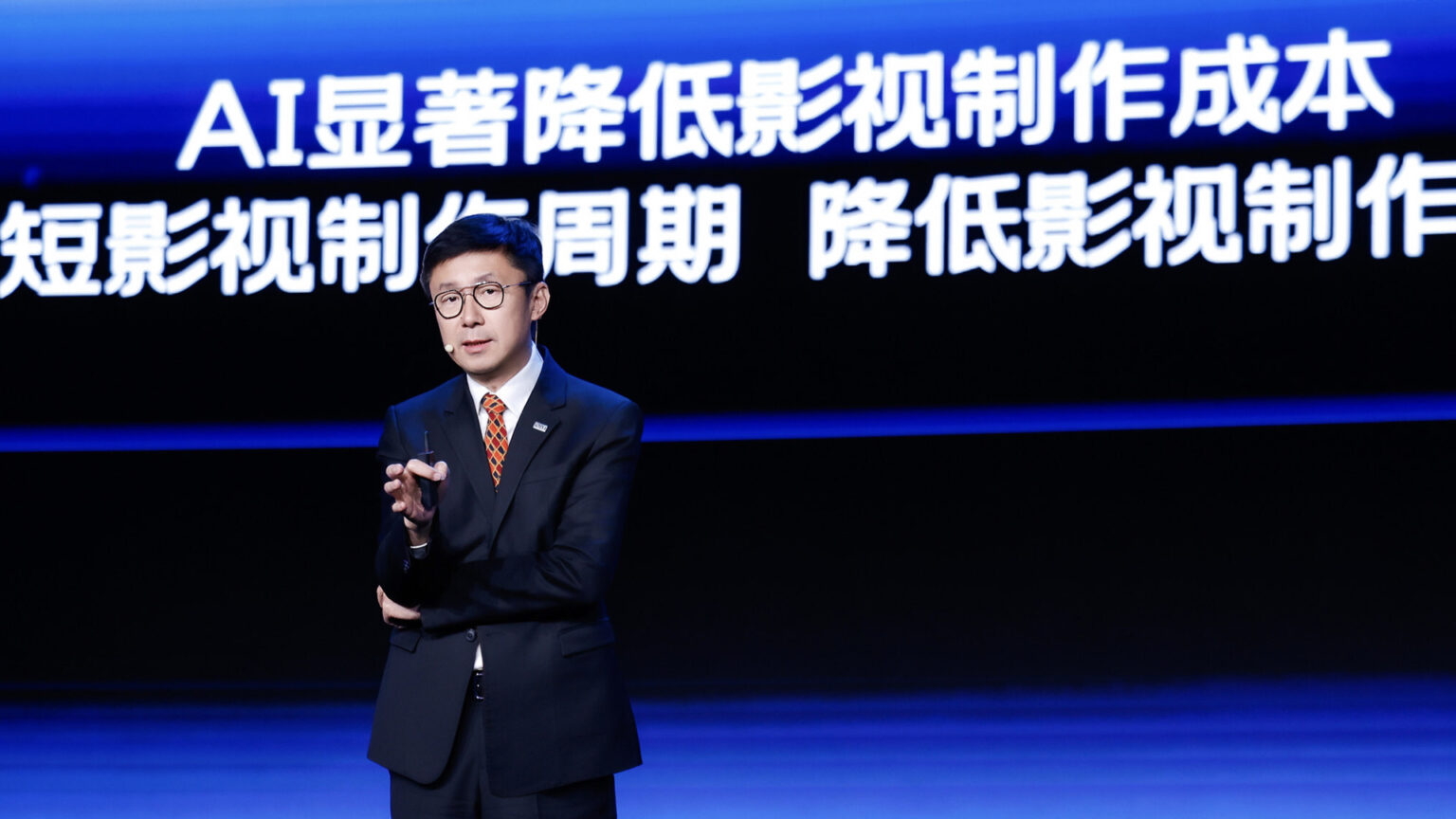
What choice will a longform video platform that produces and distributes film and TV content make in the AI era? For Gong Yu, founder and CEO of iQiyi, the answer is “decentralization.” Gong has been thinking about the concept for a long time and formally introduced it during the company’s earnings call in February.
Over the past decade, China’s longform video industry has looked like an escalating content arms race. Platforms used higher production budgets and more top IP to exchange for users and scale, trying to sustain growth through hits. But as user dividends faded, costs continued to rise, while short video kept siphoning attention and budgets.
At a more fundamental level, content has never been a business that can be industrialized and replicated with stable certainty. There has always been a gap between large investment and guaranteed returns.
The arrival of AI as a new variable has sharply lowered the cost of film and TV production while compressing production cycles, giving this almost unsolvable problem a new answer.
The arrival of AI offers a new answer to this problem: it has lowered the cost of film and TV production while shortening production cycles.
Gong summarizes AI’s chain reaction in the film and TV industry as the “one-one-two” law: unit content costs fall by one order of magnitude, the number of creators increases by at least one order of magnitude, and the number of works increases by at least two orders of magnitude. This, he believes, will drive a surge in user consumption. It also fits the Jevons paradox, an economic principle in which technological progress improves efficiency, but total consumption of the resource rises instead.
Under a decentralized platform model, creators will own more copyrights, more private-domain traffic, more interaction with users, and a more direct consumer-facing revenue model.
To that end, iQiyi launched Nadou Pro in March, a professional film and TV production platform connected to its proprietary Qizhi large model. It also connects to the latest versions of AI-driven platforms including ByteDance’s Dreamina, also known as Jimeng AI, Kuaishou’s Kling AI, Shengshu’s Vidu, MiniMax’s Hailuo AI, and Alibaba’s Wan. Nadou Pro currently carries almost no commercialization target. Its main goal is to serve creators who want to produce professional, longform film and TV content.
Gong has rarely hesitated on AI, and has continued investing in it. In 2023, he publicly said:
“Humans will not be replaced by AI. Humans who do not master AI will be replaced by humans who do.”
But video generation technology was far less advanced then, and Gong’s AI practice stayed mostly internal. Now, those efforts are reaching a point of accumulated payoff.
Nadou Pro has launched or planned nearly 70 AI agents, covering the full process from screenwriting, directing, art design, filming, editing, and marketing, while also including functions such as script analysis and AI-assisted scene analysis. These capabilities did not emerge over the past three months. Since iQiyi set the goal of industrialized film and TV production in 2021, it has successively launched various AI-driven creative enablement modules.
Capabilities that originally served only iQiyi’s internal system have since been accumulated and turned into external tools that the industry can use, regardless of whether users cooperate with iQiyi.
“We want to enlarge the AI-generated content cake and drive creation across AI video, especially the production of commercial feature-length content,” Gong said.
At the iQiyi World Conference, the company also announced that it would provide a limited-time additional subsidy of 20% for mid-length dramas and AI-generated content. With traditional and emerging creators advancing in parallel, and with both technology and capital being poured in, the 16-year-old video platform is showing clear ambition.
During the event, 36Kr spoke with Gong about why and how iQiyi is moving forward in the AI era.
The following transcript has been edited and consolidated for brevity and clarity.
36Kr: At the earnings call in February, you said iQiyi should move toward decentralization. Why raise this at that particular moment?
Gong Yu (GY): This is not a new idea. Only the term was raised recently.
I have worked in the internet sector for more than 20 years and witnessed the media industry move from a centralized stage dominated by newspapers, magazines, and radio to the decentralized stage dominated by social media today. Before AI emerged, it was difficult for this process to repeat itself in the film and TV industry because the threshold for video production was too high and the money required was too substantial. The emergence of AI has lowered both the production threshold and costs. All the conditions are now in place.
In the second half of 2025, video generation large models iterated one after another globally, further breaking down technical barriers. In terms of film and TV presentation, there are almost no obstacles that cannot be crossed. For example, the differences between Veo 3.0 and Veo 3.1, or between Sora and Sora 2, are enormous, and Seedance 2.0 shocked the industry.
Some problems are still difficult to solve. For example, AI-generated short videos still do not have enough clarity for the big screen. But these issues should be resolved over the next six months to a year. So beginning last year, I felt we could start using AI to create longform content such as mid-length dramas, long dramas, and animation. Once the technical threshold for commercial feature-length content falls, our model should change as well.
36Kr: So the phrase “decentralization” was newly raised on the earnings call, but the idea itself had been brewing in your mind for a long time.
GY: Yes. However long iQiyi has existed, that is how long I have been thinking about this.
36Kr: Did the emergence and iteration of video models, including Seedance 2.0, speed up your decision to build a decentralized platform? What did you do during this process?
GY: It sped things up, but many actions cannot be completed in just a few months.
For example, the release of GPT-4 in 2023 had a major impact on us. At the time, large language models were advancing quickly, and scripts, one of the core elements of our industry, are made of language. How could we make good use of AI’s capabilities and release its potential?
In March 2023, we carried out internal employee training involving several thousand people. We launched an AI-generated content section and opened a batch of generative AI tools for free use by all employees.
The second step was to use AI to reduce our internal operating and production costs. Starting then, we invested a great deal of energy into R&D. Nadou Pro, which we released recently, includes many agents migrated from intelligent systems that we internally developed and applied over the past three years. It is effectively the result of three years of accumulation.
36Kr: What goals and expectations do you have for the decentralization strategy?
GY: In the early stage, there are no major KPIs. The broad direction is that the operations team should be able to acquire more good works.
Around the third and fourth quarters of this year, we expect some good works to appear. Overall content volume will definitely continue growing quarter-on-quarter. With a larger base, the probability of hits will also be higher.
36Kr: Can you elaborate on how iQiyi built Nadou Pro?
GY: The development paradigm for applications in the AI era is not to fully complete one version before releasing it. Starting last year, we established around ten new studios, made up of people who understand both content and technology. While they create, feedback from the process also helps us continuously test internally and improve Nadou Pro’s functions.
These new studios have created a “catfish effect” inside iQiyi, even driving more than 70 existing studios to compete with one another and improve together. These studios have now all begun using Nadou Pro, and almost every studio is planning its own AI-generated content projects.
36Kr: There are many creation tools in the market now, and many platforms accept AI-generated video content. What helps Nadou Pro and iQiyi stand out?
GY: There are probably only two or three professional film- and TV-grade tools or agents in the market now, and we are one of them. Beyond agents, we also provide IP, digital assets, creator community resources, and commercial monetization resources. These integrated resources are our moat. More precisely, they are the moat we build for creators.
Nadou Pro is not our main business. We hope to use Nadou Pro to promote the popularization of AI-generated content across the industry.
36Kr: In this process, how can you ensure that good content goes to iQiyi?
GY: There is no guarantee. We can only stay open. In this process, we provide the platform, technology, and connections, which raises the probability of obtaining good works.
In the future, IP adaptation rights and the compute consumed through Nadou Pro may be provided to creators as a form of investment. Whether we provide agents, digital assets, or IP, the ultimate goal is to attract good works and good creation.
36Kr: Among the internet companies we have spoken with, almost all have some fear of missing out. People in the film and TV industry may feel it even more, especially since many roles may be replaced. Does iQiyi feel something similar?
GY: We know very well that the high costs and long cycles of traditional film and TV production are major barriers to the industry’s development. But AI can help us overcome those barriers.
In fact, I am very excited. A problem that had been unsolved for a long time has suddenly been solved. This is a once-in-a-decade opportunity.
In the past, creators might have ideas and ability, but how could they turn those into a drama? A creator who can write a novel may not be able to write a script. Even if they can write a script, they still need to find a director and funding. Once production really begins, costumes, props, makeup, locations, and other issues all come into play.
Now there is a new possibility: as long as creators find two or three partners, they can use natural language and Nadou Pro to make video content. Some links they did not know how to handle before can now be crossed with technology. As the production threshold falls, most practitioners in the film and TV industry, including mid-tier creators, can produce their own works. The number of creators will rise, and works will multiply.
It is like programming. Originally, because machines could not understand natural language, code and programs appeared, including programming languages such as C++, Python, and Java. In essence, these were created to standardize the dialogue between people and machines. Now that AI has appeared, machines can directly understand human natural language. Demand is also increasing sharply for programmers who are more sensitive to user needs and understand them more accurately.
36Kr: At the February earnings call, besides decentralization, you also proposed improving the quality of original content and maintaining overseas business growth. How are these three goals related?
GY: They are goals on different dimensions and do not conflict.
The quality of original content must improve. Success or failure in our industry is highly correlated with content quality. As for the composition of top content, some will be live-action and some will be AI-generated. Whether AI-generated content can enter the top tier this year remains uncertain. There is an opportunity, but it will be difficult.
There are now two groups of people in the industry. One group consists of traditional film and TV professionals who are not yet skilled enough at using AI. The other consists of people who understand technology but have limited experience in film and TV creation. There will be a gap period. The two groups will learn from and cooperate with each other, then produce the top creators of the future.
Next year, I believe there will be more top AI content. Over the next three to five years, that proportion will become higher and higher. Quantitative prediction is risky, but I think that after five years, half of the top film and TV works on the internet may be live-action, and half may be created by AI.
36Kr: Over the past decade, iQiyi’s rivals may have been traditional longform video platforms, and in the past two years, emerging short drama platforms. In the AI era, who are iQiyi’s rivals?
GY: Our attention is still primarily focused on longform content. But from a broader perspective, user attention is limited. If users watch short dramas, they may not have the energy to watch long dramas. On that level, we do face competition from short dramas.
36Kr: Which type of competition creates more pressure for you?
GY: Industry upheaval caused by technological innovation concerns me more. That is what makes me most anxious.
KrASIA features translated and adapted content that was originally published by 36Kr. This article was written by Xiao Xi for 36Kr.