

In films about financial markets, the protagonists are typically passionate about the direction of prices. The unconventional contrarians of “The Big Short” bet that the value of bonds backed by subprime mortgage loans will plunge. The meme stock devotees of “Dumb Money” reckon that if they keep the faith, their holdings will rise “to the moon.”
However, many of the biggest players in finance today don’t care whether prices rise or fall by very much. Using mountains of borrowed money to magnify their returns, they seek to profit from tiny differences between prices for the same thing in spot and futures markets, a gap known in the industry as “basis.”
In the classic case of basis trading, hedge funds take offsetting positions valued in the hundreds of billions of dollars in the US Treasury market, buying bonds in the spot market and selling them in the futures market, where delivery of the securities is promised at a set price by a later date. This strategy can work because the futures tend to command a premium before they converge with the spot price upon expiration.
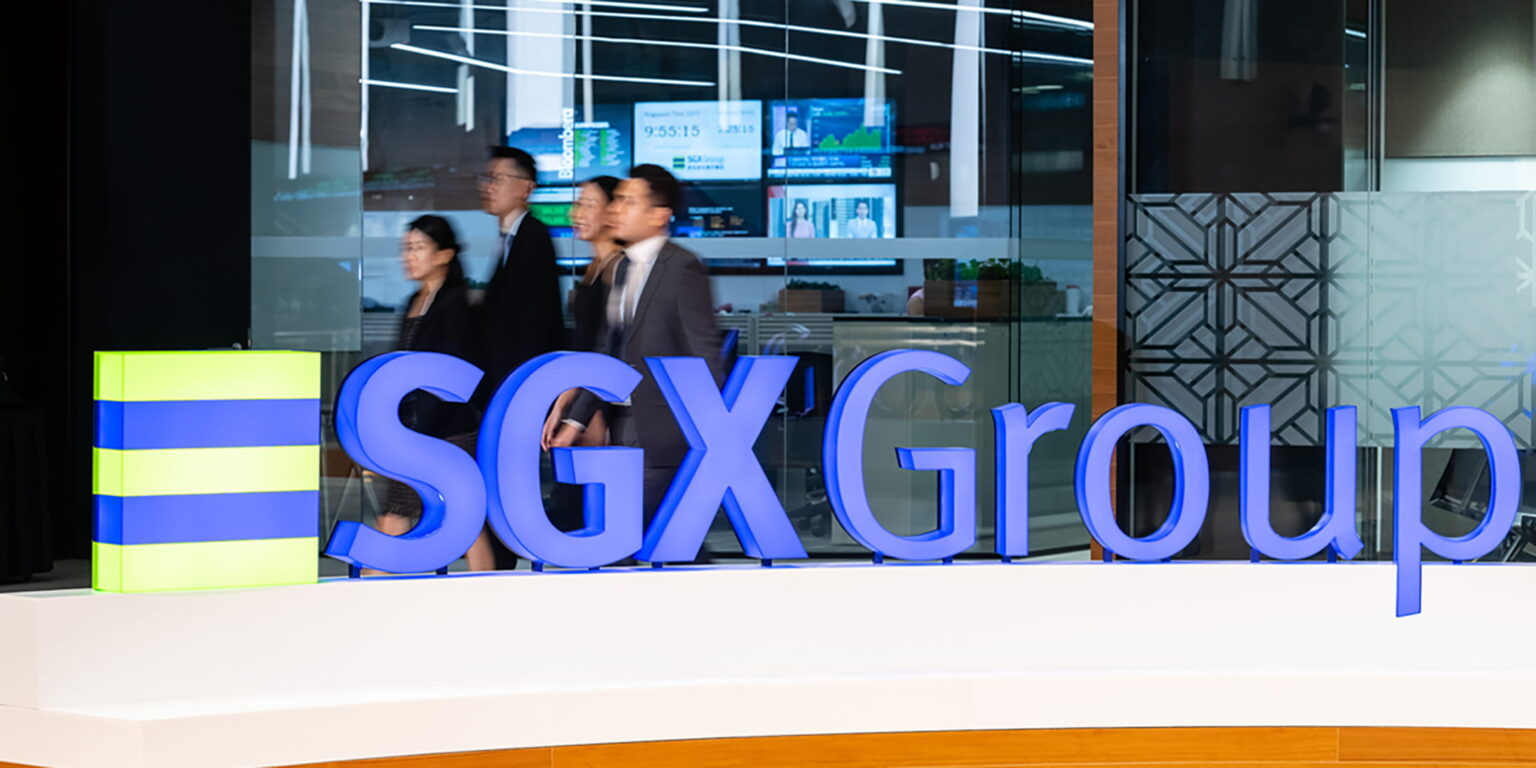
Demand from the basis trading community helps explain one of the more intriguing recent developments in Asian finance: Singapore exchange operator SGX’s first foray into the cryptocurrency derivatives market. In November 2025, shortly after prices for digital assets plunged, it began offering perpetual futures, which have no expiration date and are settled every trading day in cash, on bitcoin and ether, the two biggest cryptocurrencies by market value.
In a telephone interview with Nikkei Asia, Michael Syn, SGX Group president, said the perpetual futures are being marketed to the kind of sophisticated institutional investors that use derivatives for basis trades or to craft diversified portfolios. Retail speculators, or “punters” in Singaporean parlance, are not on SGX’s radar.
“There have been attempts to paint this as, ‘Oh, Singapore wants to be a crypto hub.’ No, it has nothing to do with being a crypto hub. It is a derivatives hub because of us,” Syn said. “You wouldn’t come to us for a directional punt (bet).”
The stage was set for the SGX move in 2024, when the US Securities and Exchange Commission began approving exchange-traded funds tracking bitcoin and other cryptocurrencies. This spurred the inclusion of bitcoin into “reference portfolios” used to measure fund managers’ performance, Syn said, pushing these investors to consider bitcoin in much the same way as they do gold when making asset allocations. In Asia, family offices have been particularly enthusiastic about crypto, he said.
“Something sort of changed in the past 12, 18 months around the institutional skepticism around crypto as a whole and bitcoin in particular,” Syn said. “Now, you have asset owners and asset managers, institutional grade ones, saying, actually, ‘I need to have some access to this.'”
As the crypto market developed, opportunities for basis trading were created. SGX is hoping that its crypto derivatives will better suit some of the investors who have been taking futures positions on unregulated Asian exchanges where the action goes on 24 hours a day, seven days a week.
The crypto basis trade works much like the US Treasury one, with investors usually buying in the spot market, selling in the futures market and milking the difference. Prices tend to be higher for crypto in the futures markets because investors can buy on a leveraged basis and do not have to take possession of any coins, which can be a problem for some.
In this round-the-clock crypto trading world, the future often comes quickly. Many basis traders seek to exploit the difference between today’s spot price and tomorrow’s futures price, roughly speaking. Sometimes, time horizons are more limited than that.
“The most advanced traders in the world trade today’s price versus the price in four hours’ time, eight hours’ time, 16 hours’ time, one day’s time,” Syn said. “So, what we are doing is filling a very obvious gap.”
SGX’s sales pitch is that its perpetual futures offer institutional investors a more reliable way to gain crypto exposure. On the unregulated Asian exchanges where perpetuals came of age, leverage levels can reach 100 to one, meaning a USD 1 payment is enough to control a position worth USD 100. But to keep going in times of turbulence, these exchanges conduct “auto-liquidations,” in which computers close out positions including profitable ones, theoretically, if liquidity is squeezed sufficiently.
SGX’s crypto perpetuals offer far less leverage. The ratio was about three to one at the start, and there was no weekend trading. But “there is no concept of auto-liquidation,” Syn said. Investors on SGX post margin, the term used for a downpayment on futures positions, with a broker that is recalculated as prices change.
“If we need to call margin, we will call the broker, and the broker will have margin,” Syn said. “Then the broker deals with the customer at the end of it across a large portfolio. … The broker typically has sight of all your assets.”
Industry statistics cited by SGX suggest its potential market is substantial. Futures and other derivatives account for 76% of global cryptocurrency trading volume, according to Coinlaw, a research firm, with 48% of that derivatives trading occurring in the Asia Pacific region. A September 2025 report by Chainalysis, a blockchain data platform, said APAC crypto transactions grew 69% to USD 2.36 trillion in the previous 12 months.
Although basis trades are meant to be safe bets, the popularity of the strategy makes some market supervisors nervous because of the large borrowings used to boost returns. In March 2020, as the Covid-19 pandemic began to take hold, highly leveraged hedge funds furiously unwound basis trades to raise liquidity, helping push Treasury yields higher and contributing to the decision by the US Federal Reserve to intervene by buying government securities, according to a report by the Bank for International Settlements.
The consolation for regulators is that the presence of the basis traders makes it easier for the government to market its debt. In a 2023 interview with the Financial Times, Ken Griffin, founder and CEO of Citadel, a US hedge fund, said clamping down on basis trading would cost taxpayers “billions or tens of billions of dollars a year” in interest costs.
Whether basis trading in cryptocurrencies can produce similarly measurable benefits is hard to say, even for Syn, who described the SGX perpetuals as a response to the “voice of the customer.”
“I cannot state that it is socially purposeful because we haven’t established that crypto is socially purposeful,” Syn said. “But we have established that institutions have decided that this is a foundational part of their strategic asset allocation.”
Ultimately, SGX officials believe good things happen when markets bring together rational actors pursuing their own interests. Price discovery improves, and people in the real economy become better equipped to hedge risks and secure supplies.
“It all comes down to whether you believe in the so-called efficient markets hypothesis,” Syn said. “The argument goes like this: The market is possibly the only mechanism known to mankind that brings together participants responding to incentives and information and creates this wonderful public good, which is a publicly transactable price.”
This article first appeared on Nikkei Asia. It has been republished here as part of 36Kr’s ongoing partnership with Nikkei.