
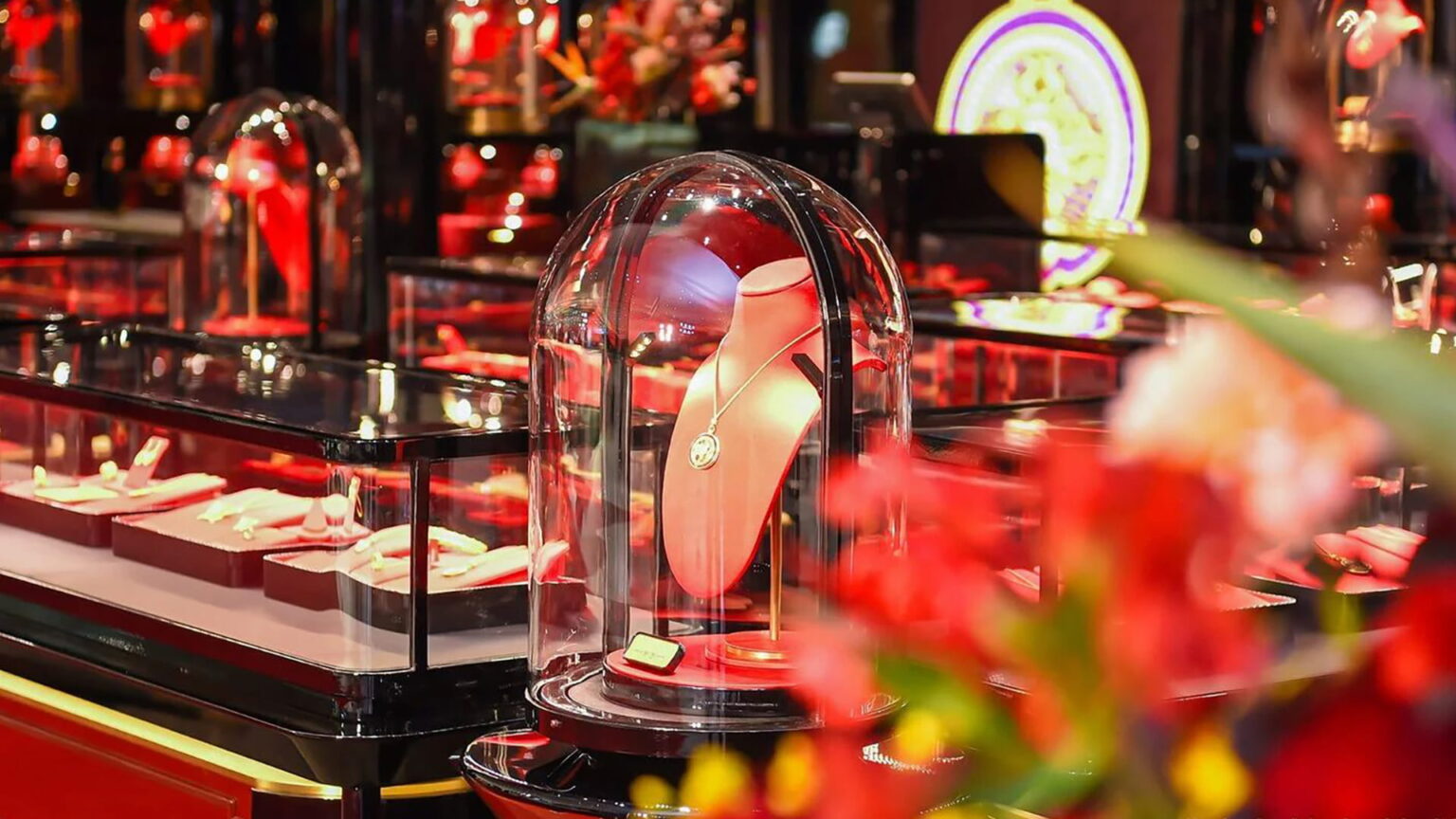
Gold jewelry retailers are becoming more sought after by China’s top commercial districts. Malls with annual sales exceeding RMB 10 billion (USD 1.5 billion), including Deji Plaza in Nanjing, Hangzhou Tower, Wushang Mall in Wuhan, Beijing SKP, and Hangzhou MixC, have already introduced a large number of local high-end gold jewelry brands.
China World Mall in Beijing, a leading commercial landmark known for stringent screening of brands’ industry standing and consumer appeal, is also moving faster to introduce more Chinese high-end brands. That shift is a meaningful signal.
Chinese micro media outlet Dujiao Mall reported that on April 24, Jinlux took over a temporary space previously occupied by Jaeger-LeCoultre, the luxury watch brand owned by Richemont, and entered the south zone of China World Mall, located in Beijing’s central business district. It became the latest Chinese high-end brand to compete on the same stage as international luxury houses.
Less than a week after opening, Jinlux had already delivered a strong performance, according to 36Kr. Its store drew heavy foot traffic and long lines, making it one of the busiest shops in the south zone.
On April 27, actress Gao Ye and Dong Hao, editor-in-chief of Harper’s Bazaar Art, attended the brand’s ribbon cutting ceremony, drawing wider attention.
Jinlux has emerged as a notable new player in China’s high-end jewelry market.
Amid rising cultural confidence and shifting consumer preferences, Chinese aesthetics have grown from a cultural consumption trend into a force shaping parts of the consumer market.
A wave of domestic high-end brands has emerged, challenging the longstanding dominance of international luxury brands in China. Consumers who once gravitated toward traditional luxury houses are seemingly considering local alternatives more.
This broader environment suggests China has more favorable conditions to nurture luxury brands of its own. Homegrown high-end gold jewelry brands, now increasingly sought after by the country’s top malls, sit near the center of that opportunity.
Jinlux, which has broken through with a differentiated gold-and-ruby proposition, is one of the more closely watched representatives of this emerging category.
According to Liu Zhiyu, co-founder of the brand, Jinlux has a significant customer overlap with leading international luxury brands such as Louis Vuitton, Hermes, and Cartier.
Despite being an emerging brand, Jinlux has found momentum in China’s high-end commercial districts. Its Wushang Mall flagship store posted a strong opening, with single-day sales exceeding expectations. The performance of its first store drew attention. Its store in Block B of Hangzhou Tower also reported strong sales on International Women’s Day.
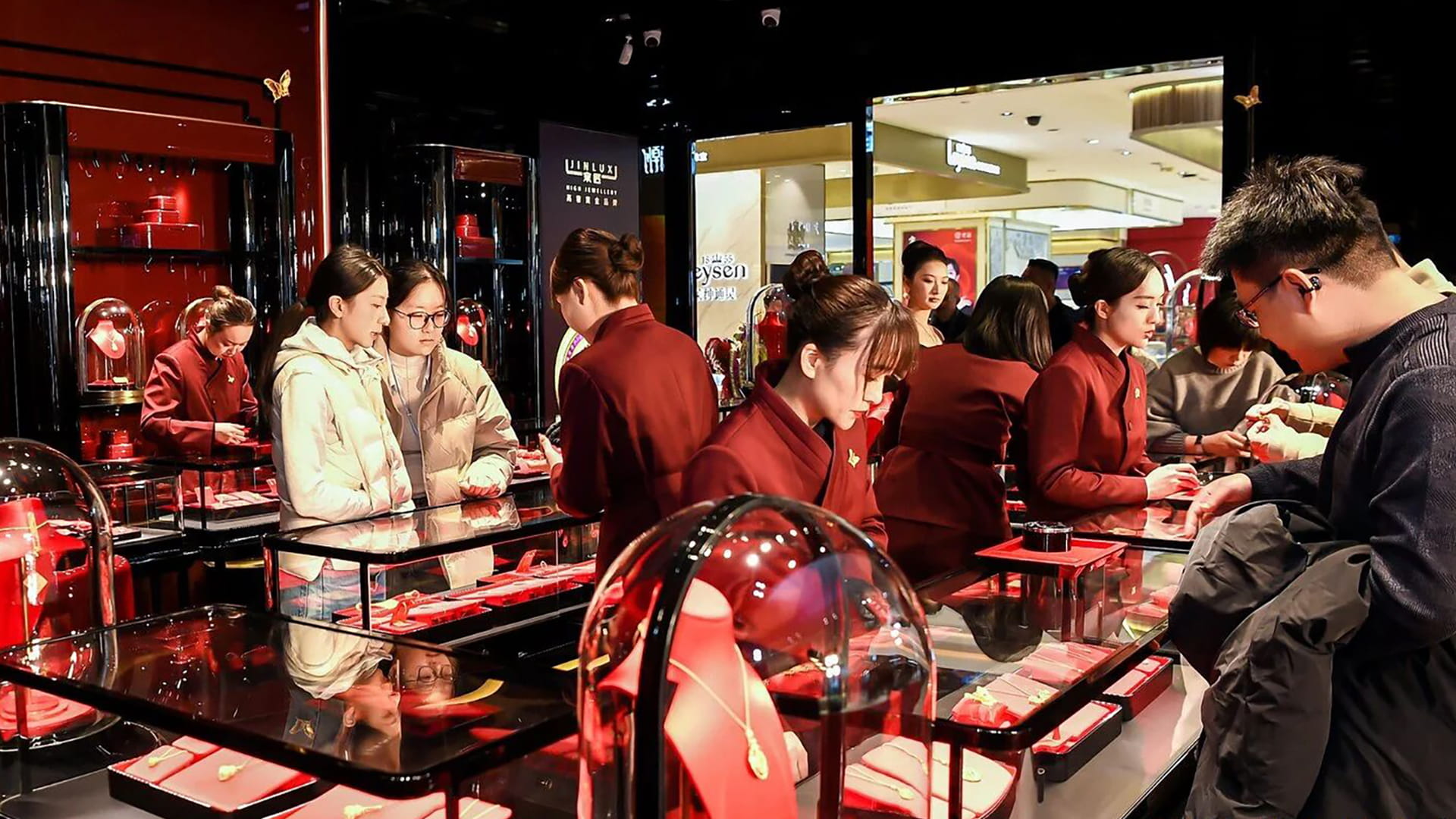
More notably, the brand’s operating efficiency and brand value have started to become visible. The Hangzhou Tower Block B store’s monthly sales per square meter surpassed RMB 1 million (USD 146,670.6), putting its store productivity ahead of some international luxury brands, according to the company.
Jinlux’s momentum is not reflected only in sales figures. As early as March, consumers drawn to its branding and craftsmanship were asking on social media platform Xiaohongshu when the brand would come to Beijing.
At present, a sizable share of Jinlux’s sales comes from cross-regional customers.
Since the opening of its Hangzhou Tower and Wushang Mall stores, many consumers attracted by Jinlux’s craftsmanship details and international aesthetic sensibility have reportedly traveled across cities to buy its products in person, according to 36Kr.
The Beijing China World Mall store has shown similar drawing power. On the second day after it opened, a customer who had previously bought Jinlux products online told 36Kr that she had traveled from Jinan, Shandong, to visit the Beijing store in person.
Top-tier luxury malls in China also appear increasingly open to Jinlux as the brand gains visibility.
Jinlux currently operates four stores in luxury malls with annual sales exceeding RMB 10 billion, including Blocks B and D at Hangzhou Tower, Wushang Mall in Wuhan, and China World Mall in Beijing.
In addition, its MixC Tianjin store is scheduled to open in June, while its Deji Plaza store in Nanjing is also set to debut that month.
The brand will also accelerate its expansion across China’s top commercial districts. It expects to open 30–50 offline stores over the next three years.
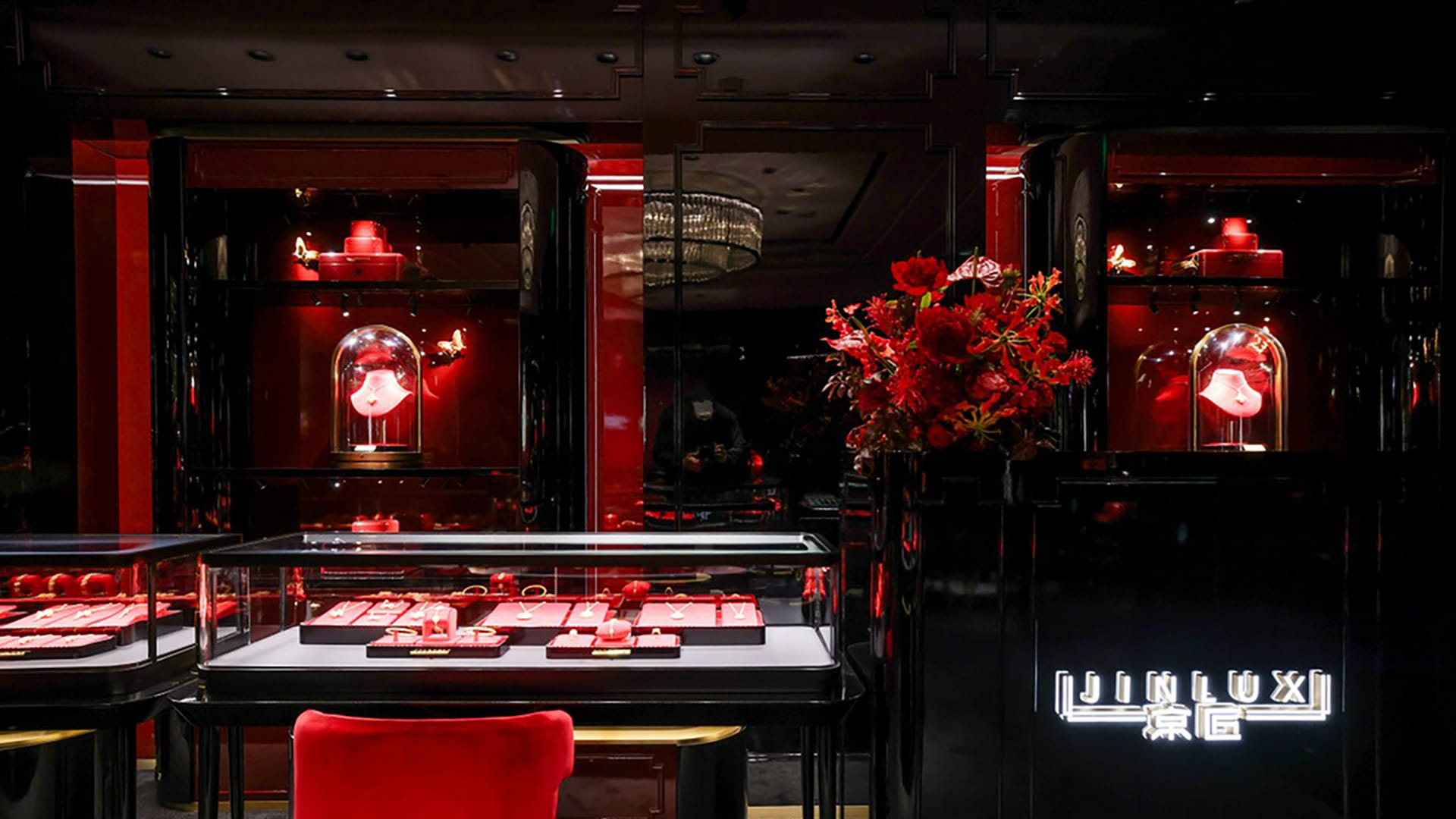
From the outset, Jinlux has positioned itself inside top malls, standing alongside international jewelry brands and subjecting itself to the dual test of China’s most discerning consumers and its most selective commercial landlords.
Steve Jobs once said a brand’s success ultimately depends on aesthetics and taste. Regardless of where a brand originates, the underlying logic of Eastern and Western aesthetics can overlap.
Jinlux’s founding team consists of jewelry industry veterans with more than a decade of experience. The team identified this shared logic and made aesthetic strength central to the brand’s development, embedding it throughout Jinlux’s growth path.
Unlike traditional gold brands that rely heavily on raw material pricing, Jinlux avoided selling bulk goods from the outset. Its proposition is based less on gold weight and more on the pricing power of design, craftsmanship, and brand.
The more one understands the brand, the clearer it seems that Jinlux is trying to build its moat through aesthetics, cultural symbols, and refined craftsmanship. Together, these elements create a sense of scarcity that is difficult to replicate quickly.
At a time when China’s high-end jewelry market is dominated by heritage gold craftsmanship and increasingly similar aesthetic styles, Jinlux has chosen a different path through its distinctive gold-and-ruby pairing.
The brand has consistently approached its work through the lens of high-end jewelry. It places particular emphasis on top-grade natural gemstones, especially rubies. According to the company, its gemstone supplier also works with Patek Philippe and Rolex. Jinlux has helped popularize the gold-and-ruby aesthetic and create a new value zone between heritage gold and modern jewelry.
Data may better illustrate Jinlux’s market position.
The red-and-gold aesthetic associated with Jinlux has contributed to a 50% increase in ruby prices on the supply chain side, according to people familiar with the matter.
For Jinlux, jewelry must be beautiful enough to move consumers, with Chinese aesthetics as a central focus. The brand also seeks to extend that foundation by applying European techniques to build a more complete aesthetic system.
But this path is not easy.
On one hand, Eastern philosophy tends to be abstract, while Western craftsmanship tends to be concrete. Using Western craft language to express Eastern philosophical ideas requires the design team to understand both cultural systems and exercise strong aesthetic control.
On the other hand, gold is soft and highly malleable. Softer metals can make gemstones more prone to loosening or falling out. Large-scale gemstone setting poses an even greater technical challenge.
Jinlux’s aesthetic strength does not come from simply stacking craft techniques or materials, or from showing off technical prowess. Instead, its shapes, colors, and craft details are coherently integrated, forming a distinctive aesthetic system.
Its color approach, built around a red-and-gold aesthetic, is visually distinctive.
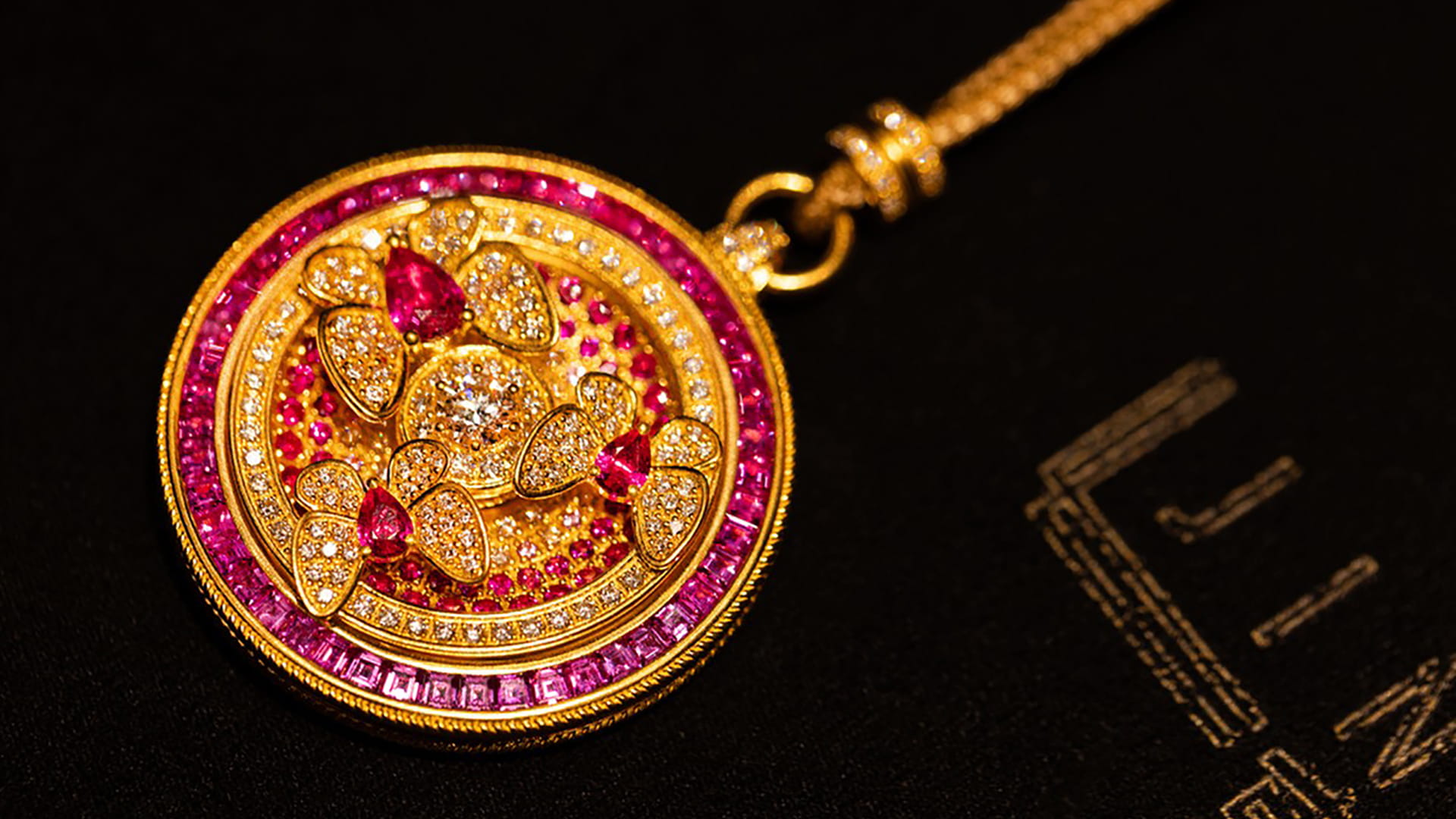
In its Youyuan series, the butterfly form is reimagined as a central motif, preserving its shape while emphasizing the lightness and opulence of jewelry. With a gentle touch, the wings quiver, making the piece feel almost lifelike.
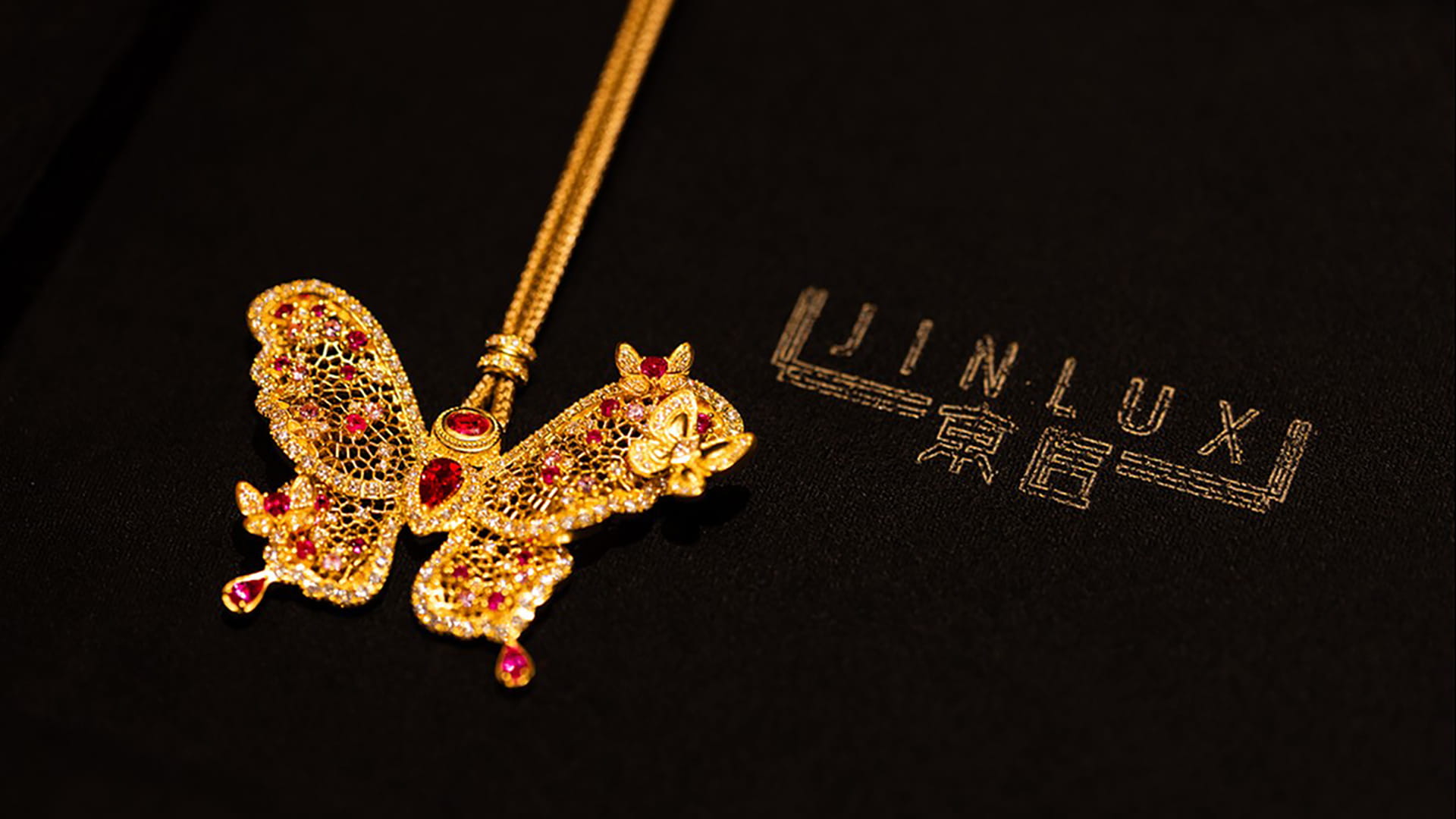
Jinlux’s jewelry also attempts to present distinctive compositions within small surfaces. In one medallion piece, for example, the brand embedded three butterfly ornaments that rotate in paired forms within a composition inspired by the Baoxiang flower.
But Jinlux does not try to feel distant or unattainable. Instead, it emphasizes what it calls a “sense of deservingness,” presenting its jewelry as something consumers can see as a reward for themselves, rather than a status symbol kept out of reach.
From the start, Jinlux appears to have paid close attention to consumer needs, using refined craftsmanship to meet consumers’ aesthetic expectations and practical demands.
To do that, the brand draws on Eastern aesthetic imagery as its foundation and adapts techniques from Europe, including French lacework, Italian fabric-texture work, and Swiss pivot mechanisms. Through these craft barriers, it creates both visual and tactile experiences, using product capabilities to stand out in the crowded gold jewelry market.
Jinlux has built three main product systems: Youyuan, Wanxiang, and Daguan. It continues to iterate, following a rhythm of launching one major product series each year while introducing limited-edition products with cultural attributes tailored to different regions and seasons.
In addition, Jinlux said it dynamically adjusts its product structure based on market changes, using a flexible and up-to-date product strategy to strengthen its competitiveness and market sensitivity.
For Jinlux, product strength rooted in aesthetics is both the starting point and the basis for sustained growth. While the traditional gold jewelry sector still competes largely on scale and price, and the heritage gold segment is becoming increasingly crowded, Jinlux has chosen to define itself through a gold-and-ruby category.
Its playbook borrows from luxury brands: using an international aesthetic system as a moat, working around material constraints with refined craftsmanship, building brand momentum through emotional value and scarcity, and attracting high-net-worth customers with luxury-grade works.
Jinlux’s customer base includes not only domestic consumers but also foreign customers drawn by its unique aesthetic sensibilities, putting new pressure on international luxury houses that have long led the market.
At the same time, Jinlux has attracted capital interest. According to Liu, the brand has been in contact with investors and plans to introduce external capital at an appropriate point.
Bringing in capital could help Jinlux scale its business model and deepen its moat. If market conditions remain favorable, it could also help the brand expand awareness more quickly.
From these perspectives, capitalization is a likely next step in Jinlux’s development.
Next, Jinlux will launch new works under its Youyuan series in late June, covering a full range of products including pendants, stud earrings, rings, and bangles.
KrASIA features translated and adapted content that was originally published by 36Kr. This article was written by 36Kr Brand.
Note: RMB figures are converted to USD at rates of RMB 6.82 = USD 1 based on estimates as of May 18, 2026, unless otherwise stated. USD conversions are presented for ease of reference and may not fully match prevailing exchange rates.